


The Origins of Portfolio Construction: Benjamin Graham’s 50/50 Rule and the Classic Balanced Strategy
In the winter of 1949, the scars of the Great Depression were still fresh on Wall Street, and post-war inflation was quietly eroding the purchasing power of cash. When Benjamin Graham published The Intelligent Investor, he was not trying to help speculators beat the market every quarter. He was trying to solve a far more fundamental problem: how to keep an investor solvent—and sane—across wildly unpredictable economic regimes.
Graham proposed a disarmingly simple anchor for what he called the “defensive investor ” a strict 50% allocation to high-grade common stocks and a 50% allocation to high-grade bonds.
The genius of Graham’s 50/50 framework had very little to do with mathematical optimization and everything to do with human psychology and mechanical rebalancing. When equities roared ahead and swelled to 60% of the portfolio, the investor was forced to trim stocks at elevated valuations and buy bonds. When a liquidity panic crushed equity prices down to 40% of the portfolio, the investor had dry powder in fixed income to rotate back into cheap businesses. It was a self-correcting pendulum designed to eliminate daily guesswork.
For decades, Graham’s mechanical split served as the bedrock of wealth preservation. Yet as markets matured and institutional capital grew more sophisticated, a deeper question emerged: Why stop at two assets that mostly respond to a single economic variable—growth?
Evolution of Institutional Asset Allocation: From Modern Portfolio Theory to the Yale Model and All-Weather Risk Parity
That question drove the next half-century of portfolio evolution. Three years after Graham’s book hit the shelves, a young economist named Harry Markowitz published his seminal paper on Modern Portfolio Theory (MPT). Markowitz proved mathematically what traders knew instinctively: the risk of a portfolio is not the average risk of its individual holdings, but rather a function of how those holdings covary under stress. Over time, Wall Street translated Markowitz’s math into the ubiquitous 60/40 portfolio (60% equities, 40% bonds), tilting Graham’s balance toward the higher long-term compounding of stocks while relying on bonds as a deflationary shock absorber.
However, legends of institutional capital saw the hidden flaw in the 60/40 armor: equities are roughly three times as volatile as bonds, meaning over 85% of a 60/40 portfolio’s actual risk is concentrated in a single bet—rising economic growth.
Three pioneers broke that dependency in different ways:
Harry Browne and the Permanent Portfolio (1981): Browne argued that an economy can only exist in four states: prosperity, inflation, deflation, or tight-money recession. He split capital equally across four quadrants—25% Stocks, 25% Long-Term Treasury Bonds, 25% Cash, and 25% Physical Gold—proving that an asset which looks dead for a decade is the exact asset that saves the portfolio when the regime flips.
David Swensen and the Yale Endowment Model (1985–2021): Swensen realized institutional investors were overpaying for daily liquidity they did not actually need. By shifting Yale’s endowment into alternative assets, natural resources, and private equity, Swensen captured the illiquidity premium while insulating the university from public equity valuation swings.
Ray Dalio and the All-Weather Risk-Parity Framework (1996): Dalio synthesized these insights at Bridgewater Associates. Instead of allocating by dollars, Dalio allocated by risk across four macroeconomic boxes defined by whether Growth and Inflation are rising or falling relative to expectations. By equalizing the volatility contribution of equities, nominal bonds, inflation-linked bonds (TIPS), and commodities, the All-Weather engine was engineered to compound steadily without ever needing to predict central bank policy.
On paper, many investors believed they had replicated these institutional models simply by adding property and credit to their stock portfolios. Then came the autumn of 2008—and the brutal discovery of how false diversification behaves in a liquidity vacuum.
Lessons from the 2008 Global Financial Crisis: Why Real Estate, REITs, and Leveraged Portfolios Failed the Liquidity Test
Nothing exposes the difference between true structural diversification and disguised leverage like a systemic credit freeze. Going into 2007, millions of individual investors, family offices, and even university endowments believed they held “bulletproof” portfolios because their net worth was spread across stocks, residential and commercial real estate, Real Estate Investment Trusts (REITs), high-yield corporate credit, and private property syndications.
The comforting myth of the era was that real estate was an uncorrelated “hard asset” that only moved up.
When the subprime mortgage apparatus imploded in 2008 and interbank lending froze, investors discovered a devastating mathematical reality: in a liquidity shock, correlations across all leveraged growth assets converge to 1.0.
Consider how different portfolio architectures performed during the 2008–2009 crucible:
The Real Estate and REIT Trap: Investors who relied heavily on rising property values and public REITs as their primary diversifier suffered catastrophic drawdowns. Because real estate is fundamentally a leveraged bet on credit availability and economic growth, when the credit spigot shut off, property values plunged while debt obligations remained fixed. The FTSE NAREIT All Equity REITs Index collapsed by roughly 68% from peak to trough—falling even harder than the S&P 500’s 57% drop. Worse, holders of direct property, mortgage-backed funds, and private real estate syndications found themselves gated or completely illiquid at the exact moment equity markets offered generational buying opportunities.
The Failure of the 60/40 and “Endowment-Lite” Portfolios: Traditional 60/40 portfolios dropped between 22% and 30% in 2008—a painful shock for retirees who thought 40% in bonds made them immune to deep drawdowns, especially if their bond sleeve contained corporate credit or mortgage debt rather than pure sovereign Treasuries. Even the famed Yale Model suffered a nearly 25% drawdown in fiscal 2009 because its heavy allocation to illiquid real estate and private equity left it starved for cash when credit markets seized up.
How Risk-Parity and the Permanent Portfolio Performed: By contrast, portfolios built on true macro regime balance proved their worth. In 2008, while equities and REITs were in freefall, Long-Term U.S. Treasury bonds surged over 25%, and Physical Gold rose roughly 5.5% (before rallying more than 100% over the ensuing three years as central banks launched Quantitative Easing). Harry Browne’s four-quadrant Permanent Portfolio lost less than 2% to 5% in 2008, and macro risk-parity strategies preserved vast amounts of capital—giving disciplined allocators liquid dry powder to buy distressed assets at pennies on the dollar in March 2009.
The lesson of 2008 was etched in stone: Real estate and REITs are not crisis hedges. They are pro-cyclical, interest-rate-sensitive equity proxies loaded with embedded debt. To survive both a 2008-style deflationary liquidity shock and a 2022-style inflationary rate shock, a portfolio must look beyond leveraged property.
Modern Portfolio Diversification: Integrating Precious Metals, Commodities, Private Equity, and Digital Assets
Transitioning from the lessons of 2008 and 2022 into today’s fiscal landscape requires confronting a dual reality: leveraged real estate fails during credit contractions, and sovereign bonds alone fail during inflationary supply shocks.
To build a true All-Weather Core today, the modern allocator must carefully separate pro-cyclical real estate from true monetary and operational hedges:
Precious Metals and Hard Commodities: Unlike real estate—which carries property taxes, maintenance capex, tenant credit risk, and refinancing cliffs—physical gold, silver, and platinum are the only financial assets inside a portfolio that are not simultaneously someone else’s liability. While broad commodities (energy, copper, agriculture) hedge supply-driven price inflation, physical bullion and sovereign coins hedge monetary debasement and central bank credibility shocks.
Disciplined Real Estate vs. Blind REIT Exposure: If real estate belongs in a portfolio at all, it must be sized as part of your growth and inflation sleeve, never mistaken for your defensive liquidity sleeve. Rather than holding highly leveraged commercial REITs vulnerable to refinancing walls, institutional allocators favor debt-free hard infrastructure, strategic land with zero carrying-cost debt, or unleveraged cash-flowing assets acquired during credit washouts.
Private Equity and Founder-Led Compounders: Public markets today represent a shrinking fraction of the real economy. Incorporating select private equity, or public equivalents like family-controlled and founder-led holding companies with net-cash balance sheets and negative working capital, allows a portfolio to harvest compounding cash flows without relying on cheap debt or daily multiple expansion.
Digital Assets as High-Velocity Liquidity Barometers: Bitcoin and select digital assets have matured into institutionalized bearer assets. In a macro risk-parity framework, digital assets function as a high-beta convex call option on global fiat liquidity. Because their volatility is four to five times that of equities, risk-parity sizing dictates that a modest 1% to 3% capital allocation captures asymmetric upside during monetary expansions without threatening core survival during liquidity freezes.
Having the right asset classes, however, only solves half the equation. If all of those assets—especially immobile real estate and domestic banks—are trapped inside a single country and priced in a single currency, your “diversified” portfolio is still vulnerable to a single point of failure.
Hedging Geopolitical Risk, Regional Crises, and Currency Collapse in Global Portfolios
History is a graveyard of investors who nailed their local asset allocation only to be wiped out by the jurisdiction they lived in. And nowhere is this vulnerability more acute than in property-heavy portfolios. When a country experiences a sovereign debt crisis, capital controls, or currency debasement—whether in 1990s Asia, 2008 Iceland and Spain, or modern emerging markets—domestic real estate becomes a financial prison: you cannot move a building across a border, rents are paid in a depreciating local currency, and governments inevitably target fixed property with punitive taxes.
Even in stable Western economies like Canada, the UK, or Australia, home-country bias is a silent wealth destroyer. Investors routinely tie 60% of their net worth to a single domestic housing market and another 30% to domestic bank and resource stocks—betting their entire family balance sheet on the fiscal health and central bank competence of one nation.
Accounting for country-specific, regional, and currency risks requires looking at your portfolio through a “look-through” geographic and monetary lens:
Neutralizing Single-Country and Regional Concentration: No single nation has a permanent monopoly on compounding. Japan commanded 45% of global equity market cap—and the most expensive real estate on earth—in 1989 before entering a three-decade structural winter. A resilient core intentionally balances North American exposure with cash-flowing compounders in Europe, developed Asia-Pacific (such as Singapore and Japan), and resource-rich emerging markets.
Surviving Currency Collapses and Fiat Debasement: When a domestic currency enters a structural decline, import costs soar and local purchasing power erodes. You insulate a portfolio from currency collapse not by day-trading forex, but by holding foreign-currency-denominated revenue streams and globally priced hard assets. A multinational enterprise in Europe, a commodity producer pricing contracts in USD, physical gold, and unhedged global equity funds naturally re-price upward in local currency terms when the domestic fiat currency weakens.
Factor-Based Resilience Across Borders: Rather than buying blind emerging-market or international beta—which is often stuffed with state-owned banks and heavily indebted property developers—institutional allocators apply factor filters across geographies. Emphasizing the Value, Quality (high Return on Invested Capital), and Low-Leverage factors ensures your international exposure is anchored in businesses with fortress balance sheets that survive regional credit crunches.
At this point, a natural objection arises: If a truly resilient portfolio requires global equities, factor tilts, sovereign duration, commodities, precious metals, and strict limits on real estate risk across multiple currencies, doesn’t managing it become an exhausting full-time job?
Low-Cost ETFs and Factor Investing: Minimizing Operational Drag and Day-to-Day Portfolio Activity
It would—if you tried to build it the old-fashioned way with 80 individual securities, physical rental properties with midnight tenant calls, futures rolling contracts, and daily macro trading.
In institutional asset management, there is a hidden enemy that destroys more wealth than bear markets: operational drag. Operational drag is the compounding toll of bid-ask spreads, property transaction costs, management fees, capital gains taxes from constant turnover, and—most expensive of all—decision fatigue. Every time an investor checks a screen and makes an ad-hoc tactical trade based on a headline, they introduce behavioral leakage into their expected utility.
The modern explosion of low-cost, institutional-grade Exchange-Traded Funds (ETFs) allows an independent investor or family office to execute a Bridgewater-caliber macro framework with near-zero day-to-day activity. By using liquid ETF building blocks costing between 0.05% and 0.35% annually, you can assemble a global All-Weather Core in under ten tickers and touch it only twice a year.
Here is how those institutional quadrants translate into a low-friction, ETF-driven architecture that avoids the 2008 real estate trap while protecting against inflation:
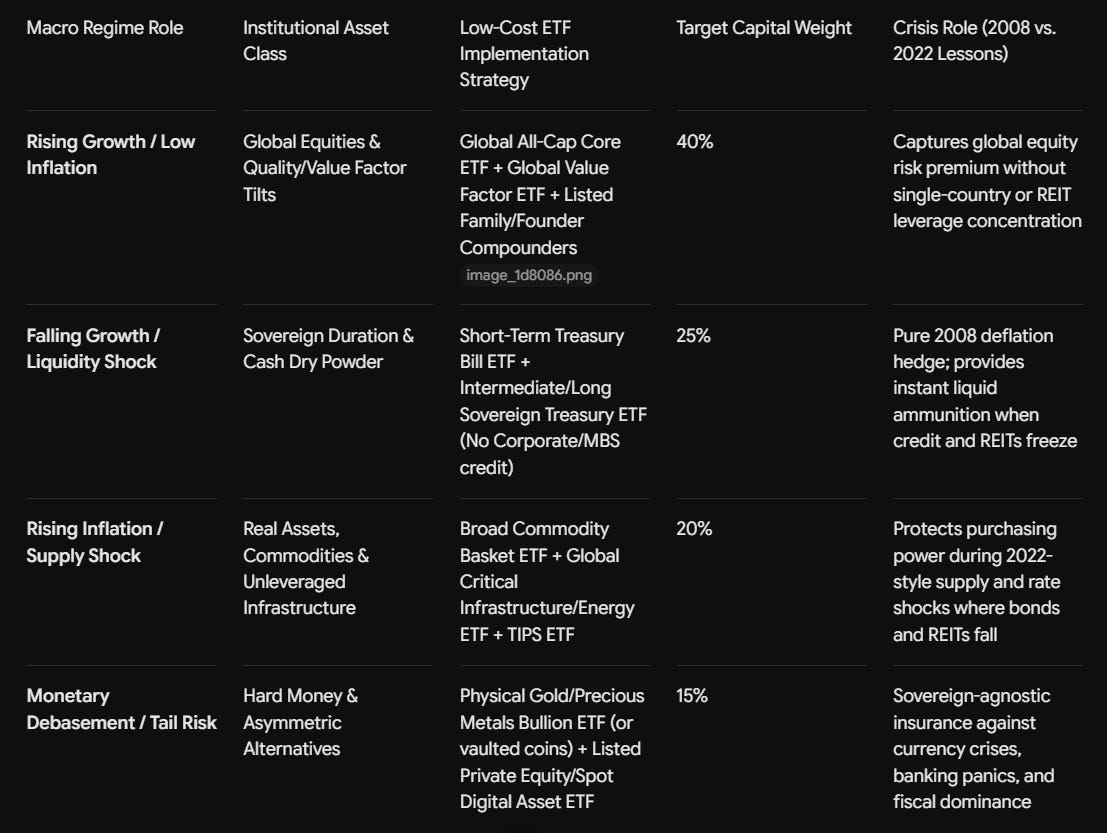
The Power of the “Do-Nothing” Operating System
Once this structural core is in place, the day-to-day operational workflow drops to zero. You are no longer waking up at 6:00 AM to parse central bank transcripts, worry about commercial real estate refinancing walls, or react to geopolitical flashpoints, because the reaction is already pre-programmed into the architecture:
Unhedged Global ETFs Do the Currency Work: By holding unhedged international and global ETFs rather than currency-hedged variants, you avoid paying ongoing forward-contract roll costs and automatically gain foreign currency diversification against a domestic currency or local housing slump.
Tolerance-Band Rebalancing Replaces Market Timing: Instead of rebalancing on an arbitrary calendar date—or worse, trading on gut feel—institutional allocators use tolerance bands (for example, a 5% relative drift threshold). In a 2008 scenario where equities plummet and sovereign Treasuries and gold surge, you mechanically trim your Treasuries/gold once they breach their upper band and buy cheap global equities. In a 2022 scenario where commodities surge and bonds drop, the pendulum swings in the opposite direction.
Core-and-Satellite Separation: By automating 80% to 90% of your capital inside a low-cost, multi-asset All-Weather ETF core, you free your cognitive bandwidth. If you choose to hunt for asymmetric individual stocks or distressed property with the remaining 10% to 20% of your capital, you do so from a position of psychological and financial strength—knowing that neither an inflationary spike nor a 2008-style liquidity freeze can sink the ship.
True financial sophistication is not measured by how many properties you manage or how many trades you execute in a week. It is measured by how many economic regimes your portfolio can survive while you are out living your life.
About the Author
The Global Gambit (@theglobalgambit): The Global Gambit is an independent investment research publication focused on intrinsic valuation and fundamental research centered on family-owned compounders and management with high skin-in-the-game. Backed by multi-asset trading, engineering, and real estate experience and based on Vancouver Island, British Columbia, the publication equips investors with deep-dive institutional dossiers (The Kingside Dossiers) and actionable capital allocation frameworks (Logic & Leverage). 👉 Explore the research and subscribe at: www.theglobalgambit.com
Disclaimer
This publication and its contents are provided strictly for informational, educational, and research purposes only and do not constitute financial, investment, legal, tax, or accounting advice, nor should they be construed as an offer, solicitation, or recommendation to buy or sell any security, Exchange-Traded Fund (ETF), derivative, commodity, digital asset, or real estate instrument in any jurisdiction.
The views, frameworks, and asset allocation models expressed in this article reflect the independent analysis and opinions of the author as of the date of publication and are subject to change without notice. Past performance of any asset class, index, or portfolio strategy—including historical references to the 2008 Global Financial Crisis and 2022 inflation regime—is not indicative of future results. Investing in financial markets involves substantial risk of loss, including the potential loss of principal. Readers are solely responsible for their own investment decisions and are strongly encouraged to conduct their own independent due diligence and consult with a licensed financial advisor, registered portfolio manager, or tax professional regarding their specific financial situation and risk tolerance before implementing any strategy discussed herein. Published by Parch Nature Enterprises Ltd. (operating as The Global Gambit, www.theglobalgambit.com).