CANADIAN DEFENCE: Portfolio Power Plays Amidst Trade War
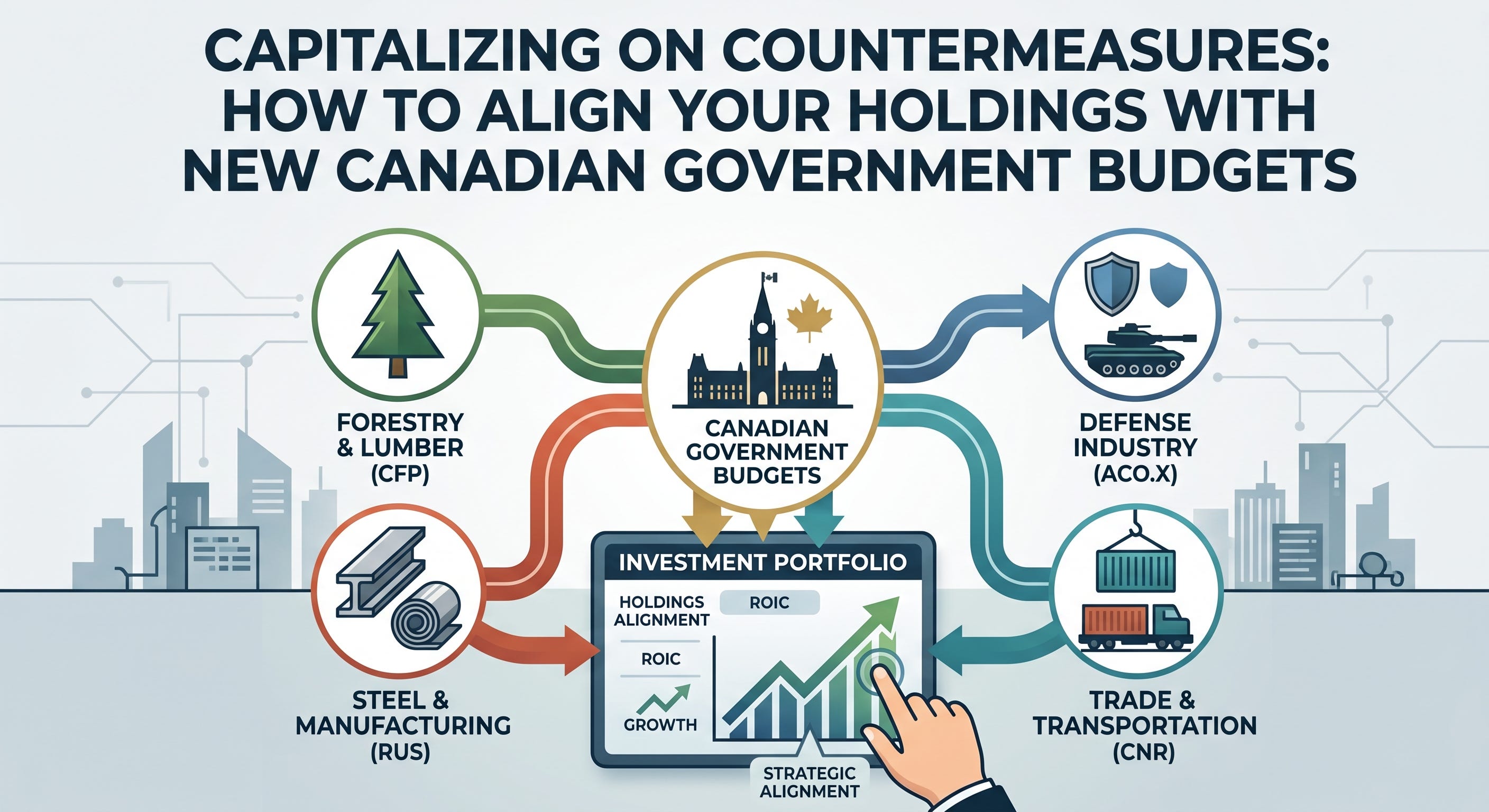
The Canadian government has deployed a multi-pronged fiscal response to counter the 50% tariffs and trade disruptions imposed by the United States, prioritizing trade-exposed industries and domestic supply chain resilience.
Canfor Corporation (TSX: CFP)
Sector Focus: Forestry & Softwood Lumber (SRF & Tariff Support Beneficiary)
Canfor is a dominant player in the North American lumber market, with majority ownership held by the Jim Pattison Group. The company has faced severe cyclical compression and tariff pressure, pushing it into deep-value territory. With the federal government aggressively routing emergency funding to keep facilities operational, Canfor is positioned to absorb non-dilutive capital from the Strategic Response Fund to modernize its mills.
Expected 5-Year Gains: Assuming federal relief successfully buffers near-term cash burn, operational leverage will expand significantly. Over a five-year horizon, the integration of subsidized capital will allow Canfor to upgrade high-margin engineered wood facilities, driving a recovery in ROIC and yielding substantial fundamental asset growth once the cyclical housing market rebounds.
ATCO Ltd. (TSX: ACO.X)
Sector Focus: Defense Infrastructure & Utilities (Defense Industrial Strategy Beneficiary)
Controlled by the Southern family, ATCO operates a highly capital-efficient holding structure with deep roots in modular structures, logistics, and defense contracting. The new $81.8 billion Defense Industrial Strategy and the accompanying “Buy Canadian Policy” directly intersect with ATCO’s core competencies in building remote military infrastructure and energy grids.
Expected 5-Year Gains: The influx of domestic defense spending will secure a long-term backlog of high-margin infrastructure contracts for ATCO. Within five years, this guaranteed federal pipeline is expected to increase the company’s baseline earnings visibility, allowing the family-led management to widen their economic moat and compound capital at sustained double-digit ROIC spreads.
Russel Metals Inc. (TSX: RUS)
Sector Focus: Steel & Aluminum Distribution ($1B Steel Industry Earmark Beneficiary)
As one of the largest metals distribution companies in North America, Russel Metals maintains rigorous capital discipline and high inventory turnover. The $1 billion federal earmark for the steel industry, combined with localized measures like Ontario’s $1.3 billion Manufacturing Investment Tax Credit, will heavily subsidize the domestic industrial base.
Expected 5-Year Gains: Russel Metals will benefit from the localized stabilization of the steel market. Over the next five years, the company is expected to capture enhanced margins as domestic manufacturers lean on local distributors to comply with new federal procurement rules. While exact future market pricing cannot be forecasted, the fundamental expectation is a substantial increase in free cash flow generation and sustained dividend distributions.
Canadian National Railway (TSX: CNR)
Sector Focus: Trade Diversification Corridors ($5B Corridors Fund Beneficiary)
CNR operates an irreplaceable tri-coastal rail network with a massive economic moat and significant long-term backing from major institutional holding structures. The $5 billion Trade Diversification Corridors Fund is specifically designed to shift Canadian exports away from the U.S. and toward global ports.
Expected 5-Year Gains: The government’s push to diversify trade routes will directly drive volume through CNR’s lines connecting to the ports of Vancouver, Prince Rupert, and Halifax. Over the next five years, federal infrastructure investments are anticipated to enhance port throughput capacity, allowing CNR to expand its high-margin long-haul intermodal volumes and further solidify its industry-leading operating ratio.
Prime Beneficiaries of the $81 Billion Defence Allocation
To effectively capture a share of the $81 billion Defence Industrial Strategy, the optimal approach requires filtering the Canadian defense and aerospace sectors for structural resilience. The most compelling beneficiaries are those exhibiting wide economic moats, consistently high return on invested capital (ROIC) spreads, and disciplined capital allocation—particularly entities anchored by multi-generational family or founder-led ownership.
Here is a breakdown of the Canadian equities best positioned to absorb this federal spending, categorized by their structural advantages and expected pathways to profitability.
How These Companies Will Capture the Spending
ATCO Ltd. (TSX: ACO.X) A significant portion of the $81 billion mandate is earmarked for Arctic sovereignty and the modernization of domestic military bases. ATCO’s Frontec division specializes in operational support services, disaster response, and remote modular housing for the military.
The Benefit: As the government mandates northern base expansions and early-warning radar facility upgrades, ATCO will secure long-term, high-margin infrastructure contracts. The Southern family’s conservative management style ensures that this non-dilutive federal capital will be digested efficiently, widening their existing moat and driving stable, long-term free cash flow.
Magellan Aerospace Corporation (TSX: MAL) Magellan is a tier-one aerospace manufacturer heavily involved in global defense supply chains, including the F-35 program. The company operates under the disciplined oversight of its majority shareholder, N. Murray Edwards.
The Benefit: The Canadian government’s commitment to upgrading its fighter jet fleet and domestic aerospace capabilities guarantees a steady pipeline of domestic and allied procurement orders. Magellan will directly benefit from the “Buy Canadian” offset policies (Industrial and Technological Benefits), which require foreign prime contractors to invest heavily in Canadian suppliers. This guarantees high-margin manufacturing backlogs and margin expansion over the coming decade.
Exchange Income Corporation (TSX: EIF) Through its subsidiary PAL Aerospace, EIF operates specialized, highly technical maritime patrol and Intelligence, Surveillance, and Reconnaissance (ISR) aircraft. EIF operates as a disciplined holding company, aggressively acquiring niche aerospace and manufacturing businesses that meet strict ROIC thresholds.
The Benefit: Canada’s defense strategy places a massive emphasis on coastal defense and Arctic surveillance. PAL Aerospace is already deeply entrenched in government contracts for maritime monitoring. The new budget will dramatically expand the scope of these sovereignty patrols, locking EIF into lucrative, multi-year service contracts that provide exceptional baseline earnings visibility.
CAE Inc. (TSX: CAE) As the military procures billions in new hardware—ranging from advanced fighter jets to unmanned aerial systems—they require a modernized training pipeline for pilots and operators. CAE holds a dominant, wide-moat position in global defense and civil simulation.
The Benefit: Hardware is useless without operators. A substantial slice of the $81 billion will flow directly into CAE’s Defense and Security division to build out flight simulators and synthetic training environments. Because simulation software and hardware require massive upfront R&D (already spent by CAE), the incoming federal contracts will flow through to the bottom line at highly attractive margins, reinforcing the company’s capital efficiency.
These structural setups and capital-efficient moats provide excellent underlying fundamentals to explore in upcoming editions of The Global Gambit, offering readers a precise roadmap for navigating government-driven market shifts.
In our upcoming research series, we will conduct granular deep dives into each of these companies—examining their capital allocation efficiency, balance sheet resilience, and the precise share of federal stimulus and non-dilutive funds they are positioned to absorb. From procurement backlogs under the Defence Industrial Strategy to subsidized modernization programs via the Strategic Response Fund, our models will quantify exactly how these fiscal inflows translate into expanded ROIC spreads and long-term shareholder value. Subscribe and follow our forthcoming publications and notes to access our comprehensive company breakdowns, valuation models, and actionable frameworks designed to help you construct and protect your portfolio in this new macroeconomic era.


