

The Turkish real estate market has officially entered a sophisticated era of structural maturation in 2026. Following several years characterized by hyper-speculation, extraordinary inflationary pressures, and sweeping regulatory overhauls, the landscape has stabilized into a fundamentally driven market. While Istanbul remains the colossal financial epicenter and Antalya serves as the undisputed heavyweight of mass tourism, Izmir has quietly, yet decisively, emerged as the strategic haven for discerning real estate capital. Known affectionately as the “Pearl of the Aegean,” Izmir offers an unparalleled blend of coastal lifestyle, robust domestic economic activity, and a relatively untapped, high-potential market for international investors.
For real estate investors, expatriates, and retirees looking toward the Mediterranean basin in 2026, Izmir presents a profoundly unique value proposition. The city avoids the extreme foreign saturation and subsequent regulatory crackdowns seen in southern resort towns, all while offering superior capital appreciation prospects compared to the heavily priced-in districts of Istanbul. This comprehensive report explores the fundamental drivers of the Izmir property market, analyzing the latest 2026 legislative shifts in rental and tax laws, shifting buyer demographics, construction replacement costs, and granular financial modeling of net investment yields for distinct property types.
The 2026 Market Landscape: Demographics, Supply, and Demand
The dynamics of supply and demand in Izmir have shifted significantly following the macroeconomic stabilization efforts of the Turkish government. By early 2026, the Turkish real estate market witnessed a deliberate transition from speculative fervor toward stable, utility-driven growth, characterized by cooling nominal price escalations and a normalization of transaction volumes.
The Demographic Shift in Buyer Profiles
To understand the Izmir market, one must first analyze the broader national context of foreign investment in Turkey. Historically, foreign demand has been dominated by buyers from Russia, Iran, Iraq, Germany, and Kazakhstan. In 2022, property sales to foreigners peaked at a staggering 67,490 units nationwide, but this figure adjusted sharply downward to 23,781 units in 2024 as global capital flows normalized, geopolitical shocks subsided, and Turkish citizenship-by-investment thresholds were strictly enforced.
By the spring of 2026, Russians, Iranians, and Germans continue to lead national transaction statistics. For instance, in a typical recent month, Istanbul led the nation with 648 foreign sales, followed by Antalya with 594, while Izmir recorded a more modest but highly targeted volume of transactions.
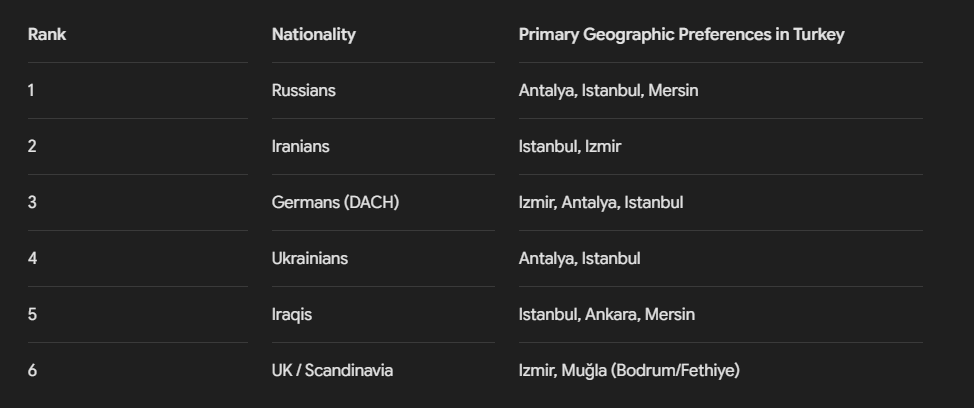
Unlike Antalya, which caters heavily to Russian and Middle Eastern capital seeking immediate resort access, Izmir attracts a highly specific, lifestyle-oriented demographic. Investors and expatriates from English-speaking countries, the DACH region (Germany, Austria, Switzerland), and Scandinavia form a substantial and growing portion of the foreign buyer base in the Aegean region. These buyers are drawn to Izmir’s inherently secular, laid-back atmosphere, its rich historic architecture, and its proximity to elite coastal enclaves like Çeşme and Urla.
Furthermore, domestic demand remains the absolute primary driver in Izmir. The city is a major recipient of internal migration, consistently attracting educated professionals, digital nomads, and middle-class families relocating from the congestion of Istanbul. These domestic migrants are in search of a higher quality of life, lower seismic risk compared to the Marmara fault line, and more manageable living costs, providing a deep, highly liquid pool of end-users for residential property.
Supply Constraints and the Age of Inventory
On the supply side, the Izmir market is characterized by a structural deficit of high-quality, modern, earthquake-resistant housing. Following the regulatory tightening of seismic building codes over the last decade, new-build properties currently make up only 15% to 25% of residential listings in Izmir. The vast majority of the available inventory consists of resale apartments built prior to the latest urban transformation initiatives, placing a massive premium on newly constructed or heavily retrofitted stock.
In terms of market liquidity, the average time on the market for a residential property in Izmir in early 2026 sits at approximately 70 days. However, liquidity is highly hyper-local. Well-priced properties in high-demand neighborhoods such as Alsancak or Karşıyaka may clear the market in 50 days or less, whereas overpriced units or those in peripheral, less-desirable districts like Menemen can languish for over 90 days. The current environment operates predominantly as a buyer’s market; approximately 80% of properties sell below their initial asking price, with successfully negotiated discounts typically ranging from 5% to 8%. The lack of accessible domestic mortgage financing—with local banking interest rates hovering prohibitively between 40% and 50%—means that cash transactions completely dominate the landscape, particularly among foreign investors and high-net-worth domestic buyers.
Subscribe to The Global Gambit to read the full analysis on Turkey's shifting rental laws and unlock exclusive global property insights.