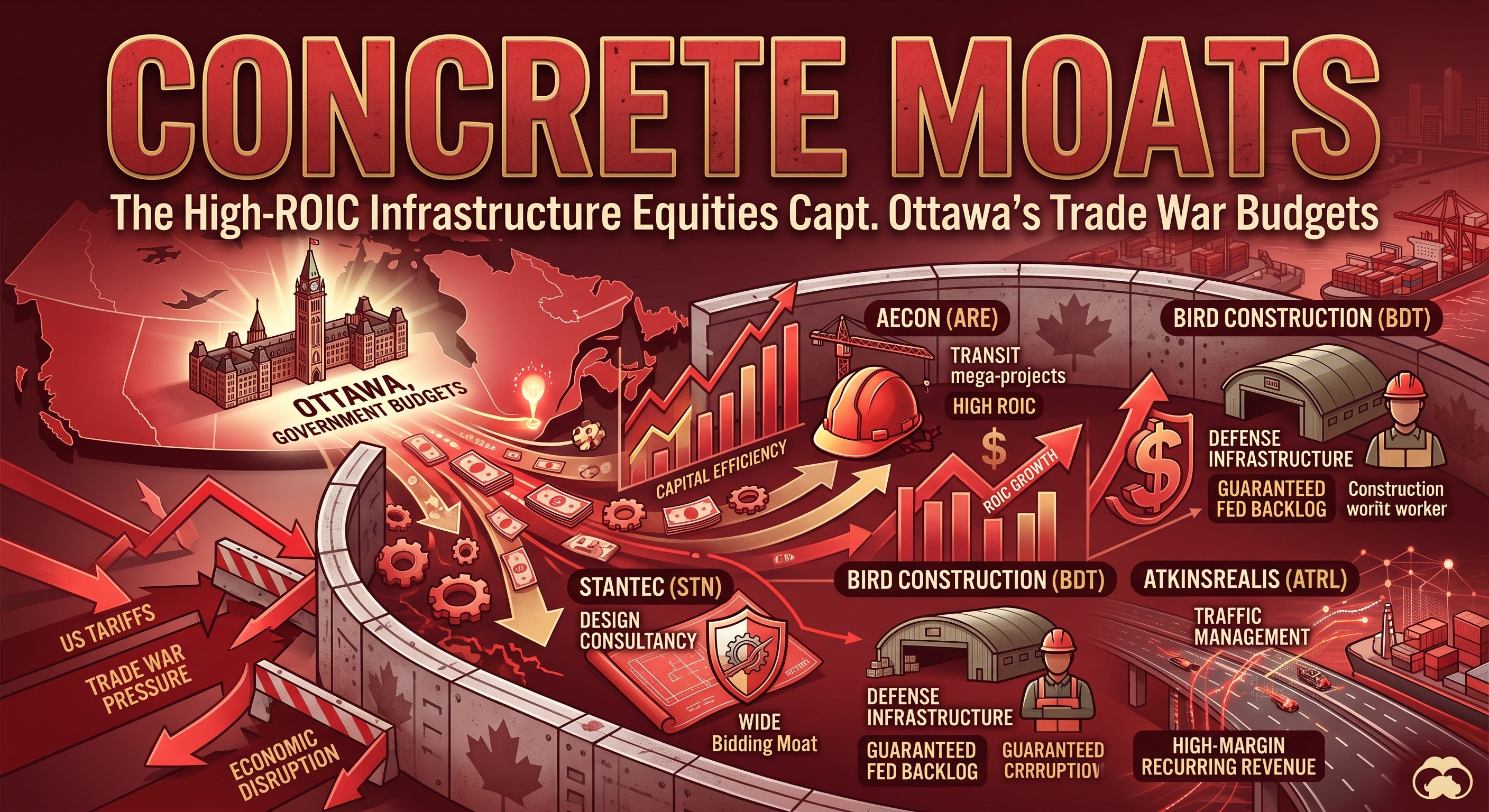
When the Canadian government deploys over $133 billion into long-term infrastructure and defense mandates to counter regional trade pressures, the capital flows decisively into the domestic heavy civil and engineering sectors. Capturing this fiscal stimulus requires targeting capital-efficient operators with wide economic moats, predictable backlogs, and disciplined balance sheets. The following publicly traded infrastructure equities are structurally positioned to absorb these non-dilutive government inflows, heavily compounding their return on invested capital (ROIC) while establishing a distinct margin of safety.
Aecon Group Inc. (TSX: ARE)
Sector Niche: Heavy Civil Construction & Transit Corridors
Catalyst & Moat: Aecon operates with a deep competitive advantage in executing highly complex, multi-billion-dollar public infrastructure consortiums. The company is heavily entrenched in mega-projects such as the $4.4 billion Ontario Line transit expansion. Furthermore, Aecon has been selected as the joint-venture construction partner for the Government of Canada’s Arctic Over-the-Horizon Radar (A-OTHR) project, a critical component of NORAD modernization.
Mechanism of Benefit: Government-funded transit and northern defense infrastructure programs operate on five- to ten-year timelines, effectively insulating Aecon’s backlog from private-sector cyclicality. As the $5 billion Trade Diversification Corridors Fund pushes to accelerate rail and port capacities outside of U.S. dependencies, Aecon’s heavy equipment utilization rates will climb. This absorption of fixed costs against guaranteed federal revenues will drive immense operating leverage, allowing the firm to expand margins and secure stable free cash flow yields through the end of the decade.
Stantec Inc. (TSX: STN)
Sector Niche: Multidisciplinary Engineering & Climate Resiliency
Catalyst & Moat: Stantec commands a formidable global moat in complex environmental and civil engineering design, requiring substantially less capital intensity than physical construction firms. Validating their structural dominance, Stantec was recently awarded the multidisciplinary project management and design mandate for the initial phase of the A-OTHR long-range surveillance radar network.
Mechanism of Benefit: By embedding itself at the foundational planning stage of federal defense upgrades, Stantec locks in long-tail consulting revenues before physical ground is ever broken. The government’s strategic focus on optimizing the Pacific, Prairies, and Central Corridors necessitates exhaustive logistics and environmental engineering. Stantec’s deep-value structure will capture these high-margin design fees entirely insulated from raw material inflation, ensuring their ROIC spreads continue to widen with minimal balance sheet risk.
Bird Construction Inc. (TSX: BDT)
Sector Niche: General Contracting & Military Facilities
Catalyst & Moat: Bird Construction maintains a highly specialized and capital-efficient niche in constructing, renovating, and consolidating federal military assets. The firm possesses an extensive, multi-year track record with the Department of National Defence, having executed infrastructure overhauls like the Willow Park Armoury in Nova Scotia and major facility consolidations in Newfoundland.
Mechanism of Benefit: As national defense budgets expand to harden domestic bases against global instability, Bird is perfectly positioned to capture mid-to-large tier renovation contracts within a restricted, low-competition bidding environment reserved for security-cleared domestic contractors. The company currently demonstrates highly disciplined capital return metrics, sustaining a stable dividend yield backed by a 78% earnings payout ratio. The influx of continuous, non-dilutive defense spending will allow Bird to expand its margins and protect this long-standing track record of dividend stability.
AtkinsRéalis Group (TSX: ATRL)
Sector Niche: Advanced Traffic Management & Transportation Analytics
Catalyst & Moat: AtkinsRéalis possesses a unique economic moat integrating advanced digital technology with physical civil infrastructure. The firm actively executes multi-year mandates for traffic operations, incident coordination, and advanced routing analytics across major highway systems.
Mechanism of Benefit: The physical construction of roads and rail lines is only half of the solution for the Trade Diversification Corridors Fund; optimizing the actual velocity of freight is critical to circumventing cross-border bottlenecks. AtkinsRéalis will benefit immensely as federal capital is deployed to integrate data analytics and advanced traffic management systems into Canada’s primary export routes. These technology-delivery mandates provide clearly defined, multi-year recurring revenue streams that inherently carry higher margins than traditional civil works, structurally lifting the holding company’s baseline profitability.
By filtering the industrial sector for these specific operational parameters—high capital turnover, specialized technical monopolies, and guaranteed federal backlogs—investors can effectively insulate their portfolios while extracting sustained value from Ottawa’s strategic economic realignments.
Over the coming weeks, we will publish dedicated, granular equity notes breaking down each of these industrial operators—evaluating their balance sheet strength, bidding moats, and capital allocation frameworks. Our coverage will isolate the specific project pipelines and procurement mandates where these firms hold structural advantages, quantifying exactly how each management team is converting trade-war countermeasures and public capital allocations into expanded ROIC spreads and long-term shareholder value.
For further analysis on navigating trade shifts and government spending, explore our related research notes linked below
Capitalizing on Countermeasures: How to Align Your Holdings With New Canadian Government Budgets
Where Government Spending Meets High-ROIC Growth to Counter US Tariffs
Insider “Cluster Buying” and Quant Valuations for US & Canadian Equities.
The Sulfur Shock: Geopolitics and CNQ’s Hidden Cash Engine
How Middle East supply disruptions sent sulfur prices soaring above $1,200/ton—and why Canadian Natural Resources Limited (TSX/NYSE: CNQ) is turning a byproduct into a half-billion-dollar windfall.


