Decoding Itaú Unibanco (ITUB): Inside the Structural Triggers Shifting Its Valuation
How an aggressive 200-million-share buyback and ruthless operational efficiency are creating a mechanical floor for valuation.
Asset Overview
Company Name: Itaú Unibanco Holding S.A.
Stock Ticker: ITUB
Exchange: NYSE
Current Closing Price: $7.84 (As of May 15, 2026)
There is a quiet, structural shift occurring beneath the surface of Itaú Unibanco Holding S.A., and the SEC EDGAR filings hold the blueprint. The data suggests Itaú Unibanco (ITUB) is actively undergoing structural financial optimization that could influence the asset’s valuation. An analysis of the company’s recent filings identifies two primary mechanical triggers currently at play: an aggressive share repurchase program designed to force EPS accretion and a disciplined cost restructuring initiative. Together, these catalysts have successfully compressed the efficiency ratio and expanded consolidated ROE. Here is what the institutional data tells us.
The Mechanics of the Aggressive Share Buyback
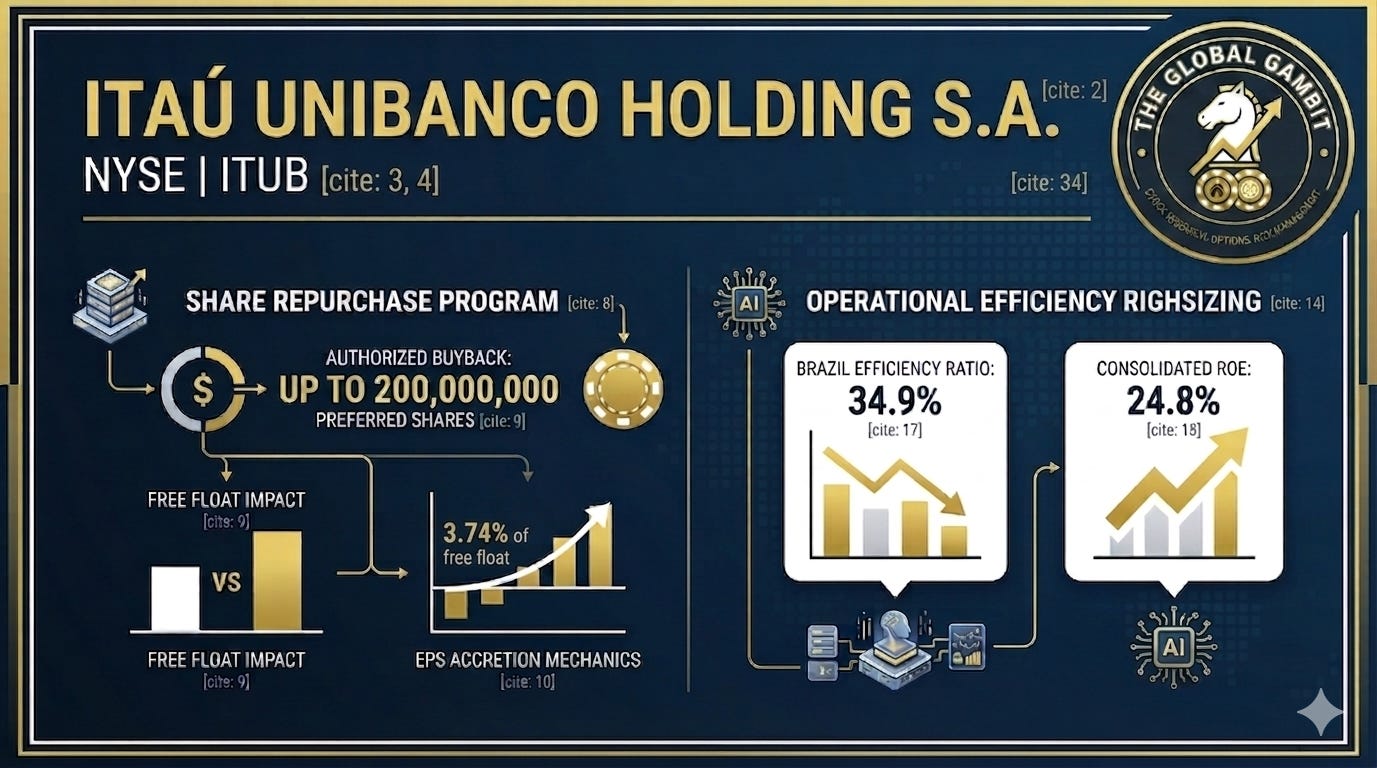
When a company systematically removes shares from the open market, it forces a mechanical shift in valuation metrics. On February 13, 2026, the Board approved a massive share repurchase program.
Program Scale: The mandate authorizes the buyback of up to 200,000,000 preferred shares.
Float Impact: This represents approximately 3.74% of the free float, active through August 4, 2027.
Capital Structure: This program is being executed without a reduction in capital.
By systematically withdrawing shares from the open market, the buyback structurally forces EPS accretion. Additionally, it concentrates the dividend yield for remaining shareholders. The mechanical impact on valuation can be expressed mathematically as:
Title: The Post-Buyback EPS Accretion Formula
Variable Definitions:
$EPS_{new}: Adjusted Earnings Per Share. The projected, structurally higher earnings per share resulting from a reduced float.
S{Net Income}: Managerial Net Profit. The company’s bottom-line earnings over a given period, which forms the numerator of the valuation.
S{out}: Shares Outstanding. The original, total number of shares held by all shareholders prior to the implementation of the buyback program.
S{rep}: Shares Repurchased. The specific volume of shares being systematically withdrawn from the open market (in this case, up to 200,000,000 preferred shares).
With the denominator structurally reduced over the duration of the program, the data implies valuation models may adjust the equity upward to maintain historic P/E multiples.
Operational Rightsizing: Compressing the Efficiency Ratio
Beyond the balance sheet engineering, Itaú Unibanco’s Q1 2026 MD&A and earnings disclosures highlight structural margin expansion. This is driven by a rigorous efficiency program.
Record Lows: Non-interest expenses declined 5% quarter-over-quarter. This effectively compressed the efficiency ratio in Brazil to a record low of 34.9%.
ROE Expansion: This operational rightsizing mechanically accelerated profitability. Consequently, it expanded consolidated Return on Equity (ROE) to 24.8%.
Net Income Acceleration: The restructuring drove a 10% year-over-year increase in managerial net income.
Forward Strategy: The ongoing transition toward digital banking infrastructure and AI integration is designed to permanently optimize the firm’s cost footprint.
Reading the Tape: Ownership & Governance Signals
Understanding the “why” behind an asset’s movement requires an audit of insider and institutional flows. A cluster of Form 4 filings hit the tape on May 11, 2026. These were filed by multiple insiders—including Alfredo Egydio Setubal and Joao Moreira Salles—for transactions dated May 8, 2026.
However, a closer audit of the filings reveals these shares were acquired via compensation grants (Transaction Code A) rather than Open Market Purchases (Transaction Code P). Without the conviction signal of synchronized Code P open-market cluster buying, this executive accumulation is a standard governance mechanism rather than an immediate pricing catalyst.
Furthermore, institutional positioning was updated via a Form 13F-HR/A filed on May 15, 2026.
Amendment Tracking: It is critical to note that this filing is an Amendment (/A), restating the prior day’s 13F-HR to accurately reflect 400 positions.
Asset Allocation: These positions total $4.31 billion in market value under Itau USA Asset Management.
Data Integrity: By verifying the /A metadata, we prevent the double-counting of these long allocations.
As always, this 13F data carries a 45-day reporting lag and reflects only long positions as of the quarter’s end. Finally, a sweep of the SEC EDGAR system reveals no recent Schedule 13D filings. Therefore, there is no indication of an aggressive activist accumulation that would force a structural turnaround.
The Audit Trail
For those conducting their own due diligence, the filings backing this data are:
Form 6-K (Material Fact - Stock Buyback): Filed 02/13/2026. Used to verify the 200,000,000 preferred share repurchase program.
Form 6-K (Q1 2026 Earnings & MD&A): Filed 05/13/2026. Used to extract the 34.9% efficiency ratio, 5% expense reduction, and ROE expansion metrics.
Form 4: Filed 05/11/2026 by Alfredo Egydio Setubal, Joao Moreira Salles, and others. Verified Transaction Code A (grant/award); confirmed the absence of Code P.
Form 13F-HR/A: Filed 05/15/2026 by Itaú Unibanco Holding S.A. Verified as an amendment to the 05/14/2026 filing to ensure accurate institutional share counts.


