

INVESTMENT SUMMARY & QUICK FACTS
Company: FirstService Corporation Ticker: NASDAQ: FSV
Date of Analysis: September 20, 2026
Current Price: $129.11
Market Capitalization: $5.85 Billion
Target Action: PASS — INITIATE DEEP DIVE
1. The Investment Thesis (The “Elevator Pitch”)
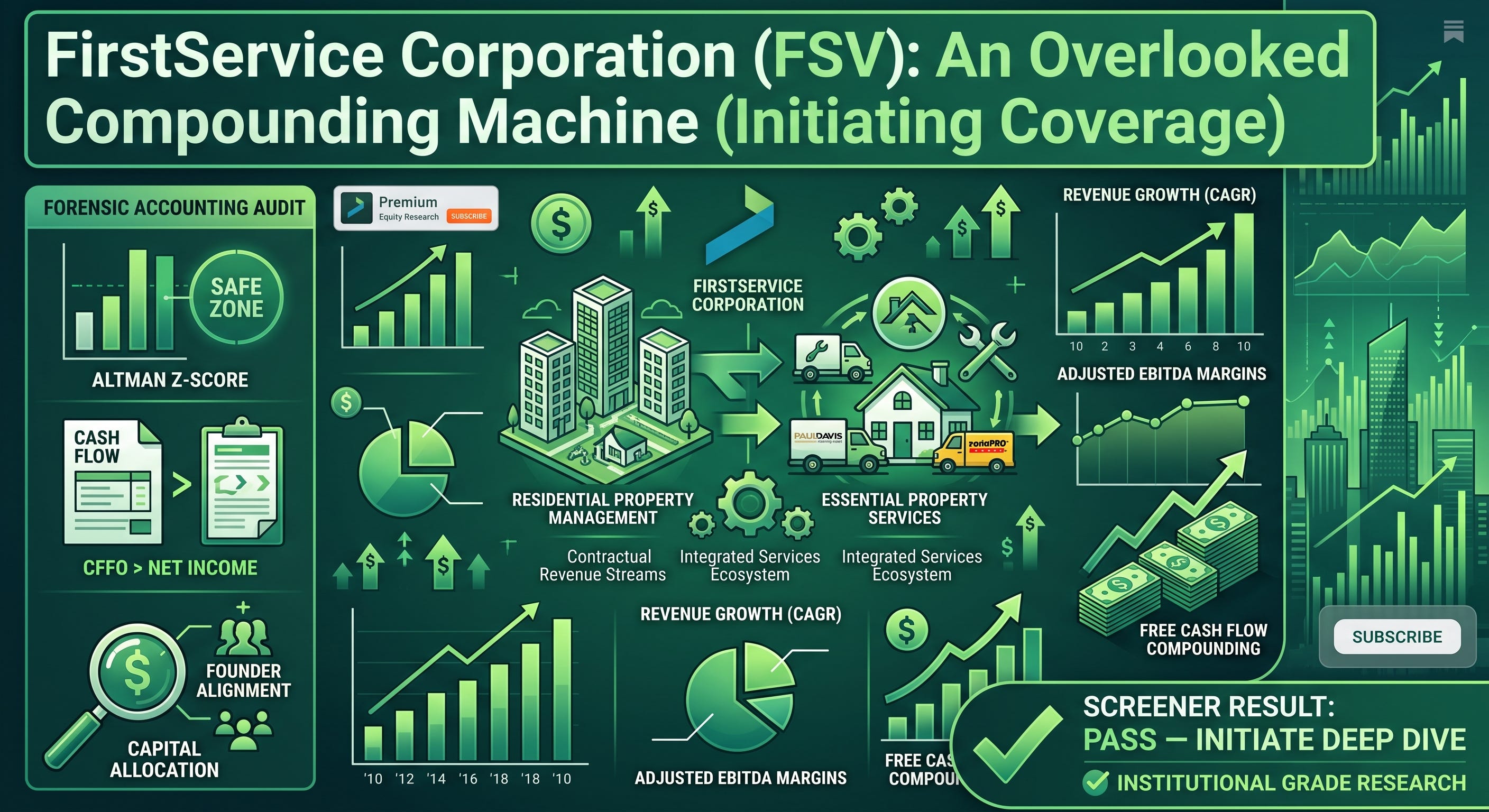
FirstService is an under-the-radar cash flow machine masquerading as a boring property services company. The thesis is straightforward: FSV operates a high-moat, annuity-like residential management core that funds a highly disciplined, founder-led M&A roll-up strategy. The market is currently penalizing the stock for cyclical macroeconomic softness in its discretionary Brands division (e.g., California Closets, home improvement), completely ignoring the entrenched >90% retention rate of its Residential HOA management contracts. With exceptional insider alignment and unlevered free cash flow converting flawlessly, the current multiple offers a rare margin of safety to acquire a predictable compounder. The market is mispricing the durability of its core recurring revenues.
2. Business Description & Industry Dynamics
FirstService operates in two distinct segments. FirstService Residential is the undisputed market leader in North American property management, overseeing more than 9,000 master-planned communities and high-rises. The economics here are contractual, asset-light, and highly recurring. FirstService Brands operates franchised and company-owned essential property services, including Paul Davis Restoration, Roofing Corp of America, and CertaPro Painters.
Applying Porter’s framework: Barriers to entry for managing complex, large-scale residential communities are massive due to necessary technological infrastructure and procurement scale. The threat of substitutes is negligible, as HOA boards rarely switch providers without extreme provocation. FSV leverages its sheer density to secure lower insurance and vendor costs for its clients, structurally squeezing sub-scale regional competitors out of the market.
3. The Decade in Review: Historical Pattern Recognition
Top-Line Trajectory: Growth is a masterclass in compounding. Consolidated revenues expanded from roughly $3.25 billion in 2021 to $5.5 billion in 2025. Growth is driven by a balanced mix of low-to-mid single-digit organic growth and relentless, programmatic tuck-in acquisitions.
Margin Integrity: Remarkably stable. Despite inflationary pressures over the past three years, Adjusted EBITDA margins have hovered consistently in the 9.5% to 11.2% band. The structural pricing power embedded in their Residential contracts effectively offsets wage inflation.
Return on Invested Capital (ROIC): Normalized ROIC currently sits at 9.59%. While optically suppressed by the heavy goodwill amortization associated with recent large acquisitions (like Roofing Corp of America), it consistently clears their weighted average cost of capital, indicating genuine value creation rather than mindless empire-building.
Free Cash Flow Generation: FSV is an absolute cash engine. Trailing twelve-month operating cash flow stands at roughly $460 million, converting to over $360 million in unlevered free cash flow. There is no persistent cash burn here; the operations fund the aggressive M&A pipeline internally.
Shareholder Yield/Dilution: Capital structure management is exceptional. Diluted weighted average shares outstanding crept from 44.4 million in 2021 to just 45.7 million in 2025—an annualized dilution rate of well under 1%. Management is not financing its M&A spree by printing stock at the expense of existing shareholders.
4. The Forensic Audit: Institutional Red-Flag Screen
A. Capital Allocation & “Skin in the Game” (Governance)
Insider Alignment: This is the crown jewel of the thesis. Founder and Independent Chairman Jay Hennick, alongside CEO D. Scott Patterson, operate with massive equity alignment, with insiders controlling roughly 10% of the firm. Furthermore, open-market transactions confirm conviction: Patterson aggressively bought 125,000 shares in February 2026 for over $19 million.
The Dilution Burden (SBC): Stock-Based Compensation is a rounding error. With trailing operating cash flow of $460 million and SBC running well below 5% of CFFO, the executive suite is actively managing the business for long-term equity appreciation, not short-term compensation extraction.
M&A Track Record: While FSV is definitively a serial acquirer, they are not “Corporate Bulimics.” They acquire fragmented regional operators (often at 5-7x EBITDA multiples), strip out redundant back-office costs, and fold them into the FirstService ecosystem. While goodwill is high ($1.33 billion), impairment charges are practically non-existent because the acquired cash flows actually materialize.
B. Earnings Quality & Cash Flow Realities
The CFFO Divergence: Earnings quality is stellar. Trailing CFFO ($460 million) drastically exceeds GAAP Net Income ($161 million). This massive positive divergence is exactly what you want to see in a roll-up: the GAAP net income is severely depressed by non-cash amortization of acquired intangibles, masking the true cash-generating power of the underlying business.
Working Capital Strains: Clean. Accounts receivable sit at ~$913 million against $5.5 billion in revenue, implying a Days Sales Outstanding (DSO) of roughly 60 days. This is standard and stable for the HOA and B2B services sector. Inventory (DSI) is similarly unalarming, as this is fundamentally a services business. There is no evidence of channel stuffing.
Cash Flow Shifting: Accounts payable and accrued liabilities are scaling proportionately with revenue. There are no sudden, unexplained spikes in deferred revenue or vendor stretching designed to artificially engineer quarterly cash flow beats.
C. Solvency & Balance Sheet Resilience
Altman Z-Score: Calculated at a robust 3.15 (Safe Zone).
(Working Capital/TA: 0.16 + Retained Earnings/TA: 0.03 + EBIT/TA: 0.08 + Market Equity/Total Liab: 2.30 + Sales/TA: 1.28). The business is fundamentally solvent and far removed from distress territory.
Liquidity Profile: The current ratio stands at a healthy 1.67. Total Debt-to-Equity is 90%, with total long-term debt sitting at roughly $1.25 billion against $217 million in cash equivalents. While leverage is present, it is comfortably serviced by the highly predictable, contractual cash flows of the Residential segment. A credit freeze would halt their M&A pipeline, but it would not threaten the core operations.
D. Accounting Distortions & Footnote Opacity
The Non-GAAP Illusion: Management frequently touts Adjusted EBITDA and Adjusted EPS. While routinely stripping out acquisition-related amortization requires scrutiny, in FSV’s case, the adjustments are fundamentally justified by the raw free cash flow generation. They are not hiding operational decay behind bespoke metrics.
Expense Capitalization & Reserves: The balance sheet is devoid of aggressive capitalization gimmicks. R&D is negligible. Allowances for doubtful accounts have scaled logically alongside total receivables (currently ~$23.5 million allowance on $936 million gross receivables). The footnotes are transparent.
5. Valuation Reality Check
FSV is currently trading at approximately $129 per share. While a trailing P/E of 36.5x screens expensive to the uninitiated, it is a phantom multiple distorted by acquisition amortization. On a Price-to-Cash-Flow basis, the stock trades at roughly 15x (and an EV/EBITDA of ~13x). For a highly defensive, recurring-revenue platform that organically compounds at mid-single digits and systematically deploys capital at high returns, 15x cash flow is more than a sufficient margin of safety. The market is currently offering a discount based on temporary cyclical fears in the home improvement sector.
6. The Verdict & Key Investment Risks
PASS — INITIATE DEEP DIVE
FirstService Corporation clears our initial institutional screen with high marks. It represents a textbook compounding machine: recession-resistant contractual cash flows, structural barriers to entry in residential property management, and exceptional insider alignment. The market’s fixation on reported GAAP earnings and cyclical softness in discretionary home improvement has created a distinct valuation disconnect, offering patient capital an attractive margin of safety.
However, before establishing an actionable entry price, investors must weigh three critical structural risks:
Housing Turnover Drag on Discretionary Brands: While the Residential HOA management division is essentially non-discretionary, the Brands division (California Closets, Roofing Corp of America, CertaPro) remains sensitive to frozen existing home sales and high interest rates. Investors must monitor whether prolonged housing stagnation triggers a sustained 10% to 15% revenue decline in these auxiliary segments, muting consolidated growth.
Elevated Capital Costs on the M&A Flywheel: FSV compounds by deploying operating cash flow and modest debt into fragmented regional tuck-ins at accretive 5x–7x EBITDA multiples. If borrowing costs remain elevated for longer, the hurdle rate for debt-financed acquisitions increases, potentially forcing management to slow the deal cadence and rely more heavily on its 4% to 5% organic growth baseline.
Wage Inflation vs. Contractual Pricing Power: On-site property management and essential maintenance are labor-intensive. Although FirstService historically exercises strong pricing power through annual contract escalators, a persistent acceleration in labor costs could temporarily outpace HOA board approvals, compressing consolidated Adjusted EBITDA margins below their historical 10% to 11% operating floor.
Our forthcoming deep-dive valuation will quantify each of these risk scenarios, stress-test margin durability across interest rate environments, and establish our definitive intrinsic value and target entry range. Read our other articles on the global gambit.
Capital knows no borders—and neither should alpha.
The Global Gambit is an institutional-grade research publication dedicated to fundamental equity analysis, cash flow forensics, and global hard asset intelligence. We bypass the retail noise to track structural valuation gaps, international real estate opportunities, and high-conviction market catalysts designed to build and protect cross-border wealth.
Subscribe at theglobalgambit.com to access the full deep-dive article upon release.
Navigation Note: While this page serves as a central directory for mobile readers, we highly recommend viewing our main platform on a desktop browser for optimal multi-desk navigation and the complete research layout experience. Explore our four specialized desks below.
North American Desk
Insider “Cluster Buying” and Quant Valuations for US & Canadian Equities.
Global Equity Desk
High-conviction fundamental research and quantitative models for European, Asian, and Global Emerging Markets.
Middle East Alpha
Fundamental analysis and Sovereign Wealth tracking for Saudi & UAE markets.
Global Real Estate Desk
Institutional analysis, macro trends, and deep-dives into global commercial and residential real estate markets. Tracking capital flows, interest rate impacts, and REIT performance
Disclaimer: I do not currently own shares or hold any direct financial interest in the company discussed in this report. However, I may consider initiating a long position in the near future. The information provided in this publication is for informational purposes only and does not constitute a recommendation to buy, sell, or hold any security. All analysis is based on publicly available information and independent research. Readers assume full responsibility for their investment decisions and should consult a licensed financial professional before executing any market transactions.