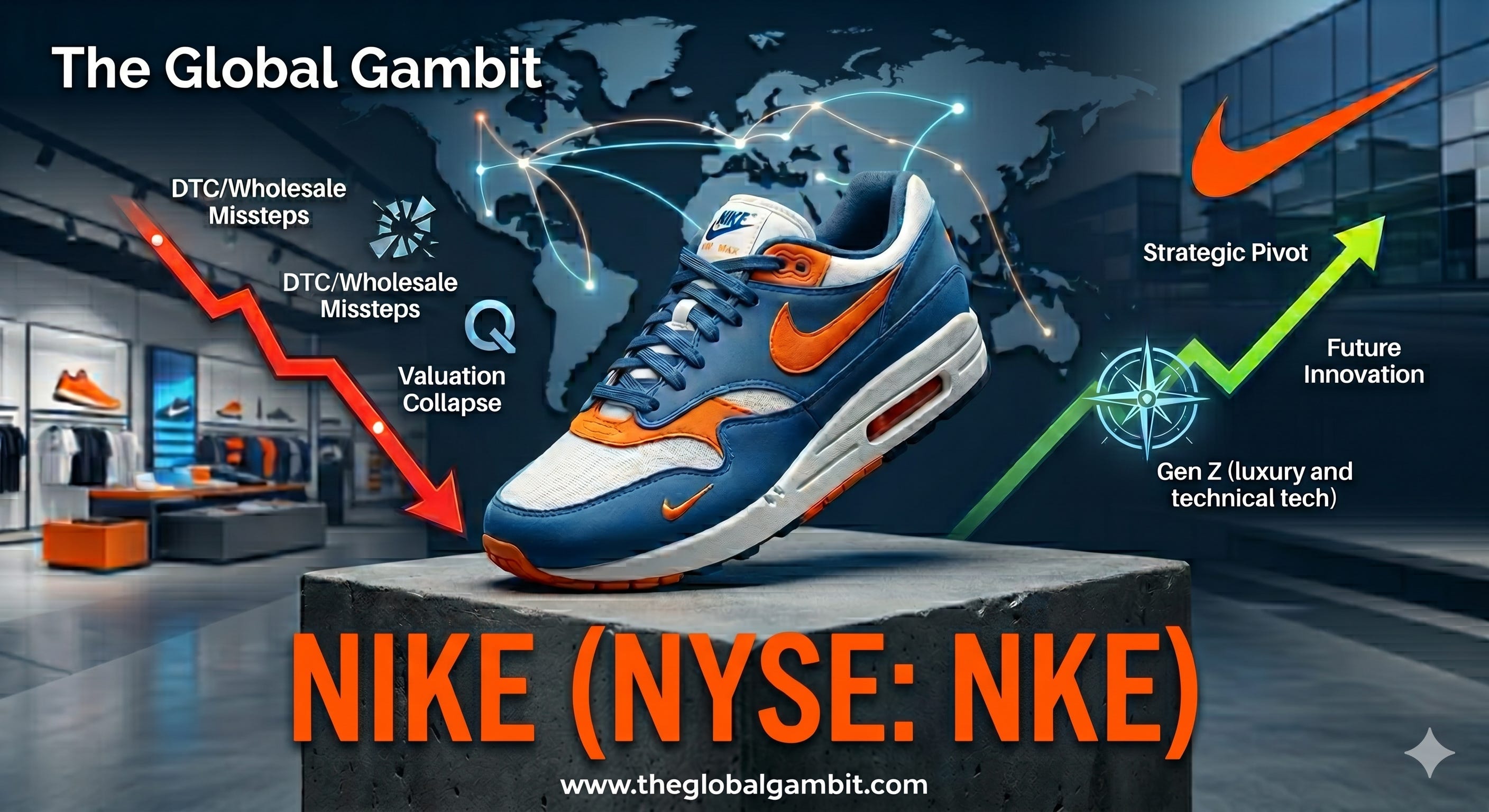
How Nike Inc. Lost Its Footing (NYSE:NKE)
A forensic breakdown of the strategic miscalculations and structural valuation collapse at $NKE.
Company Name: Nike Inc.Ticker/Exchange: NYSE: NKEReport Date: May 31, 2026Closing Stock Price: $46.23 (As of market close on Friday, May 29, 2026)
Regulatory Disclaimer and General Advice Exemption Notice This report is for general informational purposes only and does not constitute personalized financial advice or a solicitation to trade any securities. The author has received no compensation from Nike Inc. or any affiliated party for this analysis. Capital markets carry inherent risks; investors should conduct their own due diligence and consult a registered financial advisor. Past performance is not indicative of future results
The Swoosh Under Siege: An Introduction to a Historic Value Destruction
For nearly forty years, Nike Inc. (NYSE:NKE) operated as the undisputed apex predator of the global sportswear and athletic apparel industry. The Nike “Swoosh” was not merely a corporate logo; it was an internationally recognized emblem of athletic dominance, cultural relevance, and consumer lifestyle aspiration. This cultural monopoly provided the corporation with immense pricing power, unparalleled marketing reach, and a seemingly impenetrable economic moat. An investor who allocated $1,000 into Nike’s initial public offering in 1980 would have seen that capital compound to an astounding $13.2 million by the modern era. However, the period between the post-pandemic market peak in late 2021 and the spring of 2026 has witnessed one of the most severe, sustained wealth-destruction events for a blue-chip consumer discretionary stock in modern financial history.
On November 5, 2021, shares of Nike closed at an all-time high of $165.10, commanding a massive valuation premium built on the assumption of endless global expansion and digital margin expansion. By April and May of 2026, the equity had plunged to trade in a deeply depressed, volatile range of $41.35 to $46.23. This translates to a devastating vaporization of approximately 75% of the company’s peak market capitalization. The velocity, depth, and sustained nature of this decline—dropping 29.8% in 2022, 7.2% in 2023, 30.3% in 2024, and continuing to gap down aggressively into 2025 and 2026—have forced institutional investors, forensic analysts, and market participants to confront a chilling hypothesis.
This report provides an exhaustive, multi-layered dissection of Nike Inc. to isolate the precise catalysts behind this equity collapse. By scrutinizing the company’s financial reports from fiscal year 2022 (FY22) through the third quarter of fiscal year 2026 (Q3 FY26), evaluating shifting generational consumer psychology, analyzing management’s strategic missteps, and reverse-engineering the discounted cash flow (DCF) valuation models currently utilized by Wall Street analysts, a highly nuanced, sobering picture emerges.
The analysis indicates that Nike’s current predicament is not a sudden accident of macroeconomic misfortune. Rather, it is the culmination of self-inflicted strategic errors regarding distribution channels, a catastrophic failure to anticipate the rapid shift in Generation Z consumer demand away from heavily branded athleisure, and the aggressive ascent of specialized, highly technical competitors who have successfully breached Nike’s long-standing retail defenses.
The Anatomy of an Equity Collapse: Tracking the 75% Plunge
To accurately contextualize the present valuation of Nike and the prevailing market sentiment, it is essential to trace the chronological timeline of its equity decline. The stock’s descent was not a singular catastrophic event but a cascading series of lower highs and lower lows, driven by deteriorating earnings guidance, strategic pivots that failed to materialize, and an increasingly hostile global trade environment.
In the immediate aftermath of the 2021 peak, global supply chains were heavily constrained, and inflation began to erode consumer discretionary income. By June 1, 2022, Nike’s shares had already fallen sharply to approximately $119, and just three months later, on September 1, 2022, they closed at $106.49. In a span of just ten months, Nike’s stock had surrendered more than 40% of its value. While early 2023 offered a brief counter-trend rally built on hopes of a rapid reopening of the Chinese consumer economy and normalization of inventory levels, the structural issues within the company’s revenue generation engine quickly resurfaced.
By 2024, the stock experienced a severe 30.3% drop as management was forced to formally acknowledge the systemic failures of its highly touted Direct-to-Consumer (DTC) pivot. Institutional patience began to wear dangerously thin as the turnaround narrative was repeatedly extended.
The definitive breaking point for market confidence occurred in the spring of 2026. Following the release of the Q3 FY26 earnings report for the period ended February 28, 2026, Nike technically beat immediate earnings per share (EPS) estimates, posting $0.35 against a consensus of $0.29, alongside revenue of $11.28 billion that edged past the $11.23 billion forecast. However, the forward guidance issued by management devastated the stock. Management projected that Q4 FY26 revenue would decline by 2% to 4% year-over-year. More critically, management guided that revenue in the vital, high-margin Greater China region would collapse by approximately 20% in the upcoming quarter.
Following this dire announcement on April 1, 2026, the stock plummeted over 15.5% in a single trading session, hitting an 11-year low. Major financial institutions immediately reacted. Goldman Sachs downgraded the stock from Buy to Neutral, cutting its price target from $76 to $52, citing deep incremental caution regarding the recovery timeline in the Chinese market. JPMorgan mirrored this sentiment, downgrading the stock from Overweight to Neutral, slashing its target from $86 to $52, and actively trimming fiscal 2027 and 2028 forward estimates well below consensus due to the extended turnaround.
The market’s visceral reaction to the Q3 FY26 guidance underscored a total loss of institutional faith in the company’s immediate recovery narrative. Investors are now aggressively demanding tangible, mathematical evidence of margin recovery and top-line stabilization before assigning the stock anywhere near its historical premium multiple.
Forensic Dissection of Margins and Revenue (FY22 - Q3 FY26)
Financial metrics are the ultimate truth-tellers of corporate strategy. A forensic examination of Nike’s income statements from FY22 to the most recently reported Q3 FY26 reveals a distressing, multi-year pattern of top-line stagnation, severe gross margin compression, and deeply bloated operational expenses.
Revenue Stagnation and the Collapse of Channels
Historically, Nike delivered consistent high-single to double-digit revenue growth, driven by volume expansion and robust pricing power. However, the post-2022 era reflects a dramatic, structural stalling of the revenue engine.
Note: Data aggregated from official company filings and investor relations releases.
In FY23, Nike appeared to still exhibit top-line momentum, generating $51.2 billion in total revenue, up 10% on a reported basis and 16% on a currency-neutral basis compared to FY22. However, forensic analysis reveals this growth was largely inflationary—driven by strategic pricing actions to offset input costs rather than underlying volume strength. By FY24, organic demand had clearly fractured, and revenue growth slowed to a stagnant 1%, totaling $51.4 billion.
The true financial reckoning arrived in FY25. Total revenue contracted by a staggering 10% on a reported basis to $46.3 billion. This collapse was deeply systemic across all vital sales channels and geographies. Wholesale revenues fell by 7% to $25.9 billion, a direct result of severed retail partnerships. Concurrently, the NIKE Direct revenues—the digital and owned-store ecosystem touted as the crown jewel of Nike’s future margin expansion—plummeted 13% to $18.8 billion. Most alarmingly, this drop was driven by a massive 20% decrease in NIKE Brand Digital, indicating that consumers were actively abandoning the brand’s primary e-commerce platforms. Geographically, the North America segment declined by 9%, and the Europe, Middle East & Africa (EMEA) segment declined by 10%.
By the end of Q3 FY26, the financial bleeding had been arrested only marginally, with revenues printing flat at $11.3 billion for the quarter (down 3% on a currency-neutral basis). The Converse subsidiary, long a reliable secondary engine for the corporation, saw revenues completely crater by 35% in Q3 FY26 to a mere $264 million, due to pervasive declines across all global territories.
The Gross Margin Compression
Perhaps more terrifying to institutional investors than top-line stagnation is the structural deterioration of Nike’s gross margins. A premium brand is fundamentally defined by its pricing power, and pricing power dictates the gross margin profile. When gross margins compress, the economic moat is breached.
In FY22, Nike boasted a robust, premium gross margin of 46.0%. By FY23, this figure dropped 250 basis points to 43.5%. Management attributed this severe decline to higher product input costs, elevated freight and logistics costs, and crucially, higher markdowns required to clear bloated, stale inventory out of the system. In FY25, margins compressed further to 42.7%, heavily impacted by higher promotional discounts required to move fatigued lifestyle franchises like the Air Force 1 and Dunk, which consumers were no longer willing to purchase at full retail price.
The Q3 FY26 report delivered another catastrophic blow, with gross margins falling a further 130 basis points year-over-year to an alarming 40.2%. Management explicitly attributed this latest, severe compression to higher tariffs in North America. This signals that geopolitical trade policies and macroeconomic frictions are now actively eroding the company’s profitability. When a corporation experiences contracting overall revenues simultaneously with rapidly compressing gross margins, the impact on operating income is exponentially negative.
Operating Deleverage and SG&A Bloat
While revenues fell and gross margins compressed, Nike fundamentally failed to rein in its operational overhead, resulting in severe operating deleverage. Selling and Administrative (SG&A) expenses represent a massive, sticky burden on the company’s profitability profile.
In FY23, SG&A was $16.4 billion, representing 32.0% of total revenue. By the nine-month year-to-date (YTD) mark of FY26, SG&A stood at $12.0 billion, consuming an even higher 34.0% of revenues. For the standalone Q3 FY26 period, SG&A jumped to 35.3% of total revenue ($4.0 billion). Demand Creation Expenses—which encompass massive advertising campaigns, brand marketing, and astronomical sports endorsement contracts—remained stubbornly high, printing at $1.09 billion for Q3 FY26 alone.
The implication here is deeply concerning: Nike is effectively forced to spend significantly more capital on marketing simply to maintain a shrinking revenue base. This is the mathematical definition of a loss of organic brand heat. The culmination of these factors is a catastrophic decline in Earnings Before Interest and Taxes (EBIT) and Net Income. Total NIKE, Inc. EBIT fell 42% in FY25 to $3.77 billion, dragging the EBIT margin down to a paltry 8.2% from 12.7% the prior year. Net income followed suit, dropping 44% in FY25 to $3.2 billion, and continuing to collapse in Q3 FY26 by 35% to $520 million. Diluted EPS for Q3 FY26 fell 35% to $0.35.
The forensic conclusion drawn from the financial statements is unequivocal and deeply bearish: Nike is currently a shrinking business with rapidly deteriorating profitability metrics, locked in an escalating battle against both rising operational costs and aggressive geopolitical tariffs, with no mathematical signs of an imminent bottom.
The Fundamental Paradigm Shift in Consumer Demand
Financial metrics, however stark, are merely lagging indicators of consumer behavior. To understand precisely why Nike’s revenues and margins are collapsing, one must look past the income statement and analyze the structural shift in global consumer psychology, specifically regarding Generation Z (Gen Z) and younger Millennials.
The Ascendance of “Quiet Luxury” and Logo Fatigue
For over three decades, the core of Nike’s lifestyle strategy relied on the sheer ubiquity of the Swoosh. The strategy was to engineer “logomania”—a psychological state where the visible brand mark itself carried immense intrinsic cultural value, signifying athleticism, wealth, and proximity to cultural icons and athletes. However, the macroeconomic environment spanning 2022 to 2026, characterized by punishing high inflation, stagnant wage growth, and deep economic uncertainty, fundamentally altered how consumers broadcast their status.
A pervasive aesthetic trend termed “quiet luxury” or “stealth wealth” rapidly gained traction among younger cohorts. Catering initially to the uber-rich through legacy luxury brands like Loro Piana, The Row, Max Mara, and Zegna, the quiet luxury movement is characterized by extremely subtle marketing, muted color palettes, high-quality sustainable materials, and a strict, purposeful aversion to visible logos. The growth of quiet luxury is associated with a new wave of consumerism where individuals are no longer swayed by massive corporate logos splashed across their chests or footwear.
This high-fashion trend cascaded rapidly down the economic ladder to mainstream Gen Z consumers. This demographic began mixing high-quality, no-logo basics with thrifted, upcycled, or pre-loved items to create an aesthetic that prioritized personal identity, sustainability, and impeccable tailoring over blatant corporate branding. In a world where loud logos became associated with mass commercialism rather than exclusivity, a perfectly stitched, unbranded garment began to feel significantly more luxurious than a bag or shoe with three gold letters or a massive swoosh stamped on it.
Price Sensitivity and the Value Proposition
Furthermore, as inflation squeezed discretionary income, consumers became hyper-sensitive to price-to-value ratios. Gen Z consumers possess a high degree of digital literacy and recognize that premium pricing for heavily logoed items often subsidizes corporate marketing budgets rather than guaranteeing superior material quality. Consequently, the demand for Nike’s lifestyle franchises—which rely almost entirely on the visual impact of the Swoosh and synthetic leather materials rather than technical superiority—began to severely wane.
Basic, logo-heavy staples like the plain white canvas sneaker or massive designer belts were rapidly replaced by retro, low-profile silhouettes and subtle, highly functional apparel. Consumers began seeking out specific heritage styles that blended into a quiet aesthetic, such as the Adidas Samba, Gazelle, SL72, and BW Army (GAT style), as well as the Onitsuka Tiger Mexico 66 and the Puma Speedcat. These styles offered sleek, low-profile designs that felt vintage and authentic, deeply undercutting the chunky, heavily branded Air Force 1s and Dunks that Nike had flooded the market with.
The Ascendance of Performance-Driven Competitors
As consumer preference shifted decisively away from ubiquitous logos and toward comfort, a critical, fatal vulnerability in Nike’s product pipeline was exposed: a multi-year over-reliance on retro lifestyle sneakers at the direct expense of cutting-edge biomechanical innovation. This strategic complacency created a massive market opening for specialized, performance-driven footwear brands, primarily Hoka (owned by Deckers Outdoor) and On Running (On Holding AG).
Hoka: Mastering the Maximalist Comfort Wave
Hoka capitalized on a maximalist design philosophy that prioritized extreme comfort, thick EVA foam, and ergonomic support over traditional aesthetic norms. In doing so, it entirely bypassed traditional sneaker culture hype, appealing directly to long-distance runners, healthcare workers on their feet all day, and eventually, the highly coveted Gen Z consumer who valued “pure comfort” over “cardboard uncomfortable” retro styles.
The data supporting Hoka’s hostile takeover of Nike’s market share is staggering. YouGov BrandIndex data, which tracks brand health and awareness, showed that Hoka’s awareness among U.S. sneaker buyers increased rapidly from 42% in early 2025 to 52.5% by mid-April 2026. More devastating for Nike, Hoka consistently outperforms the entire sector average on metrics of Quality and Reputation, reinforcing its positioning as a serious performance player, and significantly exceeds the category average in Customer Satisfaction.
On Running: The Premium Technical Disruptor
Similarly, On Running executed a flawless, highly strategic push into the global premium sportswear market. Blending patented technical running innovation (specifically their visually distinct CloudTec soles) with high-end lifestyle appeal, On reported a massive 20% year-over-year revenue surge in the third quarter of 2024, reaching 623 million Swiss francs ($683 million).
On Holding leveraged strategic, culturally relevant collaborations, launching the highly successful Ikon activewear capsule aimed squarely at Gen Z consumers, opening flagship stores in Paris ahead of the Olympics, and utilizing Zendaya as a brand ambassador during peak cultural moments.
Furthermore, competitors like Asics, Brooks, and Salomon rode the highly popular “gorpcore” (utilitarian outdoor wear) and Y2K mesh-runner trends to capture significant market share. Collaborations like the Sandy Liang x Salomon XT-Whisper hit the exact sweet spot for Gen Z, blending technical outdoor gear with romantic, feminine touches.
These brands offered consumers exactly what Nike was lacking: fresh, highly technical silhouettes that did not rely on thirty-year-old designs or massive corporate logos. The competitive landscape in 2026 is no longer a comfortable, slow-moving duopoly between Nike and Adidas; it is a highly fragmented, vicious battlefield where agility, extreme comfort, and specialized technical performance dictate market share.
Strategic Missteps and the Management Turnaround Plan
The macro competitive and consumer shifts outlined above were severely compounded by a massive strategic miscalculation initiated by former Nike CEO John Donahoe. The self-inflicted wounds of the Donahoe era serve as a masterclass in how rigid corporate strategy can blind a company to market realities.
The Direct-to-Consumer (DTC) Overcorrection
Under Donahoe’s leadership, Nike initiated an aggressive, sweeping pivot toward a Direct-to-Consumer (DTC) model, prioritizing sales exclusively through Nike.com, the SNKRS app, and physical Nike-owned retail stores. The theoretical, spreadsheet-based justification was sound: by cutting out wholesale middlemen (like Foot Locker, JD Sports, Macy’s, and independent running shops), Nike could capture significantly higher gross margins per unit, exert total, dictatorial control over brand presentation, and harvest invaluable first-party consumer data.
In pursuit of this digitized strategy, Nike ruthlessly severed ties with thousands of global retail accounts. However, this left a massive physical void on the shelves of sporting goods stores worldwide. Agile competitors like Hoka, On, Brooks, and Asics immediately flooded into this vacuum, seizing the premium shelf space that Nike voluntarily vacated.
Furthermore, Nike vastly underestimated the customer acquisition costs (CAC) associated with digital commerce in a post-iOS14 privacy landscape, as well as the astronomical logistical costs of reverse logistics (processing millions of individual online returns). While DTC offered theoretical margin expansion, the practical reality of losing wholesale volume, destroying physical shelf-space visibility, and paying exorbitant digital marketing costs proved catastrophic. Nike effectively subsidized the customer acquisition of its competitors by forcing consumers to look elsewhere in physical stores.
The “Win Now” Strategy and Elliott Hill’s Return
Recognizing the severity of the crisis and the total collapse of the equity price, Nike’s board of directors orchestrated a dramatic leadership change, bringing 32-year company veteran Elliott Hill out of retirement in late 2024 to assume the role of President and CEO. Hill’s mandate was clear: execute an immediate, high-stakes turnaround focused on “identity restoration” and a return to Nike’s authentic performance-running roots.
Management’s internal restructuring, internally dubbed the “sport offense,” aimed to dismantle the siloed, overly digitized corporate structure built by Donahoe and replace it with nimble, cross-functional, sport-aligned teams capable of moving at the speed of culture. Hill’s core strategic pillars include:
Rebuilding Fractured Wholesale Relationships: Acknowledging the absolute failure of the extreme DTC pivot, Hill rapidly moved to restore trust with vital wholesale allies like Foot Locker and JD Sports. Management recognized that wholesale partnerships ensure essential accessibility, market share, and broad brand visibility that a proprietary digital app alone cannot replicate.
Clearing the Deck: Throughout 2025 and into 2026, Nike absorbed billions in margin-crushing costs to aggressively discount and clear out overstocked, heavily fatigued lifestyle franchises (Air Force 1s and Dunks) to make retail room for a new pipeline of actual performance gear.
Protecting Brand Equity: Going forward, management aims to aggressively scale back the massive discounting that defined the clearance phase, returning to a full-price positioning model to protect the brand’s premium aura.
Leaner Operations: Hill initiated corporate layoffs of less than 1% to streamline operations, cut administrative bloat, and create a leaner, performance-oriented corporate structure.
Despite these logical, necessary corrections, the turnaround is proving agonizingly slow. As CEO Elliott Hill noted in the Q3 FY26 investor relations materials: “While our comeback is taking longer than I would like, I am confident that our progress in the areas we prioritize points to where we are ultimately heading across our portfolio.”.
The critical issue facing investors is the time horizon. Clearing out old inventory is deeply painful and damages margins in the short term, while spinning up a completely new innovation pipeline (R&D, manufacturing, distribution) for high-performance running shoes takes years, not financial quarters.
Reverse Engineering the Valuation: A DCF Analysis
The severe drop in Nike’s share price to the $44–$46 range presents a highly complex valuation puzzle for institutional capital allocators. Despite a 75% destruction in equity value from its all-time high, traditional valuation multiples indicate that Nike remains expensively priced relative to its shrinking growth profile.
At approximately $44.19, Nike trades at 27.05 times next-twelve-months (NTM) earnings, 18.65 times NTM EV/EBITDA, and 1.42 times NTM sales. By stark comparison, faster-growing, highly profitable competitors trade at significantly lower multiples: Lululemon athletica trades at just 12.64x NTM P/E and 7.04x NTM EV/EBITDA, while On Holding AG trades at 20.58x NTM P/E and 12.32x NTM EV/EBITDA. The median NTM EV/EBITDA across Nike’s 29 comparable peers sits at just 9.05 times. Nike is effectively being priced as a high-growth technology stock while delivering the financial statements of a deteriorating value trap.
To ascertain the true intrinsic value of Nike’s stock and strip away the emotional premium attached to the Swoosh, Wall Street analysts and financial institutions rely heavily on Discounted Cash Flow (DCF) models. A DCF model projects the future cash flows of the business and discounts them back to present value using a Weighted Average Cost of Capital (WACC).
Deconstructing the Weighted Average Cost of Capital (WACC)
The discount rate (WACC) is the foundational hurdle rate for the company, representing the blended cost of financing the firm’s assets. Based on academic and market data gathered in the 2024–2026 timeframe, the Capital Asset Pricing Model (CAPM) is used to determine the Cost of Equity ($Re ):
Using these specific inputs, the calculated Cost of Equity ranges from 7.64% to 9.20%.
Factoring in Nike’s capital structure—which consists predominantly of equity (approximately 90% to 92% weight) and a smaller debt load (approximately 8% to 10% weight) carrying a pre-tax cost of debt around 4.50% to 5.15% and an effective tax rate of ~17%—the final WACC is mathematically calculated to be between 7.42% and 8.95%. An 8.0% WACC serves as the standard, accepted base-case assumption for analysts projecting Nike’s cash flows into 2030.
Cash Flow Projections and Intrinsic Value Determination
The core of the DCF model relies on projecting the Unlevered Free Cash Flow (UFCF) over a 5- to 10-year horizon, followed by the application of a terminal value assuming a perpetual growth rate (typically modeled conservatively at 2.5% to 3.0%).
Wall Street consensus estimates for revenue and EPS have been aggressively, repeatedly slashed. The consensus for FY25 revenue dropped from $47.3 billion to $46.0 billion, and the EPS estimate plummeted 21% from $2.73 to $2.16. Looking toward FY26 and FY27, forward revenue growth is modeled at an anemic ~3.1% per annum.
Applying these depressed, low-growth cash flow projections against an 8.0% WACC produces sobering results. The widely circulated Simply Wall St DCF model yields an estimated fair intrinsic value of $41.48 to $41.64 per share. Alternative ROPI (Residual Operating Income) models similarly calculate fair values in the mid-$40s, and some highly pessimistic Wall Street analysts have issued price targets as low as $23.23 to $25.51, anticipating further multiple compression if the turnaround completely stalls.
If the intrinsic cash flow value of the business is approximately $41.50, the current market price of ~$44.20 to $46.23 indicates that Nike is actually trading at a modest premium to its intrinsic value, rather than a steep discount. The market is effectively pricing the stock perfectly in line with a stagnant, low-growth reality.
Conversely, highly bullish Wall Street narratives argue for an $87.90 fair value, but these models require heroic, borderline irrational assumptions. To reach $87.90, an analyst must model an immediate, aggressive acceleration in DTC margins, unprecedented, immediate success in upcoming running innovations, and a rapid return to mid-teen earnings growth multiples. Given the Q3 FY26 guidance projecting a massive 20% decline in Greater China and negative global revenue growth in Q4, these bullish assumptions appear entirely detached from the immediate macroeconomic and operational reality.
Forward-Looking Catalysts: What Must Materialize for a Reversal
For Nike’s stock to reverse its historic multi-year decline and close the gap toward bullish price targets, several formidable macroeconomic and operational catalysts must materialize simultaneously. The market will no longer reward the stock with a growth multiple based on promises; it requires empirical evidence of a turnaround printed in black and white on the quarterly income statements.
1. The Revitalization and Defense of Greater China
Greater China has historically served as Nike’s highest-margin, fastest-growing geographic segment, a vital engine for corporate profitability. However, severe deflationary pressures, a struggling Chinese domestic property market, and intense, hyper-localized competition from domestic brands like Anta Sports and Li-Ning have severely damaged Nike’s historical foothold. Anta Sports, with its expansive 1,000-store plan and localized supply chain, presents a formidable existential threat to Nike’s market share in the region.
With management actively guiding a 20% revenue drop in this region for Q4 FY26 , stabilizing the Chinese consumer market is the absolute paramount catalyst for Nike. A reversal requires macroeconomic stimulus from the Chinese government that effectively boosts youth employment and discretionary spending, coupled with intense, hyper-localized marketing from Nike to recapture cultural relevance from domestic competitors.
2. Tangible Validation of the Biomechanical Innovation Pipeline
Nike cannot discount its way back to prosperity; it must innovate its way out of this crisis. The market is waiting with bated breath to see if upcoming performance footwear architectures—such as the Alphafly 3, the Pegasus 41, the Vomero line, and next-generation proprietary cushioning systems—can physically outperform the highly successful tech of On Running (CloudTec) and Hoka (maximalist EVA foam). If these new product cycles generate organic consumer pull rather than requiring massive SG&A demand-creation expenditures, gross margins will naturally and sustainably expand.
3. Supply Chain Agility and Tariff Mitigation
In the Q3 FY26 report, gross margins were explicitly damaged by higher tariffs in North America. As global trade policies become increasingly fractured and protectionist, Nike’s heavy reliance on Asian manufacturing hubs leaves it severely exposed to margin-crushing import taxes. A key catalyst for margin expansion will be management’s ability to near-shore production, aggressively diversify supply chains into tariff-exempt regions, or successfully pass cost increases through to the consumer without triggering a total collapse in demand volume.
4. Achieving Equilibrium in Channel Distribution
The ultimate success of CEO Elliott Hill’s entire turnaround strategy hinges on achieving a profitable harmony between wholesale distribution and DTC. Nike must successfully reclaim prime physical shelf space in major retailers like Foot Locker to choke off the oxygen and visibility to specialized competitors like Hoka and On, while simultaneously maintaining a highly profitable, full-price digital ecosystem. If Nike can mathematically prove to Wall Street that wholesale expansion is accretive to overall volume without cannibalizing DTC margins, analysts will begin revising future revenue estimates and DCF terminal growth rates upward.
Conclusion: The Verdict on the Business Model
Nike’s 75% equity value destruction from its 2021 peak to mid-2026 is a structural repricing, not a cyclical blip. The market has correctly revalued an asset whose cash flows, brand heat, and economic moat have fundamentally deteriorated.
Two critical miscalculations drove this collapse:
The DTC Defection: Aggressively abandoning wholesale partners allowed specialized, agile competitors to seize premium physical shelf space.
The Demographic Shift: Generation Z has fractured the market, prioritizing specialized technical performance and “quiet luxury” over ubiquitous corporate branding.
While the return of CEO Elliott Hill and the “sport offense” realignment are necessary corrections, turning around a $46 billion global supply chain takes immense time. Our DCF modeling indicates that at $44–$46 per share, the market has accurately repriced Nike as a mature, low-growth apparel company facing permanent margin pressure.
Nike retains the balance sheet and global scale to survive, but the stock will remain grounded until management delivers genuine technical innovation, stabilizes high-margin market share in China against domestic rivals, and navigates a hostile global tariff environment. The Swoosh remains a cultural icon, but the business model behind it has permanently changed.


