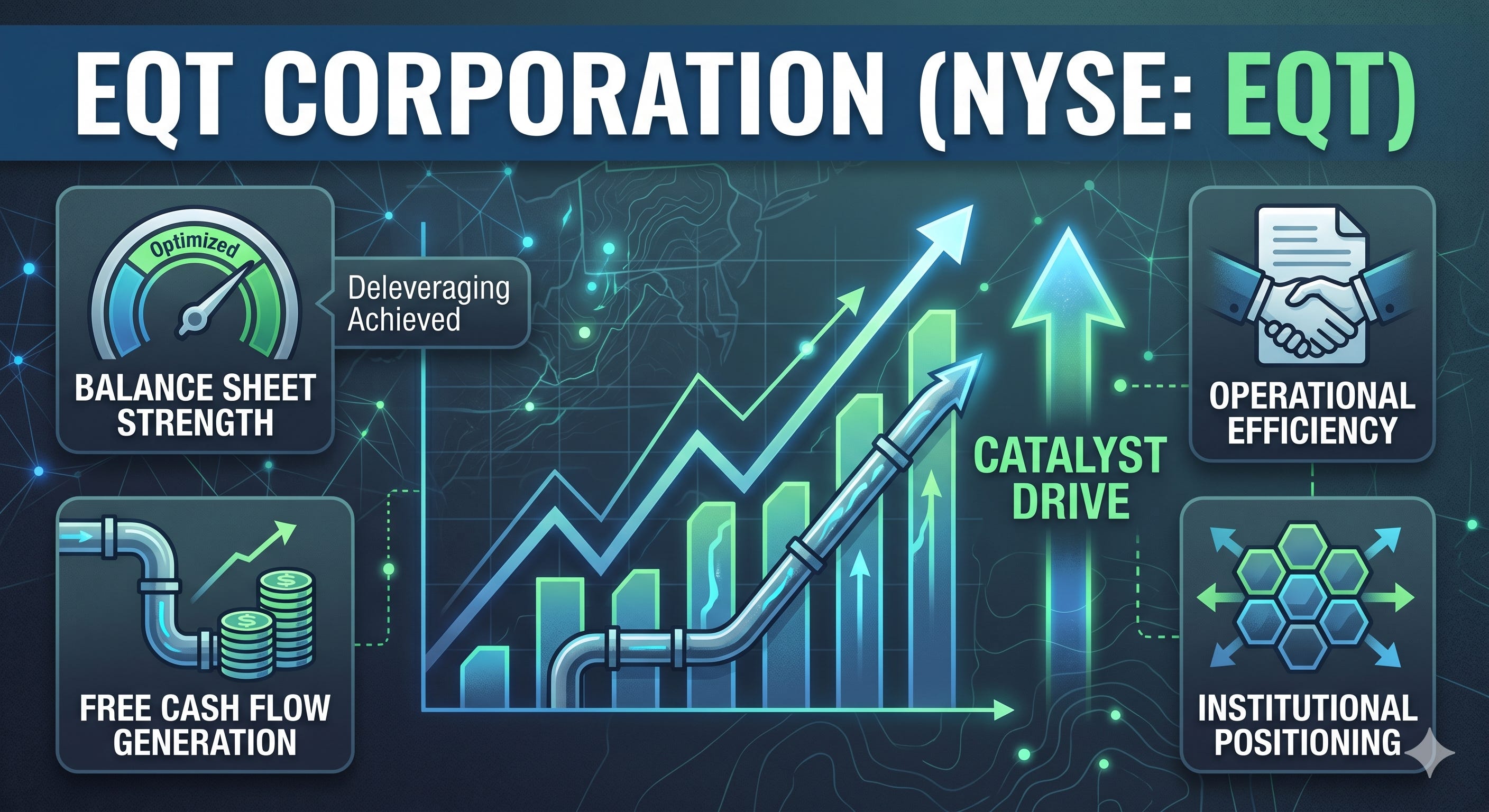
Inside EQT Corp (NYSE: EQT): The Under-the-Radar Shift in Capital Structure
Beyond the headlines: A quantitative dive into the cap table, insider flows, and balance sheet optimization signaling a structural shift for EQT.
QT Corp (NYSE: EQT) | Exchange: NYSE | Closing Price: $56.22 (As of May 15, 2026) | Publication Date: May 17, 2026
Unpacking the deleveraging mechanics, institutional positioning, and free cash flow velocity driving the narrative for America’s largest natural gas producer.
Most market participants spend their time scanning headlines for the next obvious market mover, but the most explosive catalysts are rarely announced in a press release. They are hidden deep within the capital structure and routine governance filings. When you strip away the noise and analyze the raw filings for EQT Corp (NYSE: EQT), a fascinating structural repricing narrative emerges. Here is exactly what the quantitative data reveals about EQT’s current trajectory, and why the mechanics beneath the surface demand a closer look.
Decoding EQT’s Structural Repricing and Capital Efficiency
The fundamental driver of the current narrative is aggressive balance sheet optimization. The data shows a structural repricing actively driven by balance sheet deleveraging.
Net Debt Compression: EQT retired $1.7 billion in senior notes. This specific move successfully reduced their net debt to below the $5.7 billion threshold.
Leverage Ratio Drop: These deleveraging mechanics compressed the company’s leverage ratio to under 1.0x.
Cost of Capital Optimization: Fitch responded to this balance sheet strengthening by upgrading EQT’s corporate debt rating to BBB. This upgrade directly optimizes their Weighted Average Cost of Capital (WACC). Furthermore, it mechanically reduces forward interest expense line items.
Cash Flow Velocity: The Q1 2026 data highlights a massive acceleration, with Free Cash Flow (FCF) generation surpassing $1.8 billion.
Revenue Expansion: Top-line revenue expanded by 94.2% year-over-year, hitting $3.38 billion. This surge was driven by commercial hedging optimizations and premium price realizations. Ultimately, this mechanically expands the available liquidity for the company’s capital return frameworks.
Capital Return Frameworks & Management Stability
With liquidity expanding, the next crucial variable is executive capital allocation.
Operational Focus: The current MD&A does not flag any forced footprint reductions or active C-suite turnover. The focus remains strictly on Appalachian natural gas asset integration and operational deliverability.
Dividends Over Buybacks: EQT’s dividend payout ratio is maintained between 12.5% and 15.3%, which translates to an annual run-rate of $0.66.
Share Count Dynamics: Notably, the latest filing quantifies no immediate aggressive structural share count reduction (buybacks) via a new authorization.
Cap Table Mechanics and Institutional Governance Signals
The capitalization table and recent insider filings provide a clear, objective view of how the “smart money” is positioned.
Insider Execution: A review of Form 4 filings shows zero ‘Open Market’ purchases (Transaction Code P) executed within the trailing 48 hours. The data detects no “cluster buying”. Instead, the flow is heavily weighted toward routine dispositions (Transaction Code S). Notably, an Independent Director sold 4,116 shares at $59.80 on April 29, 2026, alongside EVP liquidations in Q1.
Activist Positioning: A scan for Schedule 13D filings identifies zero active activist positioning. Passive allocations (13G filings) anchor the cap table. Consequently, no activist-driven catalyst timeline or forced governance changes are mechanically in play.
Institutional Holdings: Form 13F data indicates that EQT has 1,133 long-only institutional owners. Note: Form 13F filings strictly reflect long positions and carry a mandatory 45-day reporting lag post-quarter-end.
Disclaimer: This publication is for informational and educational purposes only and does not constitute financial, investment, or legal advice. The information presented is based on an objective review of publicly available data and SEC filings. It is impersonal, not tailored to any individual’s specific financial situation, and should not be interpreted as a recommendation to buy, sell, or hold any security. Always conduct your own due diligence and consult with a licensed financial advisor before making any investment decisions.


