K-Bro Linen Inc. (TSX: KBL): Business Model Analysis
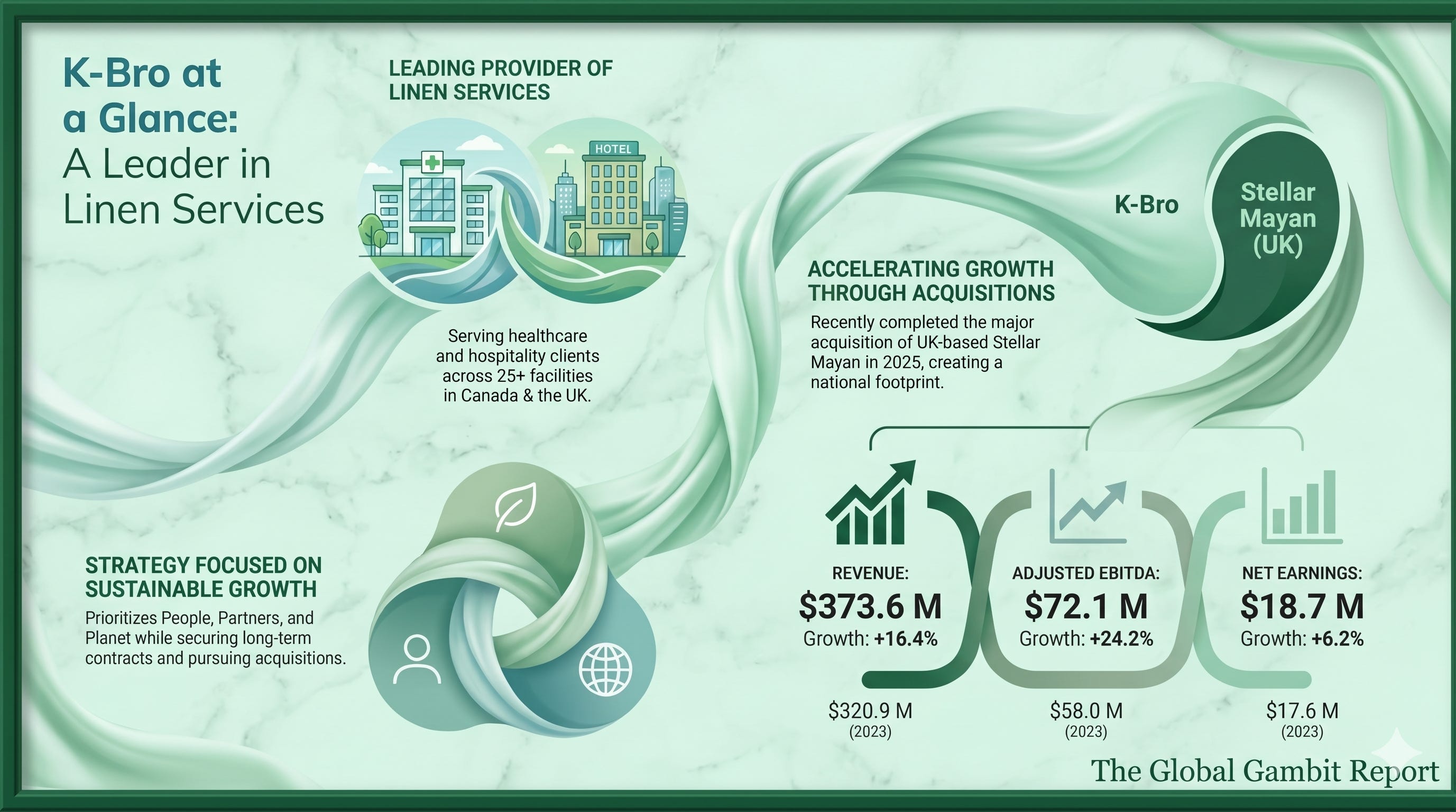
K-Bro Linen at a Glance (The Global Gambit Report)
Research Report Date: May 18, 2026
Company Name: K-Bro Linen Inc.
Ticker & Exchange(s): KBL (TSX)
Stock Closing Price & Date: $39.51 CAD as of May 15, 2026
Structural Integrity and Financial Architecture: K-Bro Linen Inc.
High-conviction equity research often gravitates toward the glamorous, the disruptive, and the technologically unprecedented. Yet, the most resilient compounding engines in the public markets are frequently found in the exact opposite direction: in the unglamorous, capital-intensive, and entirely necessary functions of the physical economy. K-Bro Linen Inc. represents the apex of this archetype. It is a company that has taken a localized, historically fragmented, and fundamentally tedious operational headache—washing and delivering millions of pounds of commercial textiles—and financialized it into a highly predictable, dividend-yielding infrastructure asset.
This report provides an exhaustive, unsparing “Step 1” structural deconstruction of K-Bro Linen’s business model. By systematically tearing down its geographic footprint, contractual underpinnings, cost architecture, and aggressive recent trans-Atlantic mergers and acquisitions (M&A) strategy, the objective is to determine whether the company possesses the deep-rooted competitive moats required to justify intensive, line-by-line financial modeling in Step 2.
1. The Core Money Engine
One-Sentence Money Engine
K-Bro Linen extracts cash from the economy by monopolizing the capital-intensive necessity of washing, managing, and logistics-routing millions of pounds of bedsheets and surgical gowns for institutional clients, effectively transforming their volatile operational headaches into a highly predictable, sticky recurring revenue stream for its shareholders.
Core Activity & Offerings
At its fundamental structural core, K-Bro operates not as a mere service provider, but as a localized infrastructure utility disguised as an industrial washing machine. The company provides a comprehensive, closed-loop suite of laundry and textile rental services, encompassing the processing, inventory management, and daily logistics distribution of general linens, operating room linens, surgical drapes, and hospitality textiles.
To understand the money engine, one must understand the friction it removes. For a major hospital network or a sprawling hotel chain, managing an internal laundry facility is a gross misallocation of capital and executive attention. It requires significant upfront capital expenditure in industrial-scale continuous batch washers and steam boilers. It consumes vast swathes of expensive physical real estate that could otherwise be utilized for revenue-generating patient beds or hotel rooms. Furthermore, it introduces the severe operational friction of managing a highly unionized, blue-collar labor force tasked with handling biologically hazardous materials.
K-Bro completely absorbs this friction. By operating centralized, highly automated processing mega-facilities and leveraging localized route-density logistics, K-Bro delivers clean, sterilized linens on a continuous loop. The client shifts a fixed capital expense into a variable operating expense, paying K-Bro strictly by the pound of linen processed. In exchange, K-Bro captures a recurring revenue stream that is practically immune to technological disruption. Sheets will always need to be washed, and they will always need to be transported physically from point A to point B.
Segment & Geographic Mix
Historically a pure-play Canadian dividend stock, K-Bro has deliberately evolved its geographic footprint into a trans-Atlantic barbell strategy, split between a mature Canadian cash-cow division and a rapidly expanding, M&A-driven United Kingdom growth engine. The scale of this transformation was vividly illustrated in the first quarter of 2026, where the company effectively reached revenue parity between the two continents: the Canadian division generated $69.4 million, while the UK division generated $69.7 million.
The Canadian Division remains the bedrock of the enterprise. K-Bro is the largest owner and operator of laundry and linen processing facilities in Canada. The footprint comprises eleven massive processing facilities and two distribution centers strategically anchored in ten major cities: Québec City, Montréal, Toronto, Regina, Saskatoon, Prince Albert, Edmonton, Calgary, Vancouver, and Victoria. These facilities operate under legacy regional brands such as K-Bro, Buanderie HMR, Paranet, Villeray, and C.M.. In the fiscal year 2025, the Canadian division acted as a phenomenal cash generator, printing $278.8 million in top-line revenue at a highly lucrative 20.6% Adjusted EBITDA margin.
The United Kingdom Division represents the company’s aggressive frontier. Having entered the market in 2017 with the acquisition of Scottish operator Fishers , K-Bro has spent recent years bolting on regional operators. The UK platform now includes the legacy Fishers brand (serving Scotland and the North of England with five sites), the 2024 acquisition Shortridge (based in Cumbria with three sites), and the transformative 2025 acquisition of Stellar Mayan. Stellar Mayan, doing business as Synergy, Grosvenor Contracts, and AeroServe, brought seven operating facilities across England (including Bermondsey, Derby, Dunstable, Sheffield, and Slough) and a Manchester distribution depot. Consequently, the UK division’s annual revenue exploded to $227.9 million in 2025. However, the cost of this rapid expansion is visible in the margin profile: due to the integration friction of Stellar Mayan and a highly competitive local market, the UK division currently operates at a slightly lower 18.1% Adjusted EBITDA margin.
2. Customer Economics & Value Proposition
Target Buyer Persona
The economic buyers of K-Bro’s services are hospital administrators, regional health authority procurement officers, and corporate hotel operators. While they utilize virtually identical services, their underlying decision-making frameworks, psychological drivers, and risk tolerances differ drastically. This dichotomy creates a bifurcated economic profile for K-Bro’s customer base.
The healthcare administrator views linen as an indispensable, mission-critical “must-have.” A modern hospital simply cannot perform surgeries without an uninterrupted supply of sterilized gowns and drapes. For this persona, reliability, stringent infection control standards, and regulatory compliance entirely supersede marginal price sensitivity. The operational risk of a delayed laundry delivery is catastrophic—it means canceled operations, paralyzed emergency rooms, and severe public relations fallout. Therefore, the procurement decision is heavily weighted toward the incumbent provider who has proven they can handle the immense logistical load without failure.
Conversely, the hospitality operator—typically managing hotels with 250 or more rooms—treats linen as a high-volume operational necessity but remains hyper-sensitive to cost and macroeconomic cyclicality. Their core focus is the guest experience and the bottom line. A hotel manager will aggressively negotiate price per pound because their own revenue is inextricably tied to volatile, seasonal occupancy rates. K-Bro serves this persona by offering reliability that prevents housekeeping bottlenecks, but the relationship is inherently more transactional than in the healthcare space.
Switching Costs & Retention
The structural brilliance of K-Bro’s business model does not lie merely in washing textiles, but in the severe contractual lock-in and implementation friction that prevent customer churn. Management views both the healthcare and hospitality sectors as a stable base of annual recurring business, but the contractual mechanisms differ.
Healthcare relationships are formalized through long-term, multi-year contracts typically ranging from three to ten years. The switching costs embedded in these contracts are exceptionally high. For example, in the major urban centers of Edmonton and Calgary, K-Bro operates as the sole significant supplier for the entity managing all major healthcare facilities in the region, a relationship that is contractually locked in until July 31, 2032. In Vancouver, the primary major customer is contractually committed to March 1, 2027, and in the province of Saskatchewan, the major customer is bound until June 1, 2031.
If a regional health authority wishes to switch providers at the end of a contract, they face an almost insurmountable barrier to entry. They must find an alternative vendor capable of instantly processing up to 40 million pounds of healthcare linen per year. In the Canadian market, alternative vendors with that specific volume capacity simply do not exist outside of K-Bro. To fire K-Bro, the health authority would either have to fund the massive CapEx to build an internal centralized laundry facility—directly violating the multi-decade secular trend of government outsourcing —or coax a foreign competitor to build a facility from scratch. Both options require years of planning and immense capital outlay, meaning the path of least resistance is almost always to renew with K-Bro.
Hospitality contracts are shorter, generally ranging from two to five years. The switching costs are lower, but still present. Transitioning a 500-room hotel to a new linen provider involves replacing the entire floating inventory of sheets and towels, retraining housekeeping staff on new collection protocols, and risking early-stage logistical hiccups that directly impact guest satisfaction. Consequently, retention rates remain structurally high across the board.
3. Financial Architecture, Debt & Leverage
Revenue Nature
The nature of K-Bro’s revenue is overwhelmingly recurring, contractually guaranteed, and insulated against sudden technological obsolescence. It is a volume-driven model, billed on a per-pound or per-item basis. Following the transformative acquisition of Stellar Mayan in mid-2025, the company’s revenue mix tilted even further toward the highly defensive healthcare sector. By the first quarter of 2026, approximately 60.9% of K-Bro’s consolidated revenue was generated from healthcare institutions, a substantial increase from the 55.6% recorded in 2025. The remaining roughly 39% of the revenue mix is derived from the more transactional, volume-variable hospitality sector.
The consolidated top-line trajectory has been aggressive. Total annual revenue surged 35.6% from $373.6 million in 2024 to $506.8 million in 2025, primarily fueled by the inorganic additions of Shortridge, C.M., and Stellar Mayan, layered over organic contractual price increases. Moving into 2026, Q1 revenues clocked in at $139.1 million, blowing past analyst forecasts by 11.82% and representing a 52.9% year-over-year jump compared to Q1 2025 ($90.9 million).
Margin Profile
Industrial laundry is a low-margin, high-volume business that relies entirely on operating leverage and scale to generate absolute cash flow. K-Bro’s margin architecture is a testament to disciplined variable cost management.
Over the last five fiscal years, the company has generated a consolidated gross profit margin that reliably oscillates within a narrow, predictable band: peaking at 36.9% in December 2024, dipping to a five-year low of 32.3% in 2022 due to inflationary shocks, and stabilizing at 36.6% in 2025. This stability is driven by the fact that the primary cost inputs are fiercely variable and directly correlated to the volume of linen processed.
At the operating level, the CEO primarily utilizes Earnings Before Interest, Taxes, Depreciation, and Amortization (EBITDA) to assess the performance of the operating segments, as it strips out the heavy depreciation associated with their industrial plants. In 2025, K-Bro generated $90.9 million in EBITDA (a 17.9% margin), up from $69.0 million (18.5% margin) in 2024. When adjusting for transaction costs and transitional friction, the Adjusted EBITDA printed at $98.6 million in 2025, yielding an Adjusted EBITDA margin of 19.5%. This trend continued into Q1 2026, where the company posted a Consolidated Adjusted EBITDA of $22.6 million, an absolute increase of 50.4% year-over-year, though the margin fractionally contracted to 16.2% due to seasonality and the dilutive effect of the UK business mix.
The income statement reveals the true anatomy of this business. The key variable cost drivers consuming the gross margin are:
Wages and Benefits: This is overwhelmingly the largest single line item. In 2025, labor consumed $196.2 million, representing 38.7% of total revenue. The commercial laundry business requires vast armies of semi-skilled workers to sort, load, and manage textiles. Consequently, the margin is highly sensitive to statutory minimum wage legislation across its jurisdictions. The absolute increase in wages from $142.2 million in 2024 to $196.2 million in 2025 was largely a structural consequence of inheriting Stellar Mayan’s cost base.
Linen Expense: K-Bro must continuously purchase new textiles to replace inventory that is stained, torn, or lost in the cycle. This capital replacement cycle consistently eats roughly 9.8% of revenue, totaling $49.9 million in 2025.
Utilities: The industrial washing and drying process is immensely energy-intensive. Natural gas to fire the boilers and electricity to run the plants cost the company $32.2 million in 2025, up from $27.9 million in 2024.
Delivery: The logistics of moving the linen via localized trucking fleets consumed $16.5 million in Q1 2026 alone, up from $11.5 million in the prior year quarter.
The margin profile also highlights a distinct geographic divergence. In 2025, the Canadian Division operated at a superior 20.6% Adjusted EBITDA margin, expanding from 19.1% in 2024. Management explicitly attributed this domestic expansion to hard-won labor efficiencies and the highly beneficial macroeconomic elimination of the Canadian carbon tax in 2025, which immediately reduced utility overheads. Conversely, the UK Division saw its Adjusted EBITDA margin compress from 19.8% down to 18.1%. This contraction reflects the complex integration margin profile of the acquired Stellar Mayan business, alongside the inevitable transition expenses incurred during M&A digestion.
Balance Sheet Leverage & Debt
For a company executing an aggressive, capital-intensive M&A roll-up strategy, K-Bro maintains a surprisingly resilient and conservative capital structure. The company uses leverage surgically rather than structurally depending on cheap credit to survive.
As of the end of the first quarter of 2026 (March 31, 2026), the company’s balance sheet carried an absolute long-term debt load of $226.0 million, alongside a current portion of long-term debt sitting at $9.2 million. Balanced against cash and cash equivalents of $30.8 million, the company’s Net Debt calculated to $204.4 million.
When contextualizing this leverage against the cash-generating capacity of the business, the architecture proves robust. Against a 2025 Adjusted EBITDA of $98.6 million, the Net Debt/EBITDA leverage ratio sits comfortably around a 2.0x to 2.1x multiple. This is an exceptionally lean position for an infrastructure-style asset protected by decade-long municipal health contracts.
Furthermore, the debt maturity profile has been deliberately de-risked to provide management with maximum flexibility. On June 11, 2025, concurrently with the closing of the Stellar Mayan acquisition, K-Bro amended its existing three-year committed Syndicated Credit Facility Agreement. The amendment integrated a $134.3 million four-year amortizing term loan and extended the overarching term of the facility all the way out to June 10, 2029. The facility bears interest at prime or the applicable banker’s acceptance rate, and is collateralized by a general security agreement over the company’s assets. This gives the company nearly three years of clear runway before facing any severe refinancing cliffs, ensuring that the business is not held hostage by short-term credit market freezes.
4. Competitive Benchmarking & Peer Matrix
The Competitor Landscape
The competitive sandbox in which K-Bro operates is inherently dual-natured, reflecting its split geographic strategy. The company is playing two different games on two different continents.
In Canada, the landscape is highly fragmented and relatively unsophisticated. Most Canadian cities possess at least one, and sometimes several, independent, privately-owned laundry facilities operating in the healthcare and hospitality sectors. These are sub-scale “mom-and-pop” operators lacking the capital to invest in modern robotics and automation. The other major contingent of competitors in Canada consists of public sector central laundries—facilities operated directly by government entities—which are historically plagued by bureaucratic inefficiencies and underinvestment. In this environment, K-Bro is the undisputed apex predator. Management views the presence of smaller private operators not as a threat, but as a menu of future acquisition targets waiting to be rolled up.
In the United Kingdom, the market structure is entirely different. The UK commercial laundry and textile rental market is a mature, £1.6 billion sector characterized by consolidated oligopolistic competition. Here, the sandbox is highly crowded with sophisticated, deep-pocketed institutional giants. K-Bro is forced into direct trench warfare with global heavyweights such as Elis SA (a multi-billion dollar French titan), Johnson Service Group PLC, Alsco, and Cintas Corporation.
Peer Comparison
How does K-Bro structurally compare to its main rivals, and why do customers choose them? In the industrial laundry business, the only metrics that ultimately matter are route density and unit processing cost.
Industrial laundry obeys the brutal laws of physical scale. A company that processes 100,000 pounds of linen a week will have a drastically higher per-pound cost of water, natural gas, and chemical detergents than a company processing 1 million pounds a week. Furthermore, the cost of trucking clean linen across a city decreases exponentially when a single truck can hit ten hotels on one street rather than driving across town for a single drop-off.
Customers in Canada choose K-Bro because it possesses unassailable route density and scale that sub-scale competitors cannot match. K-Bro can bid on a massive hospital contract at a price point that would bankrupt a smaller competitor, while still retaining a 20% margin, simply because their automated batch washers are running at maximum capacity 24 hours a day.
In the UK, the peer comparison was historically more challenging, as Fishers and Shortridge were regional players. However, by acquiring Stellar Mayan, K-Bro artificially accelerated its competitive standing to become a “top three national platform”. The combined UK entity now possesses the geographic footprint necessary to bid on massive National Health Service (NHS) trusts and nationwide hotel chains that demand a single, pan-British service provider.
Barriers to Entry
The barriers to entry protecting this business model are almost laughably high. If a well-funded private equity group wished to replicate K-Bro’s business model in Canada tomorrow, they would face insurmountable physical and contractual blockades.
First, the capital intensity is severe. The newcomer would need to deploy hundreds of millions of dollars to acquire industrial real estate in major urban centers, purchase massive fleets of commercial delivery vehicles, import specialized washing equipment from Europe, and float millions of pounds of initial linen inventory.
Second, and more importantly, even if the capital was miraculously deployed, the newcomer would turn on the lights to find they have zero customers. The target volume—the massive regional health authorities—are contractually locked into 10-year exclusive agreements with K-Bro. A newcomer cannot survive on processing linen for local restaurants while waiting for a hospital contract to expire in 2032. The sheer physics of the capital required versus the illiquidity of the customer base makes organic entry virtually impossible.
5. Market Structure & Competitive Moats
Industry Landscape
The overarching secular tailwind driving the commercial laundry space over the next decade is the relentless outsourcing of non-core services by both the public healthcare sector and private hospitality operators. Government health authorities are under constant budgetary pressure and continually seek ways to convert fixed CapEx (buying washing machines and building maintenance facilities) into variable OpEx (paying K-Bro a few cents per pound of linen). In recent years, healthcare institutions across Vancouver, Calgary, Edmonton, Saskatchewan, and Southern Ontario have explicitly elected to divest their internal linen processing capabilities. Once a hospital tears out its laundry facility to build an MRI suite, the decision is functionally irreversible.
The Moat Deep Dive
When evaluating the durability of K-Bro’s competitive advantages over a 5 to 10-year outlook, the moat is exceptionally deep, resting on two unshakeable pillars:
Astronomical Switching Costs: As detailed in the customer economics section, the operational risk profile of healthcare providers dictates immense institutional inertia. Changing a mission-critical sanitation provider carries catastrophic operational risk for a hospital. Unless K-Bro suffers a systemic, multi-month failure in sterilization and delivery, the hospital has zero incentive to endure the agony of an RFP process and transition to a new vendor.
Economies of Density / Cost Advantages: The localized monopoly. K-Bro possesses unreplicable route density in its key urban hubs. Once K-Bro secures the anchor contract for a city’s main hospital, the marginal cost of picking up laundry from a hotel three blocks away drops to near zero. This cost advantage allows them to underbid competitors on hospitality contracts while maintaining superior margins, effectively starving local rivals of oxygen.
Pricing Power
A true test of structural integrity is a company’s ability to raise prices without destroying volume demand. K-Bro exhibits concrete, contractually embedded pricing power that allows it to pass macroeconomic friction down to the customer.
Management is overtly clinical about utilizing this lever. Price increases are systematically implemented and negotiated either at the beginning of the fiscal year or in April. The recent bout of global energy volatility provided a stress test for this mechanism. During an earnings call, when questioned about the impact of spiking natural gas prices on margins, CEO Linda McCurdy offered a blunt confirmation of their pricing leverage:
“We absolutely are telegraphing to our customers that energy is having an impact on the business, and they know that... the increased cost will be reflected in the percent increase we get”.
McCurdy further clarified that these price increases would directly mitigate the margin pressure, reducing what would otherwise be a 1.2% negative impact if the company were forced to re-hedge at unadjusted crisis prices. This is the hallmark of a high-quality infrastructure business: the ability to force the end-user to absorb input inflation.
6. Historical Evolution & Capital Allocation
5-Year Trajectory
Over the last five years, K-Bro has undergone a fundamental structural mutation. It has transitioned from a steady, slow-growing, pure-play Canadian dividend stock into an aggressive, trans-Atlantic roll-up vehicle.
This strategic pivot was initially signaled by the 2017 acquisition of Fishers, which established a beachhead in the UK. However, management stepped heavily on the accelerator in the past 36 months, executing a relentless string of acquisitions:
March 2023: Acquired Buanderie Para-Net (Paranet) in Québec City to consolidate the domestic market.
April 2024: Acquired Shortridge Ltd., a prestigious operator in the North West of England servicing 1,200 hospitality customers, expanding the UK footprint into Cumbria and Dumfries.
June 2025: Executed the absolute apex of their M&A strategy, the transformative £107.2 million (approximately $143.9 million CAD) acquisition of Stellar Mayan.
This M&A binge radically shifted the revenue mix, driving total sales up an incredible 35.6% year-over-year in 2025, and pushing healthcare exposure up to 60.9% of the consolidated book. However, the evolution also introduced inevitable integration friction. The business model became more complex, and the margin profile absorbed a temporary shock. The UK division’s Adjusted EBITDA margins compressed from 19.8% in 2024 to 18.1% in 2025 as K-Bro digested Stellar Mayan’s lower-margin profile and absorbed millions in transaction and transition expenses.
Capital Allocation Track Record
Management’s capital deployment hierarchy is disciplined, highly predictable, and historically successful. The track record reveals a clear prioritization matrix:
Aggressive M&A (The Growth Engine): This is the primary mechanism for top-line expansion. Management utilizes a sophisticated mix of balance sheet debt and public equity markets to fund acquisitions without over-leveraging the core business. To fund the massive Stellar Mayan purchase, K-Bro executed a bought deal equity offering, issuing 2,334,500 common shares at $34.55 per share. This raised $75.6 million in net equity proceeds, demonstrating management’s willingness to accept mild shareholder dilution in exchange for securing dominant national scale.
Shareholder Returns via Dividends (The Yield Anchor): K-Bro operates almost like a synthetic equity-bond, catering to the Canadian institutional appetite for reliable yield. The company boasts an astonishing track record of having maintained consecutive dividend payments for 22 years. It pays a reliable monthly dividend of $0.10 CAD per share ($1.20 annualized), which is designated as an eligible dividend for Canadian tax purposes. Even during periods of intense capital deployment for M&A, the dividend has remained sacrosanct. Share buybacks are utilized, but are secondary; the company noted a modest share repurchase program in the past, but the primary return mechanism is the monthly payout.
Maintenance & Organic Capex (Protecting the Moat): Industrial machinery degrades. Management must constantly reinvest in the physical plant to maintain the routing efficiencies that form the moat. Historically, capital spending hovered around $6.0 to $8.0 million (as guided in 2023). However, following the massive UK expansion, the required run-rate for maintenance has increased. For fiscal 2026, management has guided planned capital spending to be in the range of $20.0 to $22.0 million. This elevated figure includes strategic upgrades to the existing base business in both Canada and the UK, and specifically includes the remaining £5.0 million ($9.3 million CAD) in incremental capital pledged to upgrade the Stellar Mayan facilities post-acquisition.
7. Ownership & Insider Alignment
Insider Skin in the Game
Analyzing the capital table and recent insider transaction history paints a nuanced, slightly cautious picture of internal alignment.
CEO Linda McCurdy retains a highly meaningful stake, directly holding 254,397 shares representing 1.97% of the total outstanding equity, valued at approximately $7.3 million USD. This ensures that the primary architect of the M&A strategy feels the direct consequences of capital misallocation.
However, the broader insider activity over the back half of 2024 and throughout 2025 exhibits a distinct pattern of liquidity events. Several senior officers and executives executed multiple tranches of stock sales in the open market:
Sean Curtis (Senior Officer): Sold 7,000 shares in December 2024 for roughly $262k CAD, followed by another sale of 2,802 shares for $97k CAD.
Ryo Utahara (VP of People & Partnerships): Executed multiple sales in mid-to-late 2025, including a sale of 1,200 shares in December 2025 ($30k USD) and 650 shares in June 2025 ($16k USD).
Scott Inglis: Sold 3,191 shares in December 2025 ($81k USD).
Jeffrey Gannon (General Manager): Sold 700 shares in September 2025 for roughly $18k USD.
While these individual sales are not massive in absolute dollar terms, the cluster of selling among mid-level lieutenants and operational managers suggests a natural taking-of-chips off the table. This is frequently observed following the equity run-up associated with a major integration like Stellar Mayan. Crucially, there has been an absence of significant open-market cluster buying (Transaction Code P) by directors to offset this selling pressure. It is not a glaring red flag, but it indicates that insiders view the stock as fully valued rather than deeply discounted.
Institutional & Activist Footprint
The institutional base is heavily concentrated in passive, yield-hungry, long-only asset managers, reflecting the company’s status as a low-beta (0.49), steady-cash-flow dividend payer.
The apex shareholder is RBC Global Asset Management Inc., which controls a dominant 8.26% stake (1,065,564 shares). They are followed by Beutel Goodman & Company Ltd. at 4.65% (599,829 shares) and IG Investment Management at 2.27%. In total, the top 25 shareholders own 28.9% of the company, while the general public (retail investors seeking monthly income) holds a vast 70.7% of the float.
This specific shareholder composition provides management with immense operational breathing room. Long-only dividend funds rarely agitate for sudden strategic overhauls. Consequently, there is absolutely no footprint of aggressive Schedule 13D catalyst-driven activist funds in the capital structure. Management is free to execute its 12-to-24 month synergy integration plans without the distraction of proxy battles or demands for special dividends.
8. Cyclicality & Model Fragilities
Cyclicality Exposure
The business model is distinctly asymmetric in its vulnerability to macroeconomic cycles, driven entirely by the divergence in its end-markets.
The healthcare segment (61% of revenues) is a magnificent defensive asset, functionally hermetically sealed against recessions. Municipalities do not stop conducting surgeries, and patients do not stop requiring sterile hospital beds simply because GDP growth turns negative. This segment guarantees that K-Bro will never suffer a zero-revenue environment.
However, the hospitality segment (roughly 39% of revenues) is acutely cyclical and entirely exposed to consumer discretionary spending. The fragility here is a matter of operational leverage. When hotel occupancy rates collapse—as witnessed globally during the pandemic-era travel freezes—the poundage of linen required by the hospitality sector plummets instantly. K-Bro is left holding the bag on the fixed overhead costs of running the processing plants (mortgages, base utilities, equipment depreciation) while the variable revenue evaporates.
Structural Risks
Beyond the cyclical nature of hospitality demand, a clinical analysis of the operational reality reveals three distinct structural fragilities inherent to how the business is built:
Labor Cost Inflation & Availability: Operating massive commercial laundries is not glamorous work; it requires vast amounts of human capital performing repetitive, physically demanding tasks in hot, humid environments. Wages and benefits are the company’s largest expense, consuming nearly 40% of revenue. As a result, the company is directly and severely exposed to statutory minimum wage hikes. Management routinely flags “changes or proposed changes to minimum wage laws in Ontario, British Columbia, Alberta, Quebec, Saskatchewan and the UK,” alongside general “availability and access to labour,” as critical risk factors. If labor markets tighten, K-Bro is forced to raise wages to prevent staff from fleeing to easier retail jobs, immediately compressing the EBITDA margin.
Energy Input Vulnerability & Margin Lag: Industrial washing machines and dryers consume monumental amounts of natural gas and electricity. While management successfully leverages contracts to pass these costs onto clients, there is a temporal lag. Price adjustments are typically negotiated annually. If geopolitical instability triggers a sudden, violent spike in natural gas prices mid-year, K-Bro must eat the margin compression until the next contractual reset window. Furthermore, as an energy-intensive business, they are highly exposed to the whims of environmental legislation. The fact that the 2025 Canadian EBITDA margin expansion was partially attributed to the “elimination of the Canadian carbon tax” proves just how sensitive the bottom line is to regulatory energy pricing. If a new government reinstates aggressive carbon pricing, the margin will take a direct hit.
Integration Indigestion & Execution Risk: K-Bro is now heavily reliant on acquisition-driven expansion. The UK division’s EBITDA margin drop in 2025 vividly exposes the execution risk of bolting on massive, complex entities like Stellar Mayan. Analysts have noted that this reliance “increases integration and execution risk if future deals are smaller or less efficient”. Management expects to realize run-rate cost synergies from Stellar Mayan over a 12 to 24-month horizon. Failure to extract these synergies—whether due to incompatible IT systems, cultural clashes, or misjudged facility redundancies—will result in permanently degraded returns on invested capital and a failure to justify the $75.6 million equity dilution forced upon shareholders.
5-Point Investor Pass/Fail Scorecard
1. Core Structural Strength: PASS
The foundational mechanics of the business are flawless. The company enjoys a regional monopoly-like dominance in the Canadian healthcare sector, fortified by decade-long exclusive contracts and unreplicable localized route density. The physical capital required to displace them renders organic disruption functionally impossible.
2. Critical Dependency: WATCH
K-Bro is fundamentally and entirely dependent on the continued willingness of government health authorities to outsource their logistics. While the multi-decade secular trend heavily favors privatization of non-core services, any populist or union-driven political reversal that attempts to bring blue-collar labor back in-house within the public sector would instantly decapitate K-Bro’s Canadian growth trajectory.
3. Top Secular Growth Driver: PASS
The aggressive M&A roll-up strategy executed in the £1.6 billion UK market has been a masterclass in capital deployment. By systematically acquiring Fishers, Shortridge, and ultimately Stellar Mayan, management has successfully elevated K-Bro to a top-three national player in a mature foreign market, effectively diversifying cash flows away from pure Canadian dependency.
4. Primary Red Flag/Risk (Including Leverage/Competition): WATCH
Labor and energy input inflation remain permanent, existential threats to the pristine 19.5% Adjusted EBITDA margin. While the balance sheet is highly resilient at ~2.1x Net Debt/EBITDA, the ongoing trench warfare with massive European peers like Elis SA in the UK market, combined with the recent rash of insider selling by mid-level executives, warrants mild caution regarding near-term valuation ceilings.
5. The Ultimate Unknown (The key question to answer in Step 2):
Will the United Kingdom margin permanently and structurally compress? Step 2 financial modeling must definitively prove whether the 2025 margin erosion in the UK division (dropping from 19.8% down to 18.1%) is merely temporary integration static as Stellar Mayan is digested, or if competing against institutional heavyweights in a crowded oligopoly intrinsically requires accepting a lower structural profitability ceiling than the monopolistic Canadian division enjoys.
Important Disclosures & Legal Mandate
Personal Interest Disclosure: Specific position disclosures (Long/Short/None) and trading intent for any securities discussed are located exclusively in the Mandatory Disclosure header at the beginning of each individual research report. This automated footer provides the general legal and compliance framework for The Global Gambit.
1. No Financial Advice: All content published by The Global Gambit is for educational and informational purposes only. The author is not a registered financial advisor, and this report does not constitute a recommendation to buy, sell, or hold any security. The research provided represents personal opinion and probabilistic modeling, not tailored investment advice.
2. Suitability & Risk: Investments in equities and derivatives (options) involve a high degree of risk and the potential for permanent capital loss. The strategies discussed—including the use of leverage and 6-month time horizons—may not be suitable for all investors. Readers are urged to consult with a qualified financial professional before making any investment decisions.
3. Data Integrity & Projections: While data is sourced directly from regulatory filings (EDGAR, SEDAR+, SEDI), no guarantee is made regarding the accuracy of third-party information. “Bull,” “Base,” and “Bear” cases are hypothetical projections based on current data and are not guarantees of future performance.
4. No Fiduciary Relationship: Subscription to The Global Gambit does not create a client-advisor or fiduciary relationship. The author reserves the right to discontinue coverage or rotate capital out of any mentioned security at any time without prior notice.
5. Limitation on Updates: The author reserves the right to determine which articles or positions are updated and the frequency of those updates.
6. Forward-Looking Statements: All price targets and projections are forward-looking predictions based on current data and are not guarantees of future performance.
7. To provide deep and timely market insights, this publication uses artificial intelligence to help aggregate and analyze regulatory filings and data. AI models can occasionally misinterpret information or introduce errors. Always perform your own due diligence.
8. Intellectual Property & Copyright: © 2026 The Global Gambit. All rights reserved. No part of this report may be redistributed or reproduced without express written consent. Unauthorized redistribution of paid content is strictly prohibited.


