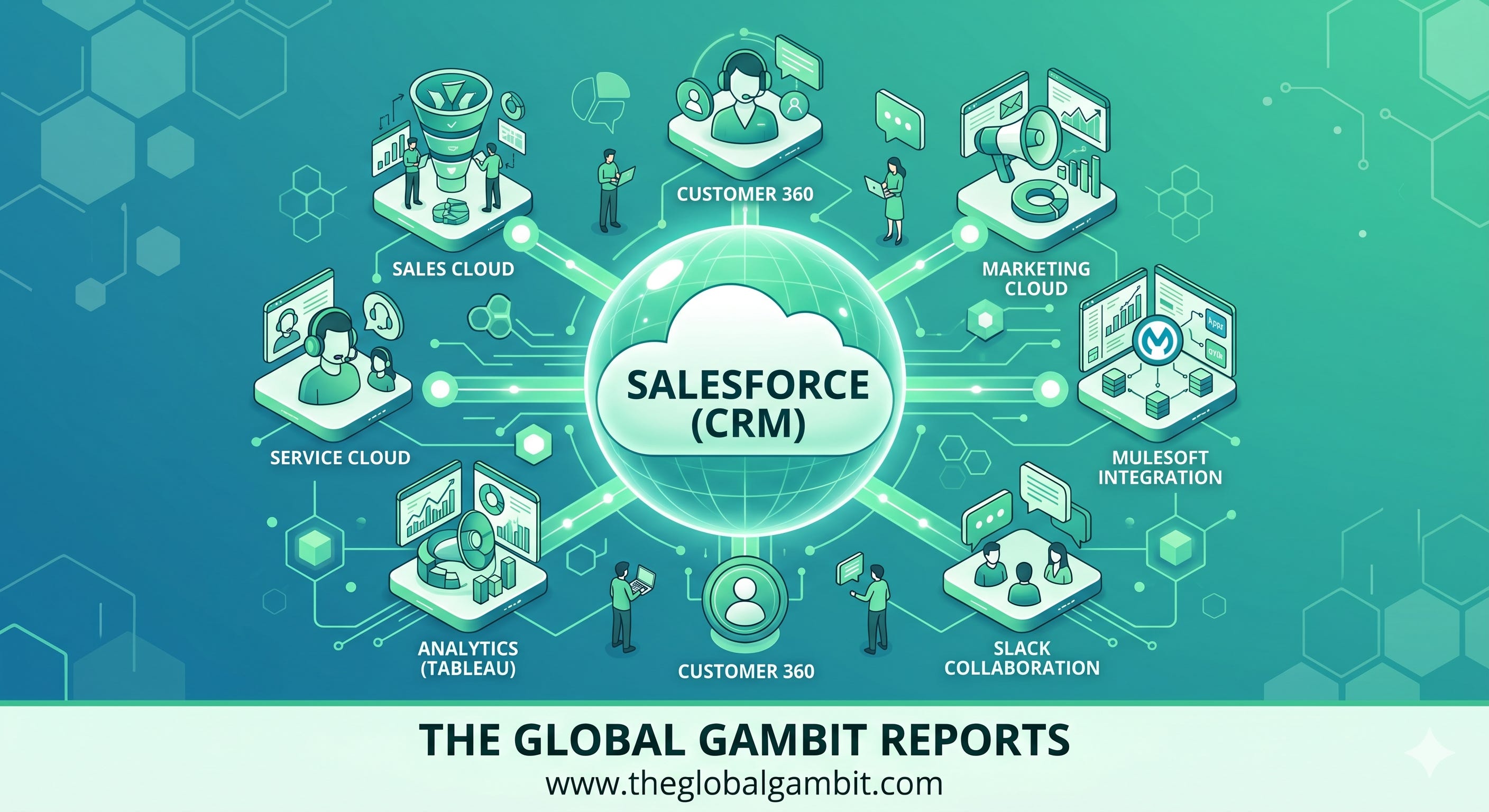
Salesforce Valuation: AI Agents, SaaSpocalypse, and the Future of CRM Software
Salesforce Stock Analysis: Navigating the 2026 Enterprise SaaSpocalypse
Salesforce Inc, Ticker: CRM, Exchange: NYSE Stock
Closing Price: $179.08 (As of market close May 26, 2026)
Date: May 27, 2026
Disclaimer: This report is for informational and educational purposes only and does not constitute financial, investment, or legal advice. All investments involve risk, and past performance is not a guarantee of future results. Please consult with a qualified financial advisor before making any investment decisions.
The enterprise software sector is currently navigating one of the most violent structural realignments in its history. Throughout early 2026, the market has rapidly priced in a scenario often referred to as the “SaaSpocalypse”—a thesis suggesting that the emergence of autonomous AI agents will permanently compress enterprise software seat counts, structurally impairing the revenue models of incumbent Software-as-a-Service (SaaS) providers. Between January and February 2026 alone, the broader software sector lost approximately $2 trillion in market capitalization as capital rotated heavily into AI infrastructure and semiconductor equities.
At the epicenter of this market dislocation is Salesforce Inc. (NYSE: CRM), the global leader in Customer Relationship Management (CRM) software. Trading at approximately $180.07 per share with a market capitalization of $147.31 billion, the company’s equity has suffered severe multiple compression, retreating sharply from its 52-week high of $280.74. The prevailing market narrative dictates that Salesforce, historically reliant on a per-user licensing model, is highly vulnerable to AI-driven seat contraction.
This comprehensive analysis evaluates the underlying mechanisms of this transition. By reverse-engineering the current stock price, quantifying the formidable enterprise switching costs, analyzing the evolution of the company’s AI monetization strategy through “Agentforce,” and projecting the 10-year outlook, the data reveals a profound dislocation between the market’s apocalyptic pricing and Salesforce’s underlying cash-flow generating capabilities.
The Macro Environment: Assessing the Risk of Salesforce Seat-Count Contraction
To understand the market’s pessimistic pricing of Salesforce, one must thoroughly examine the existential threat facing the traditional SaaS economic model. For over two decades, the valuation of enterprise software companies has been predicated on linear scaling: as a client organization grows, it hires more employees, thereby requiring more software licenses or “seats.” Wall Street rewarded this predictable, compounding Annual Recurring Revenue (ARR) with premium valuation multiples.
The advent of autonomous AI agents fundamentally severs this correlation. Modern AI agents are no longer reactive chatbots that require continuous human prompting; they are sophisticated reasoning engines capable of executing complex, multi-step workflows across disparate enterprise systems. When an AI agent can autonomously retrieve data, construct an action plan, and execute it without human intervention, the foundational unit of SaaS—the user seat—becomes an economic liability for the vendor.
The mathematics of this compression are severe. Industry models indicate that 10 autonomous AI agents can handle the workload of 50 to 100 human Sales Development Representatives (SDRs) or Customer Support specialists. A standard enterprise outbound sales team of 100 human SDRs historically required over 500 interconnected SaaS seats across various tools, generating $8 million to $10 million in annual software and payroll expenditures. If an enterprise achieves a 3x productivity gain by deploying AI agents, it can theoretically reduce its human seat count by 66%.
This creates a distinct “value paradox” for incumbent software vendors: the more efficient their AI features become at automating client workflows, the fewer human employees the client needs, leading directly to seat cancellations and revenue contraction for the software provider. Investors fear that Salesforce, which operates as the central nervous system for millions of sales and service professionals globally, will see its core CRM seat revenue evaporate as enterprises consolidate their human workforces.
Quantitative Valuation: Measuring the Multiple Compression
The fear of this structural decline has triggered a violent repricing of Salesforce’s equity. As of late May 2026, Salesforce trades at a trailing price-to-earnings (P/E) ratio of 22.94 to 23.09, representing a 35% decrease compared to the average of 35.0 over the previous four quarters.
However, equity markets are forward-looking, and the forward valuation metrics expose the true depth of the market’s skepticism. Salesforce is currently trading at a forward 12-month P/E ratio of approximately 11.9x to 13.7x. This implies that the market is valuing the world’s leading CRM platform at roughly three-fourths the multiple of its Internet-Software industry peers, which average an 18.0x forward multiple.
The following table illustrates the historical contraction of Salesforce’s valuation multiples alongside its earnings per share (EPS) growth:
Data synthesized from historical pricing and forward estimates across market data providers.
When benchmarked against its direct enterprise software peers, Salesforce’s multiple compression aligns with a broader industry sell-off. Competitors such as Adobe (10.8x forward P/E), Workday (11.5x), and Pegasystems (11.8x) share similarly depressed valuations, while broader technology platforms like Intuit (16.1x) and S&P Global (21.4x) have maintained higher premiums.
Despite this severe multiple compression, Salesforce’s underlying financial engine continues to operate at record efficiency. For the full Fiscal Year 2026 (ended January 31, 2026), the company reported revenue of $41.5 billion (up 10% year-over-year) and achieved a record non-GAAP operating margin of 34.1%. Operating cash flow reached $15.0 billion, and free cash flow hit $14.4 billion, representing a massive 34.7% free cash flow margin. Simply Wall St’s proprietary discounted cash flow (DCF) models suggest a fair intrinsic value of $349.29 per share, indicating that the stock is trading at an approximate 48.7% undervaluation discount relative to its cash generation. Alternative DCF models place the fair value at $282.43, still representing a 36% discount to the current market price.
Reverse DCF Analysis: What Growth Rate is the Market Pricing In?
Traditional valuation models rely on forecasting a company’s future cash flows to arrive at a target price. However, in periods of extreme market dislocation, a Reverse Discounted Cash Flow (DCF) model is a far more effective analytical tool. A Reverse DCF inverts the standard equation: it begins with the current market price ($180.07) and solves for the specific growth rate that is implicitly embedded in that valuation. This removes the analyst’s bias and forces a direct confrontation with the aggregate market’s consensus.
To justify the current $180.07 share price, one must evaluate the cash flows. Salesforce generated $14.4 billion in free cash flow in FY26 and has guided for operating cash flow growth of 9% to 10% for FY27. Assuming a standard cost of equity (or WACC) of 8.5% to 9.5%—which is typical for a mature, large-cap software entity with a fortress balance sheet—and maintaining a conservative terminal multiple, reverse-engineering the share price reveals that the market is pricing in a terminal free cash flow growth rate of approximately 2% to 4% over the next decade.
The implications of this implied growth rate highlight a massive disconnect between market sentiment and corporate reality. To believe the stock is fairly valued today, an investor must assume that Salesforce’s growth will effectively stall within the next 24 to 36 months. This directly contradicts the company’s official guidance. Management has forecast FY27 revenue of $45.8 billion to $46.2 billion, representing 10% to 11% top-line growth, with EPS expected to reach $7.85 to $7.93. Furthermore, consensus analyst estimates project that revenue will grow by 8.9% annually, reaching $55.56 billion by FY29, while earnings are forecast to grow by 10.7% annually.
The following table outlines the consensus analyst projections that directly contradict the market’s implied 2-4% growth rate:
Data derived from consensus analyst estimates.
By pricing the stock at 11.9x forward earnings, the market is explicitly rejecting these forecasts. The equity pricing reflects a “priced for perfection on the downside” scenario. It assumes that the proliferation of AI agents will cause seat-count contraction to accelerate faster than Salesforce can invent and deploy new monetization models, resulting in structural revenue stagnation.
Evaluating the Salesforce Economic Moat: CRM Switching Costs and Attrition Rates
The bearish thesis that AI agents will easily commoditize and replace Salesforce fundamentally misunderstands the depth of the company’s economic moat. This moat is not built solely on superior software features, but rather on the immense financial, operational, and technical friction involved in migrating away from the platform.
Over the past 25 years, Salesforce has captured 20.7% of the global CRM market, generating $21.6 billion in CRM-specific revenue in 2024, far outpacing its nearest competitors like Microsoft Dynamics (~5.2%), Oracle (~4.4%), and SAP (~3.5%). As organizations deploy Salesforce, they inevitably customize it. Over years of operation, a standard enterprise instance accumulates complex validation rules, Process Builder flows, Apex code triggers, custom objects, and intricate permission sets. The CRM becomes deeply entangled with the company’s enterprise resource planning (ERP) systems, marketing automation, and financial billing software.
Ripping out this infrastructure is a hazardous undertaking. The quantitative data regarding CRM migrations is sobering. For a mid-market organization, switching CRMs can result in $2.5 million to $5.0 million in lost revenue opportunities during the transition period due to operational downtime, data reconciliation failures, and rep retraining. Even for a small, 15-person sales team, the true cost of migrating away from Salesforce is staggering.
The table below provides a granular breakdown of the hidden costs associated with a small-scale CRM migration:
Estimates based on a 15-person sales team transitioning off Enterprise tier.
When faced with a $90,000 migration bill and a 47% statistical probability that the migration project will miss its initial timeline and budget targets, enterprise CFOs generally opt to maintain the status quo. The calculation is heavily skewed toward retention: an organization will typically absorb annual vendor price increases of 10% to 15% rather than endure the operational trauma of a system overhaul.
This deep operational lock-in is explicitly visible in Salesforce’s financial filings. As of January 31, 2026, the company’s enterprise attrition rate (excluding Slack self-service and recent acquisitions) was approximately 8.0%. Maintaining a 92% gross retention rate at a $41.5 billion revenue scale is a testament to the structural stickiness of the platform. The argument that a generic AI startup can easily disrupt Salesforce ignores the reality that an unusable or disrupted CRM is an enterprise-killing event; companies do not gamble their core revenue pipelines on unproven migration paths.
Salesforce Data Cloud Architecture: Securing AI Accuracy via Metadata Lock-In
While the market fears that AI agents will disrupt Salesforce’s moat, a deeper technical analysis suggests that the AI revolution is actually cementing the platform further into the enterprise stack. The critical factor is data architecture—specifically, the reliance of AI agents on structured metadata.
Autonomous AI agents possess a critical vulnerability: they hallucinate without perfect contextual awareness. A Large Language Model (LLM) processing raw enterprise data cannot inherently differentiate between a finalized, high-value enterprise contract and a draft document, or between an active client and a churned prospect. The AI requires metadata—data that describes the layout, behavior, relationships, and access permissions of the underlying information.
Salesforce recognized this architectural necessity and repositioned its entire platform around the “Data Cloud” (formerly a Customer Data Platform, or CDP). Data Cloud serves as the unified orchestration layer for enterprise data and metadata. Utilizing an open Lakehouse architecture built on Apache Iceberg, Data Cloud enables “Zero-Copy” integration. This allows Salesforce to query massive volumes of structured and unstructured data residing in external cloud environments (such as Snowflake, AWS, or Google Cloud) in real-time, without the costly and latent process of physically copying or moving that data into Salesforce.
The scale of this operation is immense. In Fiscal 2026, Data Cloud ingested an astonishing 112 trillion records, representing a 114% year-over-year increase. More tellingly, 53 trillion of those records were processed via Zero-Copy architectures, a 310% year-over-year explosion in volume. The Data Cloud now manages over 4 million Iceberg tables and 50 petabytes of data, providing the foundational “landing zone” where AI agents can safely operate within strict enterprise compliance guardrails.
This metadata architecture radically alters the switching cost dynamic. If an enterprise attempts to abandon Salesforce to build its own AI agents or utilize a cheaper third-party wrapper, it loses the intricate metadata relationships and the real-time Zero-Copy infrastructure that makes the AI functional. Because the AI is only as intelligent as the data it accesses, decoupling from Salesforce’s Data Cloud introduces massive security and hallucination risks. Therefore, rather than commoditizing the CRM, the shift toward AI is transforming Salesforce from a front-office application into an irreplaceable data orchestration engine.
Salesforce Agentforce Pricing Strategy: Consumption vs. Subscription SaaS Models
Despite the strength of its moat, Salesforce still faces the reality of seat-count contraction. If AI agents do the work of humans, human seats will inevitably decline. To survive, Salesforce had to invent a new monetization mechanism that captures value from digital labor rather than human presence. This effort crystallized in the launch of Agentforce, a suite of autonomous AI agents powered by the proprietary Atlas Reasoning Engine.
However, transitioning a massive, legacy SaaS customer base to consumption-based pricing proved highly volatile. Between late 2024 and early 2026, Salesforce’s Agentforce pricing underwent a whiplash-inducing metamorphosis to align with enterprise buyer psychology.
Phase 1: The Per-Conversation Misstep (Late 2024)
At its official launch in late 2024, Salesforce priced Agentforce at a flat rate of $2.00 per conversation. This model generated immediate and severe backlash from the ecosystem. Enterprise procurement teams viewed the uncapped, usage-based fee as a “blank check.” A standard support team handling thousands of daily inquiries faced the prospect of astronomical and unpredictable monthly bills. Furthermore, the $2.00 fee was charged regardless of whether the AI successfully resolved a complex issue or failed after a single prompt, misaligning cost with actual business value. Competitors like Intercom capitalized on this, offering AI resolution bots for $0.99 only when a case was verifiably solved. Consequently, Agentforce adoption initially stalled, with only roughly 8,000 of Salesforce’s 150,000+ customers adopting the tool by mid-2025.
Phase 2: Flex Credits and Micro-Actions (Mid-2025)
Recognizing the friction, Salesforce executed a total pricing overhaul in May 2025, shifting to an action-based, granular consumption model called “Flex Credits”. Under this model, customers purchase blocks of 100,000 credits for $500. A single AI “action”—such as retrieving a record, drafting a summary, or sending an email—consumes 20 Flex Credits, mathematically equating to $0.10 per action.
This pivot solved the value paradox. Trivial interactions now cost mere cents, while complex, highly valuable workflows scale proportionately. To ease budget anxiety, Salesforce introduced the “Flex Agreement,” allowing enterprises to dynamically swap unused human seat licenses for AI Flex Credits, creating a fluid transition path as digital labor scales.
Phase 3: The Settled Hybrid Enterprise Model (Early 2026)
By early 2026, Salesforce finalized a sophisticated hybrid model that balanced the unpredictable nature of external customer interactions with the rigid budgeting requirements of internal IT departments.
The current Agentforce pricing architecture is segmented into two distinct tracks:
Data compiled from official Salesforce Agentforce pricing documentation.
This hybrid model successfully decoupled Salesforce’s revenue from pure headcount. The strategy is working remarkably well. By Q4 FY26, Agentforce achieved $800 million in Annual Recurring Revenue (ARR), up 169% year-over-year. Total AI-related recurring revenue, inclusive of Data Cloud, surpassed $2.9 billion, growing over 200% year-over-year. Most importantly, the platform delivered 2.4 billion Agentic Work Units (AWUs)—Salesforce’s metric for tasks accomplished by an AI agent—proving that the shift from human seats to digital labor is successfully translating into a highly scalable, utility-like revenue stream.
Enterprise Software Competition: Salesforce vs. Microsoft and ServiceNow
As the software paradigm shifts from workflow automation to AI orchestration, the competitive landscape has evolved. Salesforce’s primary adversaries are no longer legacy ERP systems, but the AI platforms of Microsoft and ServiceNow.
Microsoft poses the most significant horizontal threat with its Copilot Studio. Bundled into the ubiquitous Microsoft 365 and Azure ecosystems, Copilot provides immense value for personal productivity—drafting emails, summarizing Teams meetings, and generating presentations. However, real-world deployment data indicates that while base pricing starts at $30 per user, actual enterprise utilization can cause compute and orchestration costs to spike drastically. Furthermore, Microsoft’s AI excels at unstructured data creation but requires complex integrations to trigger downstream operational workflows.
ServiceNow approaches the market from the back office. Its “Now Assist” AI agents are highly optimized for IT service management, automating ticket categorization, internal routing, and operational overhead. ServiceNow utilizes its proprietary Now LLM, ensuring strict data privacy and governance for sensitive internal workflows.
Salesforce differentiates itself through its deep roots as a System of Record for the front office. Agentforce agents do not merely generate content; they take autonomous action directly against live customer profiles. For example, the newly introduced “Agentforce for Revenue” autonomously generates highly complex quotes, pulling correct pricing, discounts, and terms directly from the CRM in seconds. Because Agentforce operates natively where the customer data resides, it minimizes the latency, data transfer costs, and security risks associated with bridging third-party AI agents into a separate CRM via APIs. The market is rapidly stratifying: Microsoft will command personal productivity, ServiceNow will govern IT operations, and Salesforce will dominate customer lifecycle operations.
Margin Expansion and Buybacks: Salesforce Capital Allocation Strategies
While navigating this existential technological pivot, Salesforce’s executive team, led by CEO Marc Benioff, has executed a masterclass in financial engineering to support the equity price and reward shareholders. Historically, Salesforce operated under a “growth-at-all-costs” philosophy, characterized by massive marketing expenditures and aggressive, stock-funded acquisitions. Over the past three years, under immense pressure from activist investors, the company has ruthlessly pivoted toward capital efficiency.
This operational discipline has yielded staggering results. The company’s non-GAAP operating margin expanded from the mid-20s just a few years ago to a record 34.1% for the full fiscal year 2026. This margin expansion was achieved alongside a major reduction in workforce—including a 10% cut in early 2023 and another ~1,000 AI-related job cuts in February 2026—as the company utilizes its own AI tools to reduce internal quoting time by 75%.
The resulting cash flow has been aggressively deployed to establish a synthetic floor under the stock’s Earnings Per Share (EPS). In early 2026, the Board of Directors authorized a record $50 billion share repurchase program, replacing all prior unused authorizations. Simultaneously, the company increased its quarterly dividend by 5.8% to $0.44 per share, offering a yield of approximately 0.98%.
The scale of this buyback cannot be overstated. With approximately 940 million basic shares outstanding and a market capitalization of $147.3 billion, a $50 billion repurchase authorization gives management the capacity to retire over 30% of the company’s outstanding float at current, depressed valuations. In the trailing 12 months alone, Salesforce returned $14.3 billion to shareholders ($12.7 billion in buybacks and $1.6 billion in dividends) entirely funded by its $15.0 billion in operating cash flow.
Even if the bearish “SaaSpocalypse” scenario plays out and top-line revenue growth stalls to the low single digits, the massive reduction in the share denominator virtually guarantees sustained, double-digit EPS expansion for the foreseeable future. This dynamic directly counteracts the 2-4% implied growth rate priced into the stock by the reverse DCF model.
The Agentic Enterprise: A 10-Year Strategic Outlook for Salesforce (2026–2036)
Looking ahead to the next decade, Salesforce’s trajectory hinges on its successful transition from a legacy CRM application provider to the foundational operating system for the “Agentic Enterprise.” Management has outlined highly ambitious financial targets, projecting that total revenue will reach $60 billion by 2030.
To bridge the gap from $41.5 billion in FY26 to $60 billion in FY30, Salesforce must maintain a Compound Annual Growth Rate (CAGR) of approximately 10%. This perfectly aligns with the company’s immediate FY27 revenue guidance of 10% to 11% growth ($45.8B to $46.2B). The structural mechanisms required to sustain this growth over a 10-year horizon are robust and highly visible.
First, the consumption of Flex Credits via Agentforce will create a compounding, utility-like revenue stream that mirrors cloud computing giants like AWS or Azure. As the adoption of Agentic Work Units (AWUs) scales—growing from 2.4 billion in early 2026 to potentially hundreds of billions by 2030—this usage-based revenue will seamlessly offset the inevitable attrition in human user seats. The enterprise software model will fundamentally shift from licensing human capacity to metered digital output.
Second, the strategic acquisition of Informatica, expected to integrate fully in the coming quarters, deepens Salesforce’s capabilities in AI-powered Master Data Management (MDM) and Extract, Transform, Load (ETL) processes. Combined with the Zero-Copy architecture of the Data Cloud, Salesforce is positioning itself not just to manage customer relationships, but to serve as the unified data fabric for the entire enterprise.
Third, the company’s margin profile possesses long-term durability. As AI continues to streamline software development (via internal coding agents) and automate outbound sales functions, Salesforce’s internal Research & Development (R&D) and Sales & Marketing (S&M) expenses as a percentage of revenue will organically compress. This operational leverage provides a clear pathway for free cash flow margins to breach the 35% to 38% threshold in the coming years, throwing off massive amounts of cash for continued shareholder returns.
By 2036, the concept of a standalone “CRM application” accessed via a web browser will likely be obsolete. Instead, Salesforce will operate invisibly as an orchestration engine, governing thousands of specialized AI agents working autonomously across the enterprise. The economic moat will have fully transitioned from custom code and workflow familiarity to absolute data and metadata governance. Organizations will remain tethered to the Salesforce ecosystem because replicating the intricate metadata mapping that allows their autonomous agents to operate safely and without hallucination will be computationally and financially unfeasible outside the Data Cloud environment.
Conclusion: Market Mispricing and the Ultimate Bull Case for Salesforce Equity
The current market pricing of Salesforce Inc. reflects a profound miscalculation regarding the impact of Artificial Intelligence on enterprise software. Driven by the macroeconomic panic of the “SaaSpocalypse,” equity markets have compressed Salesforce’s forward P/E multiple to a highly distressed 11.9x to 13.7x, implicitly projecting a terminal decline in the core business and an implied growth rate of a mere 2% to 4%.
However, deep quantitative and qualitative analysis demonstrates that the existential threat to seat-based software models is actively being neutralized. The transition from the flawed $2.00/conversation model to the highly granular, consumption-based Flex Credit system has successfully aligned Salesforce’s monetization with enterprise value. This pivot has already catalyzed explosive adoption, driving Agentforce ARR to $800 million and pushing total AI-related recurring revenue past $2.9 billion.
Furthermore, the assumption that AI commoditizes the CRM moat ignores the structural realities of enterprise software. Through Data Cloud’s Zero-Copy architecture and Apache Iceberg integrations, Salesforce has effectively weaponized its customers’ data gravity. The platform is embedding itself deeper into the enterprise stack as the indispensable metadata orchestration layer required to keep AI agents from hallucinating. With migration costs for even tiny teams pushing $90,000 and bearing a 47% failure rate, the 8.0% attrition rate confirms that customers are financially locked into the ecosystem.
Financially, the company remains an exceptional cash-generating asset, producing $14.4 billion in free cash flow at a 34.1% margin. Even if top-line revenue faces temporary friction during the transition from human seats to digital labor, the aggressive $50 billion share repurchase program establishes an impenetrable floor under the stock’s earnings per share.
Ultimately, the market is pricing Salesforce as a legacy software vendor caught on the wrong side of technological disruption. The operational data, however, proves it is rapidly and successfully executing the transition to become the foundational infrastructure layer for the Agentic Enterprise. As the consumption of digital labor scales to replace displaced human SaaS seats, the current valuation dislocation presents a stark contrast to the company’s highly durable, 10-year cash flow generating potential.


