

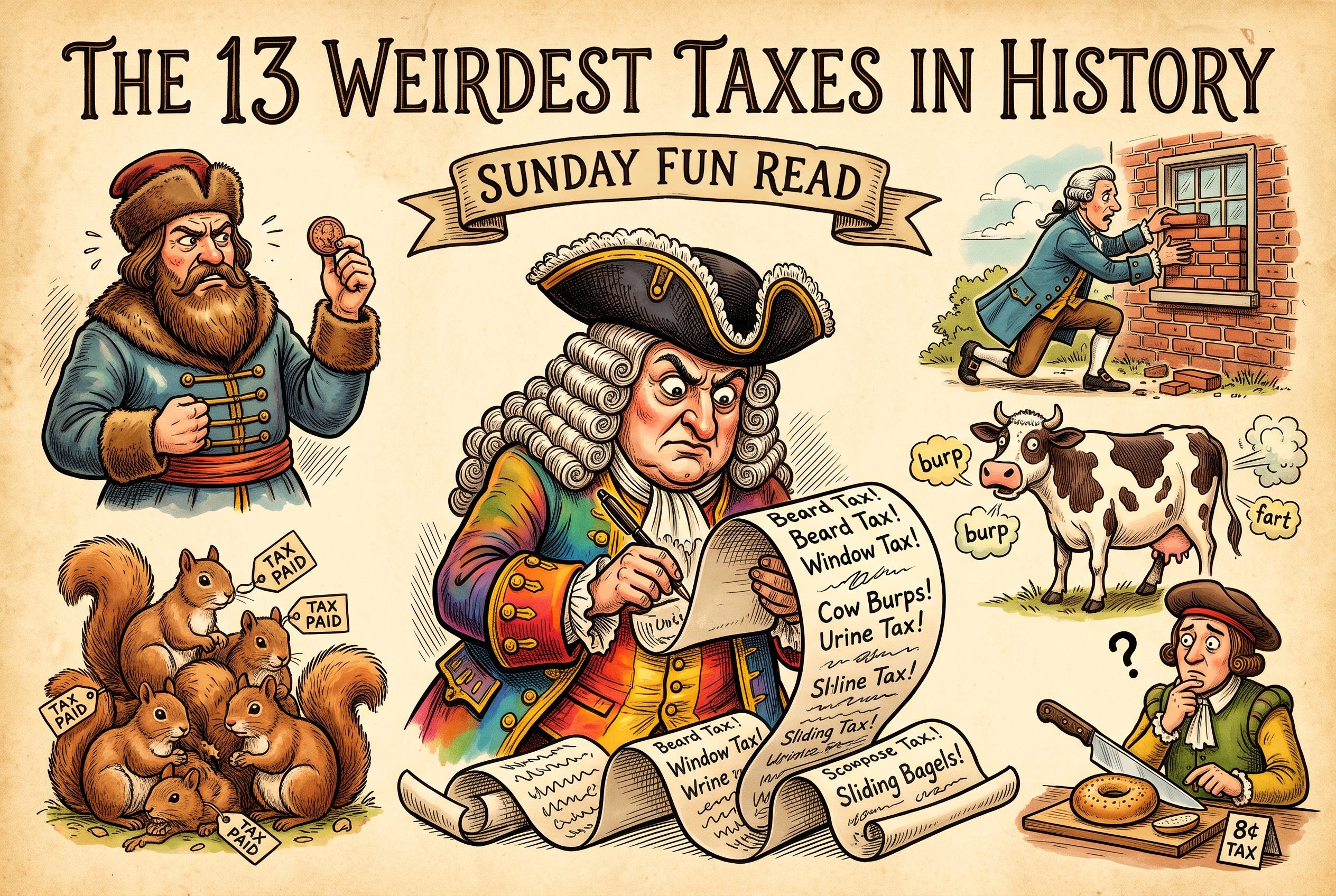
If you’ve ever stared at your paystub and wondered just how many ways a government can find to slice into your wallet, history has a comforting—and hilarious—answer: infinite ways. Whenever empires run out of cash, usually thanks to an expensive war or a monarch’s questionable spending habits, treasuries get wildly creative.
Over the centuries, lawmakers haven’t just taxed income, property, and tea. They have taxed vanity, bodily functions, sunlight, and even the act of starting a family. Here is a global tour of the strangest taxes ever invented, proving that where there’s a human habit, there’s a tax collector waiting in the bushes.
Taxing Life, Love, and Bodily Functions
Before governments figured out modern tax brackets, they went straight for the basics of human existence. If you were born, got married, or used the bathroom, the state wanted its cut.
1. The Baby-Making & Bachelor Tax (Marriage Duty Act)
Origin: England, 1694
The Story: Desperate to fund King William III’s war against France, Parliament passed the Marriage Duty Act of 1694. On paper, it was a tax on marriage certificates, births, and burials. In practice, it meant the Crown was literally taxing you for sleeping with your wife and producing a child—charging a hefty fee the moment a baby arrived. Thinking of dodging the tax by staying single? Nice try. The law also slapped an annual penalty on childless widowers and every bachelor over the age of 25. Whether you had a wedding, a baby, or a lonely Friday night, the Crown got paid.
2. The Urine Tax (Vectigal Urinae)
Origin: Ancient Rome, 1st Century AD (c. 70 AD)
The Story: To us, urine is waste; to the Ancient Romans, it was liquid gold. Rich in ammonia, collected urine from public urinals was bought by merchants to tan leather, launder togas, and even whiten teeth. When Emperor Nero (and later Emperor Vespasian) slapped a tax on the distribution of urine from public latrines, Vespasian’s son Titus complained that the tax was disgusting. Vespasian famously held a gold coin under his son’s nose and asked if the smell offended him. When Titus said no, the Emperor replied, “Pecunia non olet”—”Money does not stink”.
3. The Cowardice Tax (Scutage)
Origin: England, 1100
The Story: Not feeling up to getting impaled by a broadsword in a muddy field? Under King Henry I, English knights who didn’t want to fight in the King’s wars could simply buy their way out of military service. Officially called Scutage (from the Latin for “shield money”), it was universally mocked as the “Cowardice Tax”. Eventually, kings realized they preferred cold hard cash (which they could use to hire professional mercenaries) over reluctant knights anyway.
The Vanity Fair: Fashion Victims of the State
Once you’ve taxed life and limb, the next logical target is human ego. Rulers quickly realized that rich people will gladly pay exorbitant fees just to look fashionable—until the tax gets too high and kills the trend entirely.
Notice the embossed nose and beard on the copper coin above: Russian men had to carry this exact token in their pockets to prove their facial hair was legally paid for, or risk being tackled and shaved on the spot by the local police.
4. The Beard Tax
Origin: Russia, 1698
The Story: After touring Western Europe, Tsar Peter the Great decided that traditional Russian beards were backward and unrefined. To force his noblemen into a clean-shaven, modern look, he personally pulled out a razor at a royal banquet and shaved his horrified cabinet members. He then instituted a steep Beard Tax. Those who paid received a copper token stamped with the words “The beard is a superfluous burden.”
5. The Men’s Hat Tax
Origin: Great Britain, 1784
The Story: Figuring that wealthy gentlemen owned dozens of hats while poor men owned one (or none), British Prime Minister William Pitt the Younger taxed men’s headwear. Every legal hat had to have an official revenue stamp glued inside the lining. Hatmakers tried to dodge the law by calling their products “headgear” instead of hats, prompting Parliament to tax anything worn on the head in 1804. Forging a hat stamp wasn’t just frowned upon—it carried the death penalty.
6. The Powdered Wig Tax
Origin: Great Britain, 1795
The Story: Eleven years after going after hats, Britain needed more war money and targeted the scented starch powder that elites dusted over their giant wigs. People who paid the one-guinea annual fee were proudly called “guinea pigs.” However, most aristocrats decided the look wasn’t worth the cash, and the tax single-handedly killed the powdered wig fashion trend almost overnight.
Home Un-Improvement: Taxing Daylight and Decor
Why send tax collectors inside someone’s house to count their gold when you can just stand on the street and count their home features?
7. The Window Tax (Taxing Daylight)
Origin: England, 1696
The Story: Because the British public despised the idea of government assessors entering their homes to judge their wealth, King William III decided to tax houses based on how many windows they had. The result? Homeowners across Britain grabbed bricks and mortar and walled up their windows to avoid the fee, plunging tenements into damp, dark, disease-ridden misery. If you walk around historic London or Edinburgh today, you can still spot those bricked-up “blind windows” on 18th-century buildings, and it’s widely credited with giving us the phrase “daylight robbery.”
8. The Wallpaper Tax
Origin: Great Britain, 1712
The Story: During Queen Anne’s reign, patterned wallpaper became a trendy, affordable alternative to expensive tapestries. Naturally, the government slapped a tax per square yard on any painted, printed, or patterned paper. Clever homeowners bypassed the taxman by buying untaxed plain white paper, hanging it on their walls first, and hiring artists to hand-stencil patterns onto it afterward.
9. The Narrow House Tax (Frontage Tax)
Origin: The Netherlands, 16th–17th Century
The Story: Ever wondered why the canal houses in Amsterdam are so comically skinny and tall? During the Dutch Golden Age, property taxes were calculated based on the width of a house’s street-facing facade along the canal. Frugal Dutch merchants built houses barely wider than a front door, expanding them deep into the lot and straight up into the sky—requiring exterior hooks on the roof gables just to hoist furniture through the upper windows.
Quirky Modern Levies & Frontier Bounties
Think absurd taxes died out with powdered wigs? Not quite. The 19th, 20th, and 21st centuries have produced some absolute gems around the globe.
10. The Squirrel Scalp Tax
Origin: United States (Ohio), 1807
The Story: In the early 1800s, gray squirrels were overrunning Ohio farms and devouring crops by the ton. Instead of asking citizens for money, the state passed a law requiring every taxpayer to hand over a quota of squirrel scalps (between 10 and 100 per year, depending on their property assessment) directly to the township clerk alongside their regular taxes. Fail to bring in your pelts, and you paid a cash penalty.
11. The Butter & Bacon Tax (The “Fat Tax”)
Origin: Denmark, 2011
The Story: In an effort to slim down the nation’s waistline, Denmark introduced the world’s first “Fat Tax,” adding a surcharge to any food containing more than 2.3% saturated fat—including butter, milk, cheese, pizza, and meats. Did Danes start eating kale? Nope. They simply drove across the border into Germany and Sweden to stock up on cheap butter and bacon, creating a booming black market in dairy before Parliament sheepishly repealed the law a year later.
12. The Sliced Bagel Tax
Origin: United States (New York), 2010
The Story: If you buy a whole, untouched bagel in a New York shop and take it home in a paper bag, it’s considered a grocery staple and is tax-free. However, if an employee takes a knife and slices that exact same bagel in half—even without toasting it or adding a schmear of cream cheese—the state classifies it as “prepared food” and hits you with an 8-cent sales tax.
13. The Cow Burp & Fart Tax
Origin: Denmark, 2024 (Taking effect in 2030)
The Story: Moving from saturated fat to livestock flatulence, Denmark recently made history again by passing the world’s first carbon tax on gassy farm animals. Because cows, pigs, and sheep release massive amounts of methane when they burp and pass gas, Danish farmers will soon be taxed roughly $43 per ton of carbon dioxide equivalent emitted by their herds.
The Plot Twist: One Tax That Might Actually Be Good For You
After reading about kings taxing your bedroom habits and bureaucrats taxing the slice in your morning bagel, it’s easy to view every tax as a comedic shake-down. Yet there is one ancient tax mechanism that—when used with surgical precision rather than a sledgehammer—can actually work in your favor: The Tariff (Originating in Ancient Greece and formalized across Mediterranean ports in the 14th Century).
Unlike a window tax that forces you to sit in the dark, a targeted tariff is a border tax placed on imported foreign goods. While blanket tariffs can certainly spark price hikes at the checkout counter, strategic tariffs act like a defensive shield for local communities:
Protecting Local Jobs and Wages: When foreign competitors flood the market with artificially cheap goods made using state subsidies or exploitative labor laws, strategic tariffs level the playing field—keeping local factories open and paychecks circulating in your own neighborhood.
Securing Vital Supply Chains: If the past few years taught us anything, it’s that outsourcing 100% of your medicine, microchips, and steel to the lowest global bidder is a massive gamble. Tariffs incentivize companies to build and manufacture critical goods domestically so a single shipping bottleneck doesn’t empty our shelves.
Funding Public Goods Through Outside Access: Before income taxes existed, countries funded nearly all of their roads, ports, and infrastructure through customs duties—charging foreign merchants a toll for the privilege of selling to a wealthy domestic market.
At the end of the day, taxes have always been a mirror of what a society values, fears, or desperately needs to fund. So as you enjoy the rest of your Sunday afternoon, look out your (hopefully un-bricked) window, stroke your untaxed beard, and slice your own bagel at home—you just saved eight cents.
Bonus Section: Coming Soon—The Oxygen Tax?
At the end of the day, taxes have always been a mirror of what a society values, fears, or desperately needs to fund. Remember at the beginning of this article when I told you to take a deep breath because the air is still free? Well, enjoy it while it lasts. Given that we already have a carbon tax for the air we exhale, I am fully looking forward to governments rolling out an Oxygen Tax in the coming years for the air we inhale—probably complete with a smart meter strapped to our noses and a “deep-breathing surcharge” for anyone who goes for a jog. Until that bill arrives in the mail, look out your (hopefully un-bricked) window, stroke your untaxed beard, and slice your own bagel at home—you just saved eight cents.
Feel free to share this post to educate your fellow men on the creative ways governments empty our pockets—thank you for reading, and have a very Happy Sunday!