

INSTITUTIONAL READING FORMAT NOTICE This report is an open-access institutional showcase from The Kingside Dossiers by The Global Gambit. Because email clients compress multi-column equity valuation tables and supply-chain schematics, we have published a dedicated Full-Screen Web Terminal Edition optimized for desktop and tablet reading.
Executive Summary: The Anatomy of a Commodity Rout
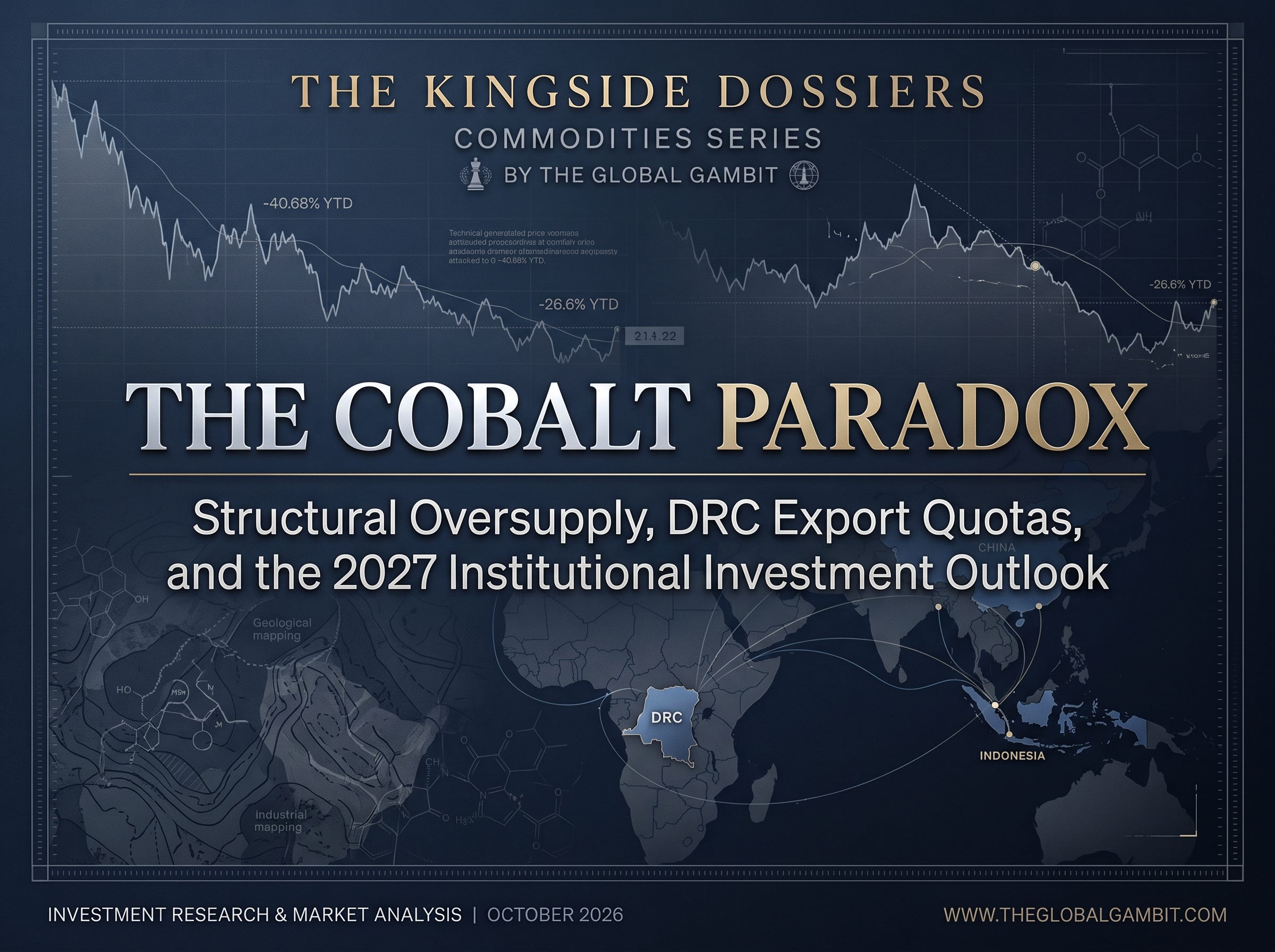
Cobalt and its primary intermediate feedstock, cobalt hydroxide (Co(OH)2), have experienced one of the most severe structural repricings in the modern industrial metals era. During the peak of the post-2022 supply wave, benchmark cobalt hydroxide prices plunged 40.68% YTD while refined cobalt metal fell 26.6% YTD, driving spot prices to nine-year lows.
Even after the Democratic Republic of the Congo (DRC) intervened with a temporary export suspension in February 2025—and subsequently replaced it in late 2025 with a strict 96,600-tonne annual export quota regime for 2026 and 2027—the underlying structural surplus has continued to pressure the value chain. Benchmark refined cobalt metal trades at $39,345/tonne (down 7.91% YoY and nearly 59% below its March 2018 all-time high of $95,250/tonne), while pure-play Chinese cobalt miners and chemical refiners have suffered YTD market capitalization losses ranging from 16.2% to 47.3%.
Key Drivers Behind the Cobalt & Cobalt Hydroxide Price Decline
Extreme Geological Byproduct Inelasticity (98% Byproduct Supply): Approximately 98% of global mined cobalt is extracted not from primary cobalt mines, but as a secondary byproduct of large-scale copper mining (~73%) and nickel mining (~25%). Because robust copper prices dictate primary capital allocation in the DRC and nickel laterite economics drive Indonesian production, miners continue extracting cobalt regardless of how far spot cobalt prices fall.
CMOC Group’s Kisanfu (KFM) and Tenke Fungurume (TFM) Supply Deluge: China’s CMOC Group fundamentally broke the global cobalt cost curve by ramping up its DRC operations to 117,500 tonnes of cobalt in 2025 (107% of target, alongside 741,100 tonnes of copper). Crucially, while a typical DRC deposit exhibits a 10:1 copper-to-cobalt ratio, CMOC’s Kisanfu (KFM) mine operates at an anomalous 2.6:1 copper-to-cobalt ratio (grading 1.79% Cu and 0.87% Co), flooding global markets with low-cost cobalt hydroxide.
Indonesian HPAL Mixed Hydroxide Precipitate (MHP) Surge: High-Pressure Acid Leach (HPAL) facilities in Indonesia—backed by Chinese battery supply chain consortia—expanded Indonesian cobalt output to 42,500 tonnes (42.5kt) in 2025, led by PT Huafei Nickel Cobalt (10.8kt, up 35% YoY) and PT Huayue Nickel Cobalt (7.6kt). Indonesian MHP provides refiners with a direct, abundant substitute for DRC cobalt hydroxide, eroding DRC pricing power.
Cathode Chemistry Substitution Toward Cobalt-Free LFP: In the electric vehicle (EV) sector, Lithium Iron Phosphate (LFP) batteries—which require zero cobalt—captured over 70% of the Chinese domestic EV market and more than 45% of global EV gigawatt-hour (GWh) deployments. Within the remaining ternary cathode segment, cell manufacturers aggressively thrifted cobalt content by shifting from NCM 523/622 toward high-nickel NCM 811 and NCM 9.5.5 chemistries.
DRC Export Ban-to-Quota Transition and Inventory Distortion: After halting exports in February 2025 to arrest collapsing prices, the DRC instituted an annual quota of 96,600 tonnes for 2026 (with 87,000 tonnes allocated to producing miners based on trailing three-year output). While the initial ban triggered a temporary restocking spike in 2025, the resumption of quota exports in 2026—combined with massive mine-gate stockpiling inside the DRC—weighed heavily on intermediate hydroxide payables and refiner equity valuations.
Downstream Chemical Arbitrage & Sulphate Margin Compression: Global cobalt sulphate (CoSO4) production dropped 17% YoY to 90kt as Chinese refiners curtailed EV precursor salts and pivoted toward tricobalt tetroxide (Co3O4, up 68% YoY to 73kt) and electrolytic cobalt metal to capture chemical-to-metal arbitrage spreads, transmitting intermediate hydroxide oversupply directly into the refined metal market.
Top Public Cobalt Producers: Stock Prices & YTD Market Cap Erosion
In the public equity markets, the impact of depressed cobalt and cobalt hydroxide fundamentals has created a sharp bifurcation:
Pure-Play & Cobalt-Heavy Integrated Producers (Primarily Chinese Listed): Suffered severe valuation compression in 2026, shedding over CN¥150 billion (~$21.1 billion USD) in combined market capitalization YTD as chemical margins contracted and DRC export quotas capped sales volumes.
Diversified Western/Global Mining Majors: Because cobalt accounts for less than 2% to 3% of consolidated EBITDA for diversified giants like Glencore and Vale, strong copper prices, iron ore cash flows, and commodity trading profits insulated their broader market capitalizations—prompting them to actively deprioritize cobalt recovery in favor of copper.
📊 Interactive View: Click here to open the full-resolution Public Producers Market Cap & Valuation Table in the Web Terminal Edition.
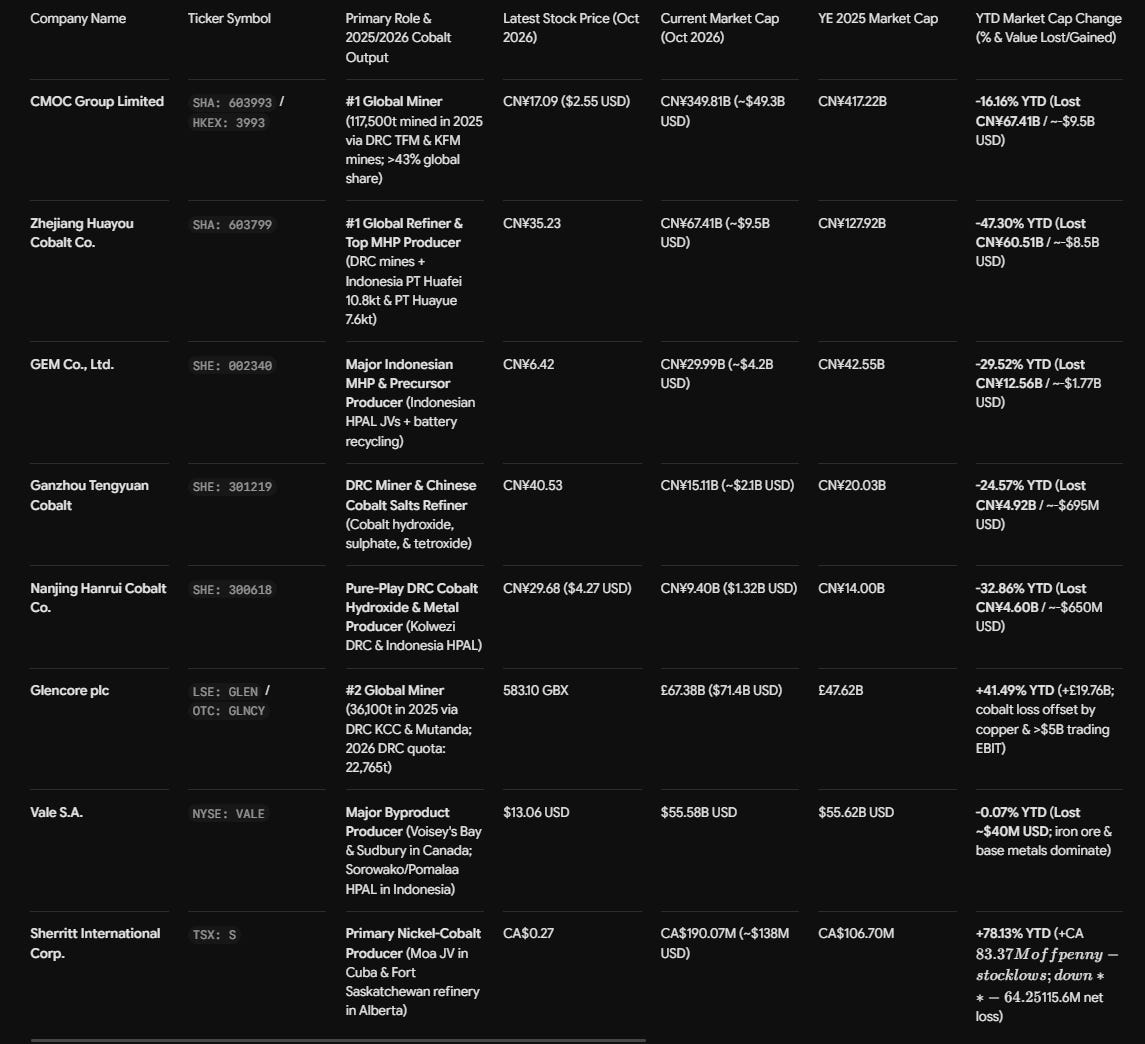
Institutional Note on Western Pure-Play Casualties: The multi-year collapse in cobalt prices completely wiped out high-cost Western pure-play equity holders. Most notably, Jervois Global—which developed the only primary cobalt mine in the United States (Idaho Cobalt Operations)—was forced to suspend mine operations due to sub-economic cobalt prices and subsequently underwent a recapitalization and delisting restructuring that extinguished legacy public equity value.
Industrial Applications: How Sectors of the Global Economy Use Cobalt
Global cobalt demand reached 276,000 tonnes (276kt) in 2025, expanding by 13% YoY, and is projected to grow at an 8.98% compound annual growth rate (CAGR) through 2031. Cobalt’s unique ferromagnetic properties, thermal stability, and high melting point (1,493°C) make it irreplaceable across five primary industrial verticals:

Electric Vehicle (EV) Lithium-Ion Batteries (~43.7% of Total Demand):
Industries: Automotive OEMs, commercial trucking, and tier-1 battery cell manufacturing.
Technical Role: Processed from cobalt hydroxide into battery-grade cobalt sulphate (CoSO4) and integrated into Nickel-Cobalt-Manganese (NCM) and Nickel-Cobalt-Aluminum (NCA) cathodes. Cobalt stabilizes the layered transition-metal oxide lattice during repeated lithium-ion intercalation, prevents oxygen evolution and thermal runaway (battery fires), and delivers the high gravimetric energy density required for long-range EVs (which exceeded 1,276 GWh of global demand in 2025).
Portable Electronics, Consumer Tech & Edge AI Hardware (~28.3% of Total Demand):
Industries: Smartphones, laptops, tablets, wearables, drones, and cordless power tools.
Technical Role: Refined into tricobalt tetroxide (Co3O4) to manufacture Lithium Cobalt Oxide (LiCoO2 / LCO) cathodes. LCO cathodes contain up to 60% cobalt by weight and offer unmatched volumetric energy density—critical for compact devices running power-intensive on-device AI processors where physical battery volume cannot be expanded.
Aerospace, Defense & Industrial Gas Turbine Superalloys (~11.5% of Total Demand):
Industries: Military aviation, commercial jet engines, space propulsion, munitions, and power generation turbines.
Technical Role: Requires high-purity metallurgical-grade cobalt metal (99.8%+ Co). When alloyed with nickel, chromium, and tungsten, cobalt imparts exceptional creep resistance, corrosion immunity, and structural integrity at operating temperatures exceeding 1,000°C. It is also essential for Samarium-Cobalt (SmCo) permanent magnets, which are used in precision-guided missiles, radar systems, and aircraft actuators because they retain magnetism at temperatures where Neodymium (NdFeB) magnets fail.
Hard Metals, Cemented Carbides & Industrial Tooling (~7.5% of Total Demand):
Industries: Oil & gas drilling, hard-rock mining, tunnel boring, metal cutting, and automotive stamping.
Technical Role: Fine cobalt metal powder serves as the tough, ductile metallic binder matrix for tungsten carbide (WC-Co) and industrial diamond cutting tools, absorbing mechanical shock while tungsten carbide provides extreme hardness.
Chemical Catalysts, Tire Adhesives & Pigments (~9.0% of Total Demand):
Industries: Downstream petroleum refining, petrochemical plastics, radial tire manufacturing, and ceramics.
Technical Role: Cobalt-molybdenum (Co-Mo) catalysts are indispensable for hydrodesulfurization (HDS) in oil refineries to strip sulfur from diesel and jet fuel. Cobalt carboxylates act as steel-to-rubber adhesion promoters in radial tires, while cobalt acetate acts as a catalyst in producing Purified Terephthalic Acid (PTA) for polyester packaging and textiles.
Global Mine Production vs. Supply Chain Bottlenecks
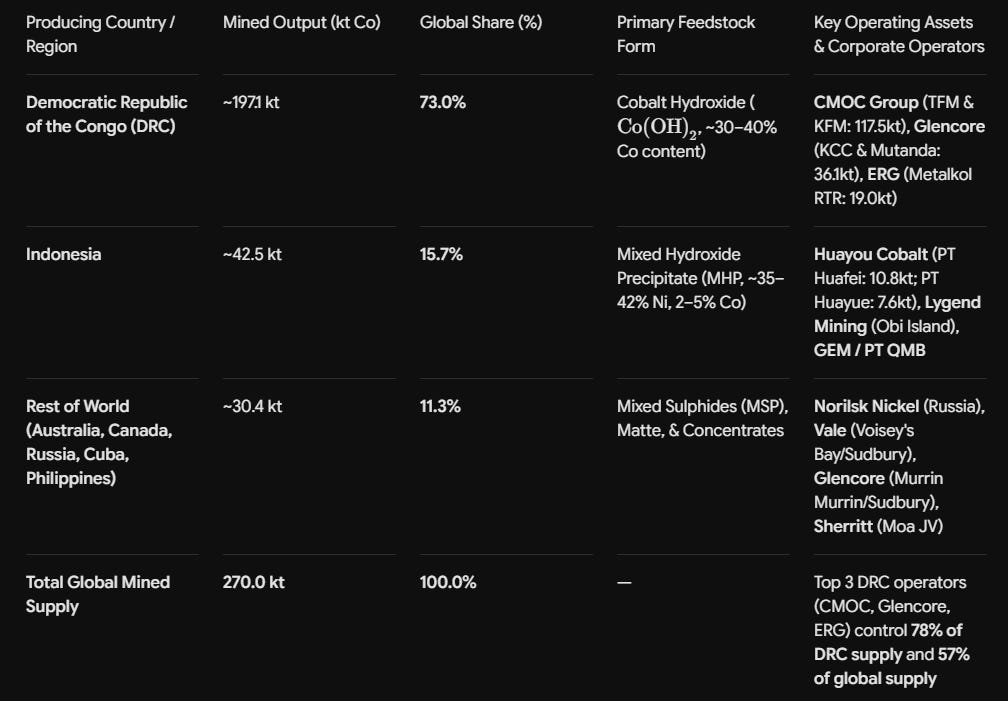
Global mined cobalt supply stood at 270,000 tonnes (270kt) in 2025, supplemented by approximately 25kt to 30kt of secondary recycling supply (originating from battery cell manufacturing scrap and end-of-life battery recovery).
📊 Interactive View: Click here to view the full-screen Global Mine Supply & DRC Quota Table in the Web Terminal Edition.
Critical Supply Chain Distortion: The DRC Quota Trap
While the DRC mines nearly 200,000 tonnes of cobalt annually, the Congolese government’s 2026–2027 quota regime caps legal exports at 96,600 tonnes per year (87,000 tonnes allocated to miners with active reserves based on 3-year historical production, plus a 9,600-tonne strategic buffer allocated to state regulator ARECOMS).
The Consequence: Roughly 100,000 to 115,000 tonnes of DRC cobalt production per year is currently “unexportable” and accumulating inside the DRC in producer and state stockpiles.
Operational Pivot: Rather than incur processing, reagents, and storage costs for cobalt hydroxide that cannot be exported, Glencore proactively adjusted its mine plans at Katanga (KCC) and Mutanda (MUMI) to prioritize high-grade copper zones, trimming its cobalt output by 5% to 36,100 tonnes while projecting constrained DRC export allocations of 22,765 tonnes in 2026 and 18,840 tonnes in 2027.
Geopolitics of Demand: China’s Monopoly vs. Western Vulnerability
How China Uses and Controls the Cobalt Value Chain
China possesses less than 2% of the world’s domestic cobalt mine reserves, yet it exercises near-total midstream and downstream dominance:
77% to 80% Global Refining Monopoly: China processes nearly all of the DRC’s cobalt hydroxide and Indonesia’s MHP into battery-grade chemicals. Chinese refineries control over 80% of global cobalt chemical capacity (sulphate and tetroxide) and 85% of global precursor cathode active material (pCAM) production.
Upstream Equity Ownership Abroad: Through state-backed and private champions (CMOC, Zhejiang Huayou, Jinchuan Group, CNMC, and GEM), Chinese entities control over 60% of mined output in the DRC and over 85% of HPAL MHP capacity in Indonesia.
Strategic Sovereign Stockpiling (SRB): China’s National Food and Strategic Reserves Administration (formerly the SRB) actively utilizes periods of depressed metal prices to purchase tens of thousands of tonnes of domestic electrolytic cobalt metal, insulating China’s aerospace, defense, and industrial sectors from geopolitical supply blockades.
Which Countries Need Cobalt Most?
While China dominates processing, end-use consumption and strategic import vulnerability are most acute in four industrialized economies:
United States (Highest Defense & Aerospace Vulnerability): The US is the world’s largest consumer of high-purity aerospace and defense superalloy cobalt metal, driven by military fighter jet engines, munitions restocking, commercial aviation (Boeing, GE Aerospace, Pratt & Whitney), and Western EV fleets. With zero operating domestic primary cobalt mines, the US is almost entirely import-dependent—prompting Washington to negotiate a bilateral US-DRC strategic critical minerals partnership and fund domestic refining initiatives under the Defense Production Act.
European Union (Highest Automotive NCM Exposure): Unlike China—where domestic automakers heavily favor LFP batteries—European OEMs (Volkswagen, BMW, Mercedes-Benz, Stellantis) remain heavily reliant on high-energy-density NCM battery chemistries for passenger EVs. Under the EU Critical Raw Materials Act (CRMA), Europe relies heavily on Finland (home to Umicore’s Kokkola refinery and Terrafame, representing ~8% to 10% of global refining) and Norway (Glencore’s Nikkelverk refinery, the premier Western source of high-purity cobalt metal).
South Korea & Japan (Midstream Battery Export Hubs): South Korea (LG Energy Solution, Samsung SDI, SK On, Posco Future M) and Japan (Panasonic Energy, Sumitomo Metal Mining) represent the backbone of the non-Chinese EV battery supply chain. Because their cell architectures are overwhelmingly built around NCM and NCA chemistries destined for US and European automakers, South Korea and Japan have the highest per-capita industrial dependency on imported cobalt hydroxide and cobalt sulphate outside China.
2027 Investment Thesis: Contrarian Recovery or Value Trap?
For institutional portfolios evaluating whether to deploy capital ahead of a potential 2027 recovery in cobalt prices, the market presents a classic tug-of-war between policy-engineered tightness and latent geological oversupply.
Bull Case Catalysts for a 2027 Rebound
Depletion of Chinese Hydroxide Inventories Under DRC Quotas: Throughout early 2026, Chinese refiners cushioned the impact of the DRC’s 96,600-tonne annual export cap by drawing down buffer stocks accumulated prior to the export ban. As Cobalt Institute data confirms, intermediate hydroxide stocks outside the DRC are running low heading into late 2026 and 2027, forcing refiners to bid up payable percentages for quota-clearedDRC hydroxide and Indonesian MHP.
Indonesian HPAL Sulfur Supply Vulnerability: Indonesian HPAL operations require massive volumes of sulfuric acid to leach cobalt and nickel from laterite ore. Approximately 75% of global seaborne sulfur imports transit the Strait of Hormuz, where 2026 maritime disruptions and blockade risks have spiked sulfur landed costs in Southeast Asia. Sustained sulfur inflation or shortages in 2027 could force high-cost Indonesian HPAL lines to throttle back MHP output, tightening global cobalt supply.
Price-Insensitive Defense & AI Consumer Electronics Demand: Global defense budgets are driving multi-year backlogs in jet turbines, missiles, and superalloys, while the global rollout of AI-capable smartphones and laptops is structurally lifting LCO battery capacity requirements (measured in watt-hours per device).
Bear Case Risks & Structural Ceilings
The “DRC Stockpile Overhang” (100kt+/Year of Trapped Supply): Investors must distinguish between an export deficit and a production deficit. Because CMOC’s KFM/TFM and Glencore’s DRC mines continue extracting copper at record pace, over 100,000 tonnes per year of unexportable cobalt is piling up inside the DRC. This creates a permanent sovereign overhang: any rally in cobalt metal toward 45,000–50,000/tonne will incentivize the DRC government to monetize its state stockpile or expand export quotas post-2027.
Consensus Macro Forecasts Remain Muted: Quantitative macro models (including Trading Economics consensus estimates) project benchmark cobalt metal to trade near $38,902/tonne in the near term and $37,264/tonne over a 12-month horizon into late 2027, reflecting skepticism that DRC export controls alone can engineer a sustained bull market while copper-driven byproduct extraction remains unconstrained.
Institutional Market Positioning Analysis for 2027
✗ ELEVATED RISK PROFILE: Physical Cobalt Metal & High-Cost Western Pure-Play Juniors (Unfavorable risk-reward profile capped by the DRC overhang).
Buying physical cobalt metal or unhedged, single-asset Western junior developers carries an unfavorable risk-reward profile for 2027 due to the massive DRC stockpile overhang that caps long-term price upside.
✓ FAVORABLE STRUCTURAL POSITIONING: Low-Cost Integrated Copper-Cobalt Majors
Core Institutional Pick — CMOC Group (SHA: 603993 / HKEX: 3993): Down 16.16% YTD in market cap to CN¥349.81B, CMOC trades at just ~11.0x forward P/E with a 33.4% ROE. Its world-class copper output (741,100 tonnes) underwrites a fortress balance sheet, giving investors the world’s largest cobalt business (117,500 tonnes) and massive DRC stockpile optionality at zero valuation premium.
High-Beta Distressed Cyclical — Zhejiang Huayou Cobalt (SHA: 603799): After a 47.30% YTD market cap wipeout to CN¥67.41B, Huayou trades near 52-week lows (CN¥35.23 vs. consensus analyst target of CN¥59.62–CN¥61.06, implying +71% to +82% upside). Because Huayou owns the largest cobalt-producing HPAL assets in Indonesia (PT Huafei and PT Huayue), its Indonesian MHP volumes are exempt from DRC export quotas, positioning it as the primary beneficiary if DRC hydroxide shortages squeeze Chinese chemical prices in 2027.
Access the Institutional Web Edition & Subscribe
The Cobalt Paradox has been released as a complimentary, open-access research dossier to demonstrate the analytical depth, primary regulatory sourcing, and quantitative equity modeling behind The Kingside Dossiers by The Global Gambit.
View, Bookmark, or Print the Formatted Web Edition: https://the-global-gambit.firebaseapp.com/the_cobalt_paradox.html
Get Future Institutional Dossiers: Subscribe below to receive upcoming deep-dive commodity, geopolitical, and global equity research directly in your inbox.
Champion Iron Limited (TSX: CIA) — High-Purity Moat, DRPF Inflection, and Asymmetric Value

Position Disclosure & Legal Disclaimer
Beyond the View: The Hidden Traps of Buying Real Estate in Georgia (Tbilisi & Batumi)

When evaluating residential property in Tbilisi or Batumi, buyers naturally gravitate toward the obvious metrics. You meticulously check the location, negotiate the price per square meter, scrutinize the floor layout, and evaluate the building’s amenities. A brand-new property can look immaculate during a walkthrough, featuring sleek modern facades, pol…
Disclaimer:
IMPORTANT DISCLOSURES & INSTITUTIONAL DISCLAIMER
1. General Informational Purposes Only — No Investment Advice:
This research report (”The Cobalt Paradox”) is published by The Global Gambit under The Kingside Dossiers series for informational, educational, and market commentary purposes only. Nothing contained in this publication constitutes, or should be construed as, investment, legal, tax, or financial advice, nor is it an offer, solicitation, or recommendation to buy, sell, or hold any security, commodity, futures contract, or derivative instrument in any jurisdiction. All content reflects impersonal, general market research and is not tailored to the investment objectives, financial situation, or risk tolerance of any specific institutional or individual recipient.
2. Regulatory Status & Publisher Exemption:
The Global Gambit, its parent entity, and its author(s) are not registered as investment advisers, broker-dealers, commodity trading advisors, or portfolio managers with the U.S. Securities and Exchange Commission (SEC), the Financial Industry Regulatory Authority (FINRA), the Canadian Securities Administrators (CSA), the British Columbia Securities Commission (BCSC), the Canadian Investment Regulatory Organization (CIRO), or any other domestic or international financial regulatory authority. This publication is distributed strictly as a bona fide financial publication of general and regular circulation.
3. Position Disclosure & Conflicts of Interest:
As of the date of publication (October 2026), the author and affiliated entities do not hold any beneficial long, short, or derivative positions in the securities of any company analyzed in this report—including CMOC Group Limited (
SHA: 603993/HKEX: 3993), Zhejiang Huayou Cobalt Co. (SHA: 603799), GEM Co., Ltd. (SHE: 002340), Ganzhou Tengyuan Cobalt (SHE: 301219), Nanjing Hanrui Cobalt Co. (SHE: 300618), Glencore plc (LSE: GLEN/OTC: GLNCY), Vale S.A. (NYSE: VALE), or Sherritt International Corp. (TSX: S)—and have no intention of initiating any position within the next 72 hours. This research was produced independently; neither the author nor The Global Gambit has received any direct or indirect compensation from any company, issuer, or third party featured in this report.4. Data Accuracy, Mining Estimates & Forward-Looking Statements:
All market prices, market capitalizations, production figures, and geological ratios cited herein are obtained from public regulatory filings, industry trade bodies, and institutional market data sources believed to be reliable as of the publication date. However, no representation or warranty, express or implied, is made regarding the accuracy, completeness, or timeliness of such data, which is subject to change without notice. References to mineral production, ore grades, and sovereign export quotas are presented for economic context and do not constitute formal technical reports under National Instrument 43-101 (NI 43-101) or SEC Regulation S-K 1300. Forward-looking statements—including 2027 cobalt supply-demand balances, sovereign policy scenarios in the Democratic Republic of the Congo (DRC) and Indonesia, and equity valuation multiples—involve substantial macroeconomic, geopolitical, currency, and commodity price risks. Actual outcomes may differ materially from those projected.
5. International Securities & Risk Warning:
Investing in global commodities, emerging market mining jurisdictions, and foreign-listed equities (including A-shares on the Shanghai and Shenzhen exchanges, H-shares in Hong Kong, and UK/Canadian listings) involves significant risks, including liquidity constraints, sovereign expropriation, export blockades, and foreign exchange volatility. Past performance is not indicative of future results. Readers must conduct their own independent due diligence and consult with a qualified, registered financial professional before making any investment decision.
© 2026 The Global Gambit. All rights reserved. Unauthorized reproduction or commercial redistribution of this dossier without prior written consent is strictly prohibited.