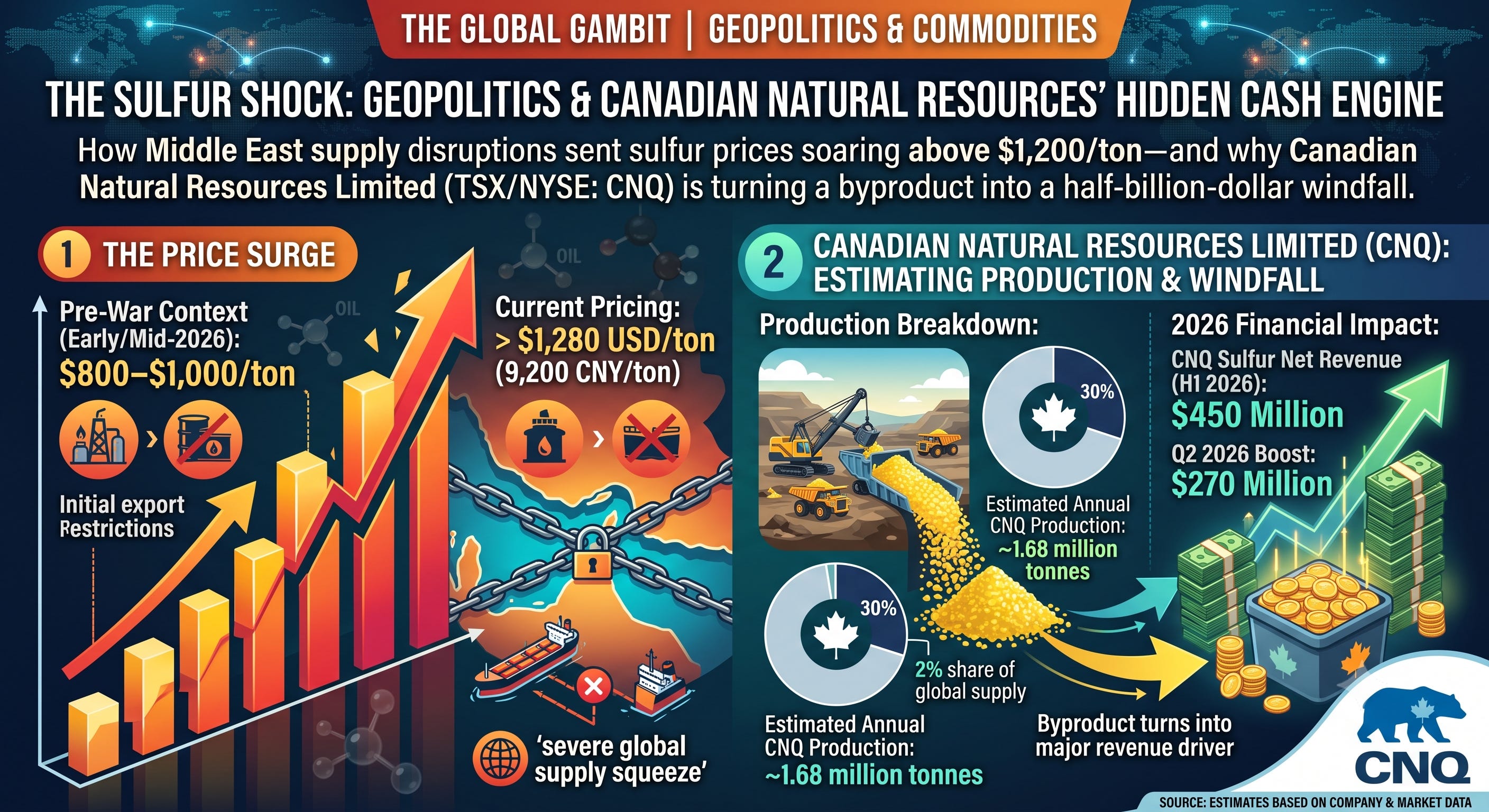
The Middle East conflict has triggered a severe supply squeeze in the global sulfur market, creating a massive, under-the-radar windfall for North American heavy crude producers.
The Price Surge
Sulfur has staged one of the most aggressive commodity rallies of 2026, driven by tightening global supply chains and acute geopolitical bottlenecks:
Pre-War Context (Early/Mid-2026): Export restrictions and reduced global gas processing had already pushed prices into the $800–$1,000/ton range by mid-summer.
Current Pricing: With disruptions around the Persian Gulf and the Strait of Hormuz choking off a region responsible for nearly half of global seaborne sulfur trade, prices have surged past 9,200 CNY/ton (approximately $1,280 USD/ton).
Because China is the world’s largest importer and consumer of sulfur—fueling everything from global agriculture to new energy materials—its domestic spot markets and ports are the critical hubs for price discovery during any international supply crunch.
Canadian Natural Resources Limited (CNQ): Estimating Production & Windfall
Canadian Natural Resources Limited is uniquely positioned to capture this upside. Sulfur is generated in massive volumes as a byproduct of the company’s oil sands mining, bitumen upgrading, and sour natural gas operations.
Production Breakdown:
Management outlines that Canadian Natural Resources accounts for approximately 30% of Canada’s total sulfur production and 2% of global supply.
With total worldwide production running at roughly 84 million tonnes per year, CNQ’s annual output is estimated at approximately 1.68 million tonnes.
2026 Financial Impact:
This unprecedented price spike has turned byproduct management into a major revenue driver.
Canadian Natural Resources generated $450 million in net revenue from sulfur sales in the first half of 2026 alone—with $270 million realized in Q2 as spot prices accelerated.


