

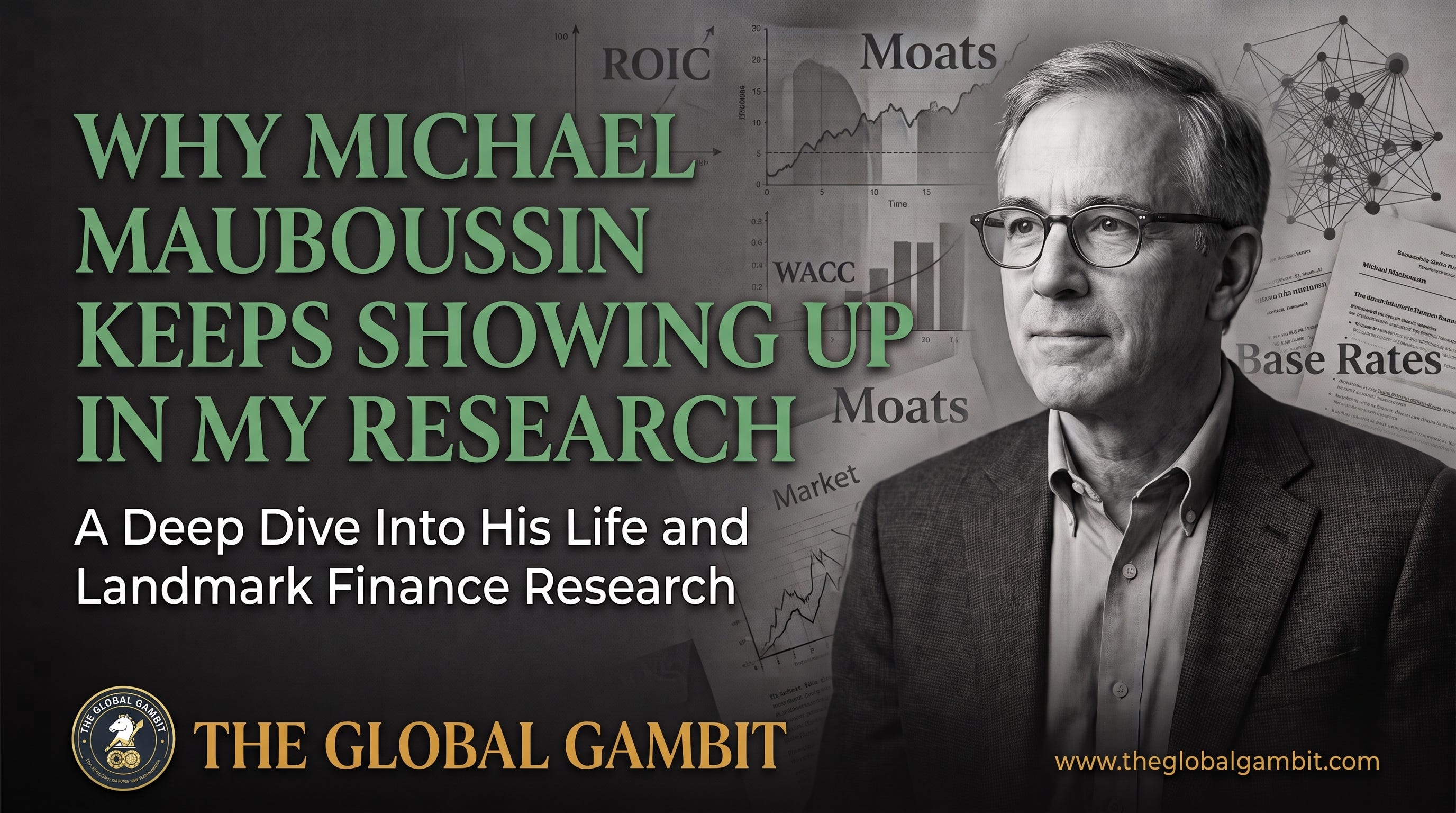
Lately, I continue coming across Michael Mauboussin’s work whenever I am researching different financial topics and market strategies. His frameworks are referenced so frequently that I was curious to find out more about him and dig into his actual research. I’ve spent some time reviewing his background and his most influential papers, and I am sharing my findings with you all today.
Who is Michael Mauboussin?
Michael J. Mauboussin is one of the most respected strategic thinkers and financial researchers on Wall Street. He currently serves as the Head of Consilient Research at Counterpoint Global, the active equity division of Morgan Stanley Investment Management. His background bridges the gap between high-level academic theory and practical, boots-on-the-ground investing.
Thanks for reading The Global Gambit’s Substack! Subscribe for free to receive new posts and support my work.
Prior to his role at Morgan Stanley, Mauboussin had an extensive career as a Managing Director and Chief U.S. Investment Strategist at Credit Suisse, and served as Chief Investment Strategist at Legg Mason Capital Management. In addition to his corporate work, he has been an adjunct professor at Columbia Business School since 1993, where he received the Dean’s Award for Teaching Excellence. He also serves on the board of trustees at the Santa Fe Institute, a leading center for multi-disciplinary research in complex systems theory.
What sets Mauboussin apart is his “consilient” approach, the principle that evidence from independent, unrelated sources can converge to form strong conclusions. He regularly borrows frameworks from physics, psychology, biology, and behavioral economics to explain stock market dynamics, corporate life cycles, and competitive strategy.
Essential Works and Research Papers
Below is a curated list of Mauboussin’s most compelling papers and books, which serve as essential reading for anyone conducting fundamental equity analysis.
Measuring the Moat: Assessing the Magnitude and Sustainability of Value Creation
The Premise: This white paper provides a systematic framework for evaluating competitive advantages, or “economic moats.” Mauboussin argues that true value creation only happens when the investments a company makes generate cash flows that exceed the cost of that capital over time. Why it matters: The paper quantifies moats not just as abstract competitive advantages, but mathematically as the magnitude of the spread between Return on Invested Capital (ROIC) and the Weighted Average Cost of Capital (WACC), paired with the duration a company can sustain this positive spread before competition erodes it. It provides a masterclass in industry analysis, examining how the diffusion of best practices, market maturation, and disruptive innovation impact long-term corporate returns.
ROIC and the Investment Process
The Premise: Expanding on his moat framework, this research takes a deep dive into Return on Invested Capital (ROIC). Mauboussin details how to properly calculate it, adjusting for modern shifts like the rise of intangible assets (such as R&D and software) and how it serves as the ultimate driver of free cash flow and economic profit. Why it matters: He proves with empirical data that the stock market heavily rewards the spread between ROIC and WACC. The paper emphasizes that high ROIC businesses generate strong returns primarily through high capital turnover or high profit margins, and provides historical base rates demonstrating how difficult it is to sustain top-quartile ROIC over time.
Public to Private Equity in the United States: A Long-Term Look
The Premise: A massive structural shift has occurred in capital markets: the number of public companies has been cut nearly in half since 1996, while private markets have raised substantially more capital. Mauboussin outlines why companies are staying private longer and how institutional capital has migrated to venture capital and buyouts. Why it matters: This paper serves as a vital reality check on capital allocation. It explains how the rise of intangible assets changes corporate financing needs and examines the underlying realities of buyout returns—including how the massive backlog of un-exited private deals and higher interest rates are changing the math for private equity returns.
The Wisdom of Crowds in Markets
The Premise: Mauboussin explores when markets are efficient and when they break down. He details the specific conditions required for a crowd to be “wise” rather than “mad”: diversity of opinions, proper aggregation mechanisms, and appropriate incentives. Why it matters: It explains stock market bubbles and crashes mechanically. When investors lose their diversity of thought and begin simply copying one another, the market stops functioning as a wise weighing machine and turns into a destructive herd.
Find copy here > > >The Wisdom of Crowds in Markets
Books: The Success Equation & More Than You Know
While his white papers are geared toward institutional analysts, Mauboussin’s books distill his philosophies for a wider audience.
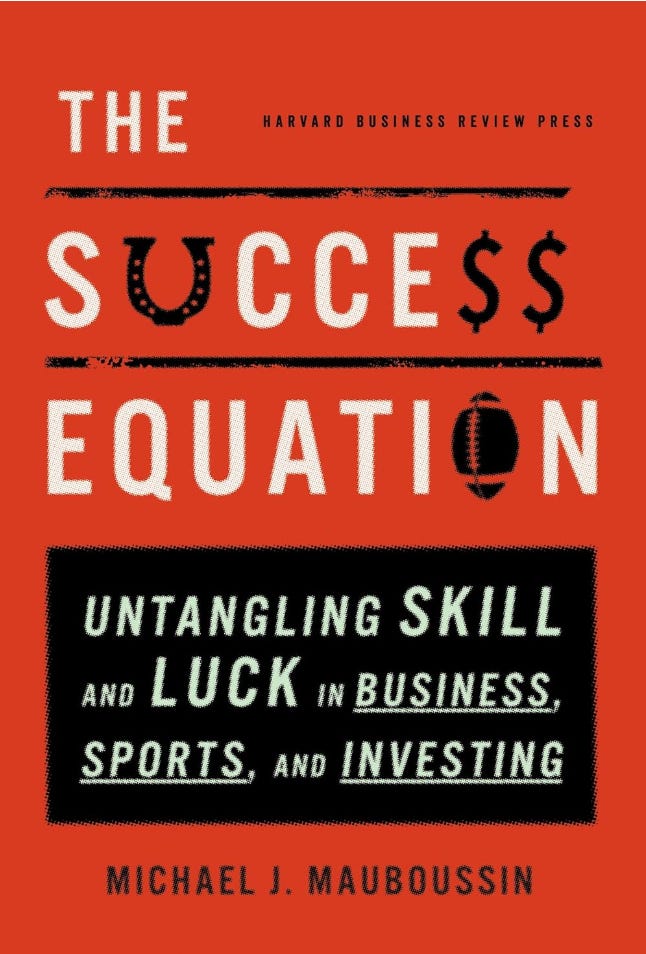
The Success Equation: Untangles the precise mixture of skill and luck in business, investing, and sports. He provides frameworks to help determine whether an outcome was driven by repeatable processes (skill) or randomness (luck), and how mean reversion applies differently to each.
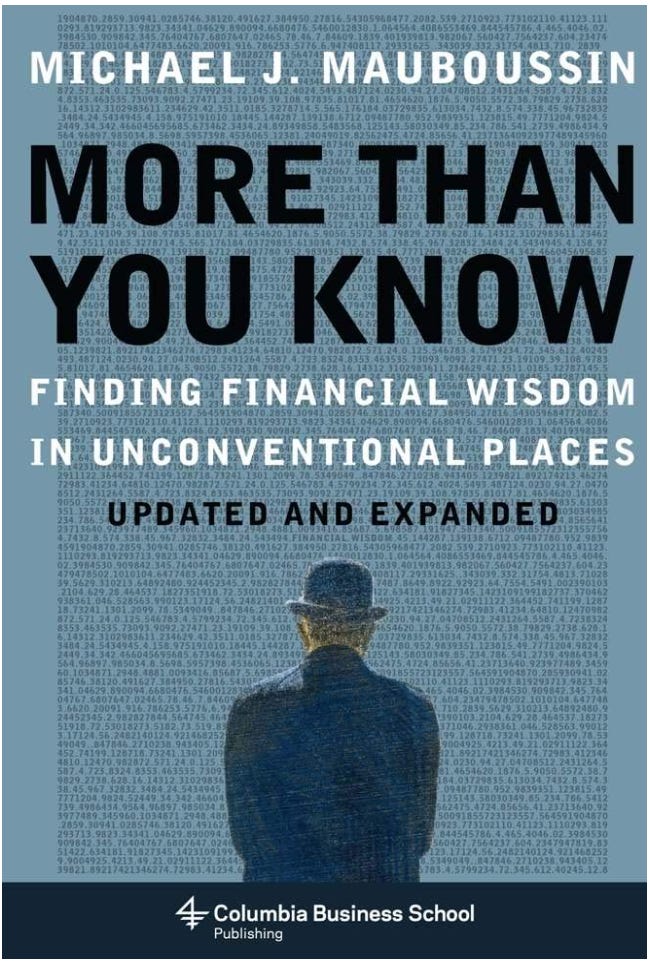
More Than You Know: Explores his “consilient” philosophy, drawing parallels between investing and disciplines ranging from physics to behavioral finance, teaching readers how to think better about probability and risk.
Related articles from the Global Gambit:
The Value Investor’s Engine: A Review of Mauboussin’s ROIC Framework
Why the spread between ROIC and the cost of capital is the ultimate driver of intrinsic value, and how to apply Morgan Stanley’s empirical research to fundamental analysis.
The CapEx Harvest: Why the Best Value is Hidden in Depressed ROIC
How to identify optical value traps and model the “triple play” of equity returns before the market catches on.