

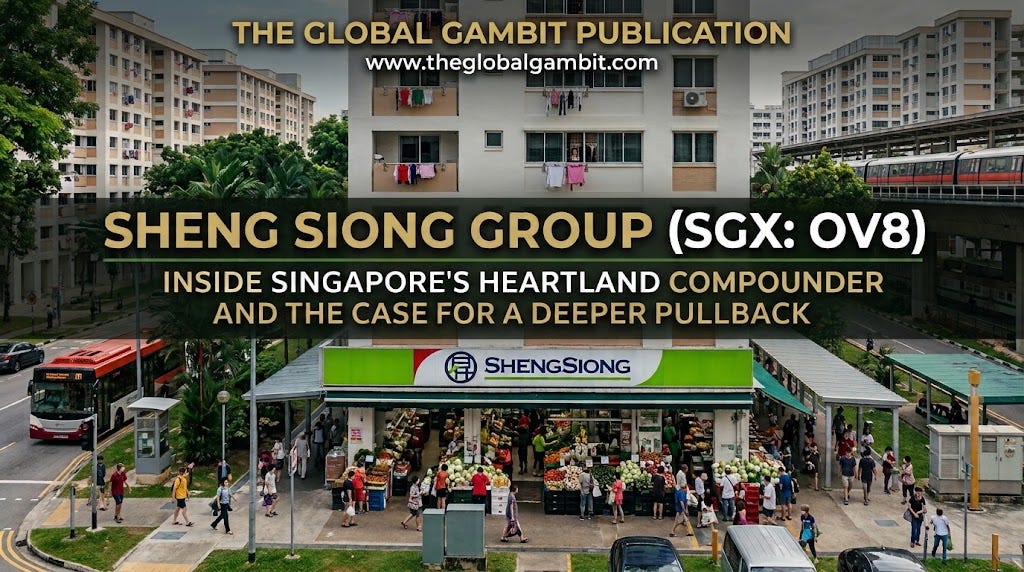
Every great family-controlled compounder has an origin story rooted in capital discipline, and Sheng Siong Group’s (SGX: OV8) begins on a Singaporean pig farm.
In the early 1980s, Lim Hock Chee and his brothers were helping their father run a sprawling family hog farm in Lim Chu Kang. When the Singapore government moved to phase out pig farming across the island in 1984, the family faced an existential crisis—and an urgent windfall of surplus pork inventory they needed to liquidate. Lim Hock Chee rented a modest 1,200-square-foot section inside a failing SaveWell supermarket in Ang Mo Kio to sell chilled pork directly to housewives. When the SaveWell chain collapsed into receivership in 1985, the Lim brothers pooled S$30,000 from their pig farm proceeds to take over the Ang Mo Kio store entirely.
They named it Sheng Siong—meaning “rising vegetable” or “ascending prosperity.”
Four decades later, that single neighborhood stall has compounded into a S$3.5+ billion retail fortress operating 92 stores across Singapore (and six in Kunming, China). Guided by the three Lim brothers—who still retain roughly 57% insider equity ownership—Sheng Siong has quietly built one of the cleanest, highest-ROIC business models in Southeast Asia.
Yet after surging to an all-time high of S$3.34–S$3.46 in mid-2026, shares of Sheng Siong have retreated roughly 30% into the S$2.32–S$2.36 range, leaving the stock down ~10%–11.8% year-to-date. Following its 3Q FY2026 earnings release on October 29, the stock shed over 16% in a matter of days.
When an elite, zero-debt compounder sells off sharply while its core business moat remains intact, value-oriented investors take notice. However, a closer look at the operational tape reveals that Sheng Siong is entering a 24-month cost, capital expenditure, and cross-border digestion phase. Rather than rushing in today, the asymmetric move is to put SGX: OV8 firmly on the watchlist and wait for a truly depressed price as the market digests three major headwinds.
The Anatomy of a Heartland Moat
Before examining why the stock is falling, it helps to understand why Sheng Siong is an analyst’s dream. Unlike sprawling Asian conglomerates or leveraged REITs, Sheng Siong’s unit economics are remarkably transparent:
HDB Heartland Captivity: Sheng Siong doesn’t fight for glitzy Orchard Road tourist foot traffic. It bids on commercial leases tucked directly underneath Singapore’s high-density Housing & Development Board (HDB) residential blocks. Once Sheng Siong secures an anchor lease in an HDB estate, zoning and space constraints physically lock competitors out of the immediate catchment area.
The “Wet-to-Dry” Margin Engine: By replicating the traditional Asian wet market inside an air-conditioned supermarket, Sheng Siong drives nearly 50% of its sales mix from fresh seafood, meat, and produce. Fresh food turns over rapidly, commands fierce customer loyalty, and carries significantly higher margins than third-party packaged goods. Supported by direct global sourcing and its centralized Mandai distribution hub, Sheng Siong has expanded its gross margin from 18.7% in 2008 to a record 32.2% in 3Q 2026.
Negative Working Capital & Elite ROIC: Customers pay at the register in cash or card; Sheng Siong pays its suppliers on 30-to-60-day credit terms. Suppliers effectively fund the inventory, allowing the company to generate a 25%–29% Return on Invested Capital (ROIC) while sitting on roughly S$389M–S$400M in net cash and zero bank debt.
Why the Stock Dropped From Its 2026 Highs
If the business model is so resilient, why did the market punish the stock after its 3Q FY2026 report?
First, valuation gravity took hold. In mid-2026, defensive yield-seekers bid Sheng Siong up to nearly 29x–30x P/E—nearly two standard deviations above its historical 20.5x–22x mean. At that altitude, the stock was priced for perfection.
Second, 3Q FY2026 exposed negative operating leverage. While 3Q revenue rose 6.2% YoY to S$441.5 million and gross margin expanded another 70 basis points to 32.2%, bottom-line net profit (PATMI) crept up just 1.8% YoY to S$44.6 million.
In short, Sheng Siong’s procurement moat is stronger than ever, but its operating expenses are currently growing faster than its revenue. In 3Q 2026, administrative expenses jumped 12.1% and selling/distribution expenses climbed 11.4%, compressing net profit margins by 40 basis points to 10.1%. Meanwhile, comparable same-store sales growth (SSSG) flipped from +2.7% in 1H 2026 to -0.5% in 3Q 2026 (dragged down by the high base of last year’s SG60 government voucher stimulus and two store lease expirations at Elias Mall and Thomson Imperial Court).
The Three Challenges Ahead (2027–2028)
The post-earnings sell-off wasn’t just a reaction to a sluggish third quarter; institutional desks are pricing in three distinct structural challenges that will weigh on earnings over the next 18 to 24 months:
1. The Operating Cost & Utility Renewal Squeeze
Singapore’s government-mandated Progressive Wage Model (PWM) continues to ratchet up baseline retail wages across the island, forcing staff costs higher even when same-store sales are flat. Compounding this labor pressure is a looming utility shock: Sheng Siong’s favorable multi-year electricity contracts are up for renewal in FY2027. Running massive cold-chain refrigeration across 92 supermarkets is energy-intensive, and analysts estimate that renewing power contracts at prevailing rates could roughly double electricity expenses—shaving 100 to 200 basis points off operating margins in FY2027.
2. The S$520 Million Sungei Kadut CapEx Wave
To break through the capacity ceiling of its existing Mandai headquarters (which is maxed out at ~90+ stores), Sheng Siong announced a massive S$520 million investment to build a new state-of-the-art distribution center and headquarters at Sungei Kadut, designed to support over 120 supermarkets by 2029.
Strategically, this cements Sheng Siong’s supply-chain moat for the next two decades. Financially, however, 70% to 80% of that S$520 million CapEx will be deployed across FY2027 and FY2028. While depreciation won’t hit the income statement until FY2030, drawing down its cash pile to pour concrete means interest income will evaporate (net finance income already fell over 90% in 9M 2026), and free cash flow will turn deeply negative during peak construction.
3. The Johor Bahru–Singapore RTS Link & The Malaysia Expansion Paradox
Perhaps the most fascinating structural debate surrounds neighboring Malaysia.
In early 2027, the Johor Bahru–Singapore Rapid Transit System (RTS) Link is scheduled to begin passenger service, capable of moving 10,000 commuters per hour in each direction across the Causeway in just five minutes. Because the Malaysian Ringgit is roughly 3.3x weaker than the Singapore Dollar and land/labor costs in Johor are a fraction of Singapore’s, the market fears retail spending leakage. Budget-conscious heartland families—especially those living near Sheng Siong’s northern Woodlands, Yishun, and Sembawang stores—will find it easier than ever to hop across the border on weekends to buy dry groceries, toiletries, and household staples at Malaysian prices.
This raises a natural question: Why doesn’t Sheng Siong just expand into Malaysia?
When you break down the unit economics, expanding the Sheng Siong model into Malaysia is a trap that the Lim brothers have wisely avoided:
Loss of the Currency Arbitrage: Sheng Siong’s secret weapon is earning revenue in strong Singapore Dollars (SGD) while procuring vegetables, seafood, and livestock in weaker regional currencies (MYR, THB, IDR, CNY). Operating stores inside Malaysia means earning revenue in depreciated Ringgit while competing on thin local margins.
The Logistics & Geographic Moat Vanishes: Singapore is a hyper-dense 735 sq km city-state where a single centralized warehouse in Mandai can replenish 92 high-velocity HDB stores within a 30-minute truck radius. Malaysia is a sprawling, car-centric geography where distribution costs per store are vastly higher and population density is fragmented.
Entrenched Local Price-Killers: Malaysia’s mass-market grocery sector is fiercely contested by deeply entrenched local titans—most notably 99 Speedmart (with over 2,600 mini-markets across Malaysia), alongside Econsave, Mydin, Lotus’s, and NSK Trade City. These local operators already run razor-thin overheads tailored to Malaysian wage and regulatory structures.
Regulatory & Cold-Chain Friction: Navigating Malaysia’s Bumiputera equity requirements, local municipal licensing, and strict Halal supply-chain segregation for a wet-market grocer originally built on pork and live seafood introduces massive operational friction (which is precisely why Sheng Siong bypassed Malaysia entirely and chose a joint venture in Kunming, China for its small overseas testbed).
The Verdict: A Classic “Patience Play” for the Watchlist
Sheng Siong Group is not a broken business; it is a world-class heartland compounder transitioning between two growth S-curves.
At roughly S$2.32–S$2.36 (~21.5x–22x trailing P/E), the froth from the July 2026 rally has been blown off, bringing the stock back to its historical fair-value multiple. However, fair value does not offer a sufficient margin of safety when heading into a known 24-month window of:
100–200 bps of utility and wage margin compression in FY2027,
S$360M–S$415M of peak Sungei Kadut CapEx outflows in FY2027–FY2028, and
Headline narrative panic around the RTS Link opening in early 2027.
Markets are notoriously short-sighted during heavy CapEx and margin-reset cycles. As quarterly earnings growth flattens in 2027 and media headlines amplify cross-border shopping fears, impatient institutional holders are likely to capitulate, compressing the multiple below its historical average.
The Game Plan:
Keep SGX: OV8 front and center on the radar, but hold your fire. Monitor the upcoming FY2026 full-year results (February 2027) and the first two quarters of FY2027 for signs of maximum pessimism around electricity renewals and RTS Link foot-traffic noise. If the market hands us a depressed valuation inside the 17x–19x P/E range (roughly S$1.80–S$2.00 per share)—while gross margins hold above 31% and new HDB store tenders continue to roll in—that will be the moment to step in and own Singapore’s premier grocery compounding machine before the 120-store Sungei Kadut engine comes online.
Coming Up Next: The Complete 10-Year Deep-Dive & Valuation Matrix
This article lays out our thesis and watchlist roadmap—but before we deploy capital into any drawdown, we need to stress-test the numbers across a full economic cycle.
In an upcoming comprehensive follow-up dossier, we will publish a complete, institutional-grade breakdown of Sheng Siong Group (SGX: OV8), featuring:
10-Year Historical Financial Audit (2016–2026): A decade-long forensic look at revenue per square foot, working capital velocity, gross-to-operating margin bridges, ROIC decomposition (with and without lease liabilities and excess cash), and capital allocation efficiency.
Granular Unit Economics & Supply Chain Architecture: A deep dive into the Mandai-to-Sungei Kadut warehouse economics, cold-chain margins, house-brand penetration, and store-level payback periods.
Multi-Scenario Valuation & Sensitivity Matrix Analysis: A full Triangulated Intrinsic Value engine—incorporating a 2D DCF sensitivity matrix (WACC vs. terminal growth), an Operating Margin vs. Store Count earnings matrix through FY2030, and an Asset-Backed / Sum-of-the-Parts (SOTP) downside floor analysis to pinpoint our exact entry tranches.
Other articles from Our Global Equity Desk:
Initiation of Coverage: Halyk Bank of Kazakhstan (HSBK)
A Deep-Value Compounder Offering a 28.6% ROTCE, a 14.5% USD Dividend Yield, and a Fortress Balance Sheet in Central Asia’s Premier Economy.
Initiating Coverage on SEGRO plc (LON: SGRO): Debt-Dependent Logistics Giant Meets Bailout
Despite owning premier urban industrial and data center real estate across the UK and Continental Europe, SEGRO plc is structurally incapable of funding its capital-intensive development pipeline org
Articles from Our Global Real Estate Desk:
The Turkish Property Trap: When Nominal Growth Masks Real Declines
How skyrocketing inflation, tightening regulations, and a foreign exodus are collapsing secondary market valuations.
The 2027 Hospitality Gold Rush: Prefab Luxury Retreats for Digital Nomads
How savvy investors are merging high-end tiny homes, zero-tax havens, and remote work trends into the ultimate boutique hotel model.
Beyond the View: The Hidden Traps of Buying Real Estate in Georgia (Tbilisi & Batumi)
Location and price draw buyers to Tbilisi and Batumi, but failing to inspect a building’s mechanical and electrical systems can turn a dream investment into a high-rise nightmare.
Beyond the View: The Hidden Traps of Buying Real Estate in Georgia (Tbilisi & Batumi)
Location and price draw buyers to Tbilisi and Batumi, but failing to inspect a building’s mechanical and electrical systems can turn a dream investment into a high-rise nightmare.
Priced for Perfection: The Danger of Overpaying for Future Wins
A powerful catalyst is worthless if the market has already priced it in. What the UAE’s casino boom teaches us about managing risk.