

INSTITUTIONAL READING FORMAT NOTICE This report is an open-access institutional showcase from The Kingside Dossiers by The Global Gambit. Because email clients compress multi-column equity valuation tables and supply-chain schematics, we have published a dedicated Full-Screen Web Terminal Edition optimized for desktop and tablet reading.
They don't trade a single egg with each other, so cheap foreign labor isn't to blame. Inside the real reasons why two economic superpowers are drowning in cheap eggs while farm costs soar and how investors can profit.
When the price of sneakers, solar panels, or steel plunges in the United States and China at the exact same time, the explanation is simple: global trade. One country uses cheaper factory labor, lower energy bills, or government subsidies to flood the world with cheap exports, dragging prices down everywhere.
But with eggs, that explanation is impossible. The United States and China do not trade fresh eggs with each other. Fewer than 2% of all eggs laid in America ever cross a national border. Fresh eggs are fragile, they spoil within weeks, and strict food-safety laws block them at the port. You cannot load millions of cheap Chinese eggs onto a slow cargo ship bound for California without ending up with a boatload of rotten shells. The American egg market and the Chinese egg market live inside two completely sealed glass jars.
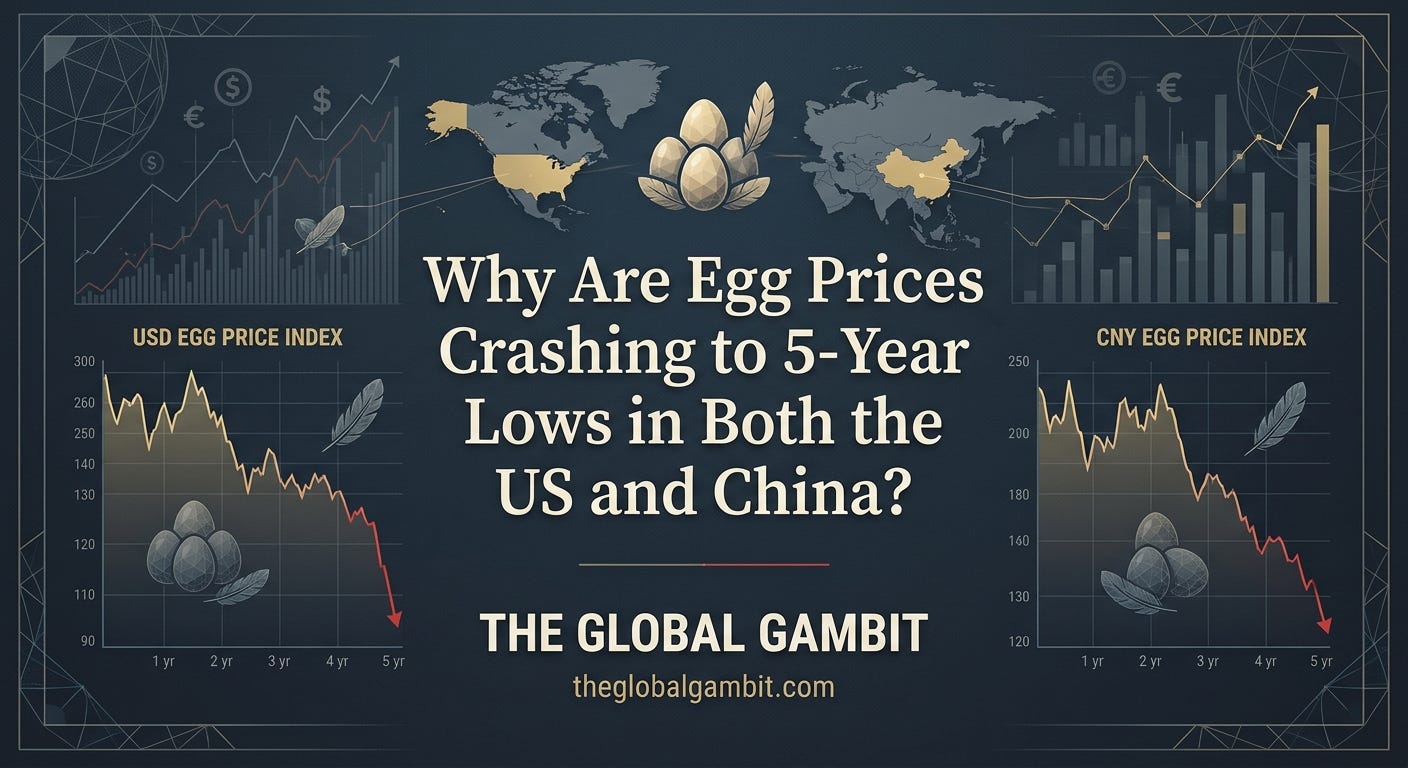
Yet inside both sealed jars, egg prices just collapsed to multi-year lows at the exact same time.
In the United States, where shoppers were paying over $6.20 a dozen during the bird-flu panic of early 2025, wholesale prices for large Midwest eggs crashed to an average of $0.81 a dozen across the first eight months of 2026 a 20-year inflation-adjusted low pushing the USDA’s full-year price forecast down to its lowest level since 2019. Even more shocking, the price of “breaking stock” (raw eggs sold in bulk to bakeries and food factories) plunged to $0.16 a dozen. Halfway around the world, China suffered the exact same fate: after falling 13.55% through 2025, Chinese egg prices hit a five-year low of 9.75 yuan per kilogram (roughly $0.78 a dozen) in spring 2026, forcing desperate farmers to slaughter laying hens early just to push prices back above 10 yuan by late summer.
If neither country is exporting cheap eggs to the other, and if every single cost of running a farm—from chicken feed and medicine to barn construction and labor is going up, what hidden force is crushing egg prices in both superpowers at once?
When you pull back the curtain on modern poultry farming, you discover that both countries were hit by the exact same two-sided storm: a quiet technology revolution on the supply side that created “super-flocks,” colliding head-on with a permanent shift in how consumers and food factories eat.
The Supply Side: How Farm Technology and “Super-Hens” Created a Runaway Glut
For decades, nature kept the egg supply in check. Cold winters slowed down how often hens laid eggs, summer heat waves stressed the flocks, and regular outbreaks of avian flu wiped out tens of millions of birds every few years, resetting the market.
Over the last two years, however, farmers in both the United States and China used their record profits from the 2024–2025 egg shortage to go on the biggest technology spending spree in farming history. That technology worked so well that it broke the natural supply cycle in three ways:
Hospital-Grade “Smart Barns” Stopped the Die-Offs: During the height of the bird-flu scare, mega-farms in both countries upgraded their poultry houses with positive-pressure air filtration systems (similar to hospital operating rooms), automated climate computers, laser perimeters to scare away wild ducks, and strict biosecurity showers. Expecting bird flu to kill off 10% to 15% of their birds like it did in past years, farmers in both nations ordered millions of extra baby chicks as an insurance policy. Instead, the new barn technology—combined with milder virus strains and widespread vaccination in China—kept the birds alive. It takes five to six months for a baby chick to grow old enough to lay her first egg. When those millions of “insurance chicks” grew up and joined the surviving older hens at the exact same moment, barns in both countries began overflowing.
Genetic “Super-Hens” That Never Miss a Day: Selective breeding and computer-mixed nutrition have quietly turned the modern chicken into an unstoppable egg-laying machine. Thirty years ago, a typical hen laid around 250 eggs a year. Today, commercial hens in both the U.S. and China average 300 to 306 eggs per year—nearly one egg every single day of the year. Inside windowless, computer-lit barns where LED lights mimic eternal springtime and automated belts deliver the exact gram of protein and calcium each bird needs, hens no longer slow down when the weather changes.
The 100-Week Lifespan: Historically, farmers kept a laying hen for about 75 to 80 weeks before her egg shells got too thin and she needed to be replaced. Thanks to breakthroughs in poultry gut medicine, enzyme additives, and precise vitamin blends, farmers in both countries are now stretching the productive life of their flocks to 90 or even 100 weeks. Older hens stayed on the job for five extra months right as the new wave of young hens arrived.
The Demand Side: Why Shoppers and Food Factories Walked Away
While farm technology was busy flooding both countries with eggs, the other side of the equation—customer demand—was quietly shrinking behind the scenes.
First, look at where eggs actually go. Most people don’t realize that roughly 31% of all eggs in America are never sold in grocery store cartons. Instead, they are cracked at giant breaking plants and sold as liquid or dried eggs to industrial food makers for mayonnaise, cake mixes, salad dressings, brioche buns, and packaged noodles.
When egg prices spiked above $6.00 a dozen in 2025, corporate food scientists from Chicago to Shanghai went into emergency mode. They rewrote their factory recipes, replacing expensive eggs with cheaper plant proteins, soy lecithin, modified starches, and whey. Here is the catch: once a giant food conglomerate spends millions of dollars testing a new egg-free recipe, getting regulatory approval, and printing millions of new ingredient labels, they do not switch back to real eggs just because prices drop. That permanent loss of factory buyers is the hidden reason why bulk “breaking stock” eggs in the U.S. crashed to an unbelievable $0.16 a dozen.
At the exact same time, everyday family habits changed in both countries:
In the United States: After two years of sticker shock at the grocery store—combined with the explosion of GLP-1 weight-loss drugs and rush-hour protein shakes—millions of households broke their habit of cooking big two-egg-and-bacon breakfasts every morning.
In China: A sluggish real estate market and tighter household budgets caused Chinese families and restaurant chains to cut back on dining out, bakery pastries, and holiday gift boxes, leaving local wholesale markets drowning in extra inventory.
When unstoppable farm technology meets shrinking factory and breakfast demand, prices only have one direction to go: straight down.
The Rising Cost Trap: Why Farmers Keep Selling Cheap Eggs While Going Broke
This brings up the question that confuses almost everyone outside of agriculture: if the cost of building barns, buying chicken feed, paying workers, and buying medicine is going up, why don’t farmers just keep their egg prices high to cover their bills?
Because in the egg business, the farmer has zero control over the selling price.
An egg is a ticking clock. Once a hen lays an egg, the farmer has roughly three to four weeks to wash it, pack it, truck it, and get it into a shopper’s refrigerator before it goes bad. An oil company can leave crude oil in the ground when prices are low, and a tech company can leave laptops in a warehouse for six months. An egg farmer cannot hoard eggs. Every single morning, millions of new eggs roll down the conveyor belt, and if the farmer doesn’t accept whatever price the grocery chain offers that afternoon, the warehouse overflows and the eggs rot.
And make no mistake—farm bills are higher than ever:
Barn Construction & Equipment (CapEx): Switching from old wire cages to modern automated, cage-free, or pasture-raised barns now costs $40 to $65 per bird, with construction and robotic packing costs jumping 30% to 45% over the last five years. Vital Farms, the leading pasture-raised egg company, is spending $140 million to $150 million in 2026 alone just to build its second giant egg-packing plant in Indiana.
Chicken Feed: Corn, soybean meal, and vitamins make up 55% to 65% of farm production costs. Even after cooling from record highs a few years ago, feed costs crept up another 4.3% in recent months.
Medicine, Vaccines, and Upkeep: Protecting mega-flocks from Salmonella, bronchitis, and bird flu requires expensive vaccines, round-the-clock sanitation crews, rising farm wages, and pricey cardboard cartons.
So why would a farmer sell a dozen eggs for $0.81 when it costs $1.55 to run the farm? Because you cannot turn off a live chicken. Even if you refuse to sell a single egg today, your hens still have to eat $0.50 worth of corn per dozen just to stay alive, and the bank still wants its mortgage payment on the barn. The only way to stop buying feed is to kill your flock early—which wipes out the millions of dollars you spent raising those hens from day-old chicks. As long as selling a carton for $0.81 pays for today’s $0.50 scoop of corn and leaves $0.31 to help pay the electric bill, the farmer loses less money selling at a loss than shutting down.
How to Compare Egg Stocks: The Per-Dozen Cost Scorecard
When Wall Street analysts look at public egg companies to see who is surviving this crash, they ignore marketing talk and look at the cost per dozen buried inside company financial filings (Form 10-K and 10-Q reports). Here is the exact scorecard the industry uses for conventional U.S. eggs:
Feed Cost per Dozen ($0.49 to $0.55): The daily corn and soybean meal ration needed to produce twelve eggs.
Non-Feed Farm Production Cost ($0.42 to $0.52): This covers barn labor, utilities, veterinary medicine, vaccines, barn depreciation, and flock amortization (the accounting cost of paying off what it took to raise the baby chick during her first 20 weeks of life before she laid an egg).
Total Farm Production Cost ($0.91 to $1.07): Adding feed and non-feed farm costs gives you the industry’s main benchmark—the cost to get twelve unwashed eggs out of the hen house.
Processing, Cartons, Trucking, and Office Overhead ($0.50 to $0.63): Washing, grading, and cartons cost $0.28 to $0.35 a dozen, while refrigerated diesel trucks and corporate overhead add another $0.22 to $0.28 a dozen.
All-Inclusive Breakeven Cost ($1.41 to $1.70 per dozen): The true price a conventional egg producer needs just to break even (for organic and pasture-raised producers like Vital Farms, expensive organic feed and family-farm payouts push the all-in breakeven cost to $2.60 to $3.10 per dozen).
When wholesale prices sit near $0.81 against a $1.55 all-in cost, the bloodbath on company income statements is immediate. Look at Cal-Maine Foods, America’s largest egg producer. In its financial report for the quarter ended August 29, 2026, Cal-Maine revealed that a 59.3% plunge in conventional egg prices—paired with a 4.3% rise in feed costs—caused its total revenue to drop 41.5% to $539.6 million. Its gross profit was completely wiped out, shrinking to just $400,000 across the entire company and plunging Cal-Maine into an operating loss of -$82.2 million and a net loss of -$58.6 million (-$1.26 per share).
Even high-end pasture-raised brands felt the pinch as supermarkets discounted cheap regular eggs, widening the price gap on the shelf. Vital Farms saw its second-quarter 2026 revenue slide 10.1% to $166.0 million, with promotional discounting and plant expansion costs squeezing its gross margin down to 6.6%, compared to 28.3% in the first quarter.
The Global Giants: Top 8 Publicly Traded Egg Companies by Revenue
For investors looking to buy into the sector on major stock exchanges while prices are depressed, these eight companies lead the global industry by total revenue:
Charoen Pokphand Foods PCL (Ticker: CPF | Exchange: Stock Exchange of Thailand / SET | Country: Thailand)
Latest Share Price: THB 20.40 (~$0.60 USD) | Enterprise Value: THB 673.21 Billion (~$20.07 Billion USD)
Revenue & Business: Generating roughly $16.80 billion USD (THB 566.02 billion) in annual revenue, CPF is an agricultural powerhouse operating massive automated egg farms, feed mills, and poultry plants across China, Thailand, and Southeast Asia.
Wens Foodstuff Group Co., Ltd. (Ticker: 300498 | Exchange: Shenzhen Stock Exchange / SZSE | Country: China)
Latest Share Price: RMB 15.12 (~$2.12 USD) | Enterprise Value: RMB 118.50 Billion (~$16.60 Billion USD)
Revenue & Business: Bringing in roughly $14.00 billion USD (RMB 100 billion) in revenue, Wens is one of China’s largest poultry, egg, and livestock giants, supplying chicks, feed, and vaccines to thousands of partner family farms.
Post Holdings, Inc. (Ticker: POST | Exchange: New York Stock Exchange / NYSE | Country: United States)
Latest Share Price: $82.00 USD | Enterprise Value: $10.77 Billion USD
Revenue & Business: With $8.41 billion USD in total revenue, Post owns Michael Foods (Bob Evans, Abbotsford Farms), making it the #1 processor of value-added liquid and pre-cooked foodservice eggs in America, generating roughly $500 million in annual segment cash flow (EBITDA).
Kewpie Corporation (Ticker: 2809 | Exchange: Tokyo Stock Exchange / TSE Prime | Country: Japan)
Latest Share Price: ¥4,375 (~$27.86 USD) | Enterprise Value: ¥585.0 Billion (~$3.86 Billion USD)
Revenue & Business: Earning $3.36 billion USD (¥530 billion) in revenue, Japan’s famous mayonnaise maker is also the country’s largest egg processor, handling roughly 10% of Japan’s entire domestic egg supply for bakeries, restaurants, and sauces.
Cal-Maine Foods, Inc. (Ticker: CALM | Exchange: NASDAQ | Country: United States)
Latest Share Price: $63.83 USD | Enterprise Value: $2.07 Billion USD
Revenue & Business: With $2.53 billion USD in trailing twelve-month revenue ($2.91 billion in fiscal 2026), Cal-Maine is the largest pure-play shell egg producer in the U.S., controlling roughly 20% of the American market alongside the Eggland’s Best franchise.
QL Resources Berhad (Ticker: 7084 | Exchange: Bursa Malaysia / KLSE | Country: Malaysia)
Latest Share Price: MYR 3.79 (~$0.88 USD) | Enterprise Value: MYR 14.79 Billion (~$3.42 Billion USD)
Revenue & Business: Generating $1.63 billion USD (MYR 7.04 billion) in revenue, QL Resources produces over 7 million eggs per day across Malaysia, Indonesia, and Vietnam, paired with seafood manufacturing and FamilyMart convenience stores.
Vital Farms, Inc. (Ticker: VITL | Exchange: NASDAQ | Country: United States)
Latest Share Price: $9.42 USD | Enterprise Value: $483.7 Million USD
Revenue & Business: With $685.0 million USD in trailing revenue, Vital Farms is the #1 pasture-raised, ethical egg brand in the United States, working with over 350 family farms.
Ningxia Xiaoming Agriculture & Animal Husbandry Co., Ltd. (Ticker: 300967 | Exchange: Shenzhen Stock Exchange / SZSE | Country: China)
Latest Share Price: RMB 15.23 (~$2.14 USD) | Enterprise Value: RMB 3.65 Billion (~$512.0 Million USD)
Revenue & Business: Generating $145.0 million USD (RMB 1.03 billion) in revenue, Xiaoming is China’s premier publicly traded breeder of commercial egg-laying chicks.
Skin in the Game: Which Egg Companies Are Truly Family-Run?
When buying into a brutal commodity crash, the smartest move an investor can make is partnering with founders and controlling families who have their own net worth locked inside the stock.
However, investors looking at America’s biggest producer—Cal-Maine Foods (NASDAQ: CALM)—need to know about a major behind-the-scenes exit. Founded in 1957 by Fred R. Adams Jr., Cal-Maine was controlled for decades by the Adams family through super-voting Class A shares (which carried 10 votes per share). In April 2025, right at the peak of the $6.00 egg boom when CALM stock traded near $92.75, Chairman Adolphus Baker and the four Adams daughters converted all 4.8 million super-voting shares into regular stock and sold over 3.02 million shares in a public offering (plus $50 million back to the company). That sale cut the family’s voting control from 53.2% down to roughly 12%, ending Cal-Maine’s status as a family-controlled company right before egg prices crashed.
Here is who actually holds the highest skin in the game today across the global leaders:
#1 in Family Control — Charoen Pokphand Foods (SET: CPF — 52.71% Family Owned): The billionaire Chearavanont family controls 52.71% of CPF through Charoen Pokphand Group, running their Asian farming empire with a multi-generational playbook.
#2 in Family Control — QL Resources (KLSE: 7084 — 45.8% Family Owned): Founder and Executive Chairman Dr. Chia Song Kun and the Chia family directly and indirectly hold roughly 45.8% of the company’s stock, making QL the ultimate family-run agribusiness compounder in Asia.
#3 in Founder Control — Ningxia Xiaoming (SZSE: 300967 — 42.5% Founder Owned): Founder and Chairman Wei Xiaoming retains over 42% ownership in China’s leading layer breeder.
#1 in the United States — Vital Farms (NASDAQ: VITL — 17.5% Insider Owned): With the Adams family cashing out of Cal-Maine, Vital Farms is now the #1 founder-aligned pure-play egg stock in America. Founder and Executive Chairman Matt O’Hayer personally holds roughly 6.76 million shares (15.2% of the company), total executive and board ownership sits near 17.5%, and 97% of employees own stock.
Other Notable Insiders: The founding Wen family and partner syndicate own 16.5% of China’s Wens Foodstuff; the founding Nakashima family controls 15.8% of Japan’s Kewpie Corp; and Chairman William Stiritz and insiders hold 10.8% of Post Holdings (though Stiritz sold roughly $23.4 million in shares in September 2026).
The Actionable Investor Plan: How to Profit From the Crash
In cyclical farming stocks, you never buy when profits are booming and the Price-to-Earnings (P/E) ratio looks tiny—that is how investors got trapped at the top in early 2025. Instead, you buy when companies are reporting quarterly losses, when trailing P/E ratios look sky-high or negative (like Cal-Maine’s 50x+ trailing P/E caused by its recent -$1.26 per share loss), and when smaller, debt-heavy farms are being forced out of business.
Step 1: Watch the Two Monthly Turnaround Signals
Every month, check the free USDA Chickens and Eggs report for two simple numbers that prove the oversupply is ending:
Rising Hen Slaughter: When independent farmers run out of cash at $0.81 per dozen, they send laying flocks to the slaughterhouse early—overriding the 100-week technology lifespan. A 15%+ jump in monthly layer slaughter means supply is shrinking fast (just as China saw before its late-summer rebound).
Falling Baby Chick Hatchings: Watch the Egg-Type Chicks Hatched line. Two straight months of 8% to 10% year-over-year drops in baby chicks hatched guarantees a tighter egg supply and rising prices five to six months later.
Step 2: Choose From Three Proven Ways to Play the Rebound
The Founder-Led Growth Play — Vital Farms (NASDAQ: VITL at $9.42): Down 75% from its $38.86 high to an Enterprise Value of just $483.7 million, Vital Farms is currently evaluated by the market like a broken business during a heavy construction cycle. Pasture-raised consumers remain loyal to the brand, founder Matt O’Hayer retains a 15.2% ownership stake, and once its $140M–$150M Indiana facility completes construction in early 2027, cash flow dynamics are positioned to shift. Market observers often analyze accumulation ranges between $8.20 and $9.50.
The Debt-Free Survivor Play — Cal-Maine Foods (NASDAQ: CALM at $63.83): Even without controlling family ownership, Cal-Maine maintains a unique balance sheet profile featuring virtually zero debt and over $850 million in net cash and short-term investments, resulting in an Enterprise Value of $2.07 billion—roughly $900 million below its market cap. While highly leveraged private operators face distress during market troughs, Cal-Maine utilizes its cash position to acquire competitor assets and expand its high-margin prepared foods division by 60%. Because variable dividends sit at $0.00 during quarterly net losses, market participants frequently monitor book-value support zones between $58.00 and $61.00, or evaluate cash-secured put options at the $55.00 or $60.00 strike to capture option premiums.
The “Cheap Egg” Beneficiary Play — Post Holdings (NYSE: POST at $82.00) & QL Resources (KLSE: 7084 at MYR 3.79): When bulk breaking-stock eggs drop to $0.16 a dozen, downstream enterprises that purchase raw eggs to manufacture restaurant omelets, liquid egg cartons, and mayonnaise experience raw material margin expansion. Post Holdings trades at approximately 7.4x EV/EBITDA while benefiting from depressed input costs, whereas Malaysia’s QL Resources provides international exposure backed by 45.8% family ownership and diversified agribusiness operations across Southeast Asia.
Disclaimer: This article is published solely for informational, educational, and entertainment purposes and does not constitute formal financial, investment, legal, or tax advice. The author and publisher are not registered investment advisors or broker-dealers. Securities, equities, and options discussed involve substantial risk of loss, and past performance is no guarantee of future results. Readers should conduct their own independent research, review official SEC, SEDAR+, or exchange filings (Form 10-K, 10-Q), and consult with a licensed, qualified financial advisor before executing any investment strategy or financial transaction.
We Screened the Indonesia Stock Exchange (IDX) Post-Crash: 5 Family-Controlled Compounders We Found

INSTITUTIONAL READING FORMAT NOTICE This report is an open-access institutional showcase from The Kingside Dossiers by The Global Gambit. Because email clients compress multi-column equity valuation tables and supply-chain schematics, we have published a dedicated
The Cobalt Paradox: Structural Oversupply, DRC Export Quotas, and the 2027 Institutional Investment Outlook

INSTITUTIONAL READING FORMAT NOTICE This report is an open-access institutional showcase from The Kingside Dossiers by The Global Gambit. Because email clients compress multi-column equity valuation tables and supply-chain schematics, we have published a dedicated
Champion Iron Limited (TSX: CIA) — High-Purity Moat, DRPF Inflection, and Asymmetric Value

Position Disclosure & Legal Disclaimer